High intensity interval training can be done in a variety of different ways. Here’s a wickedly-effective type of interval training: it requires no machines or fancy equipment, you can do it outside in the sunshine and fresh air, it develops killer conditioning, carves out legs like a sprinter, and burns calories at an accelerated rate…
In other articles about running/aerobics and high intensity interval training, as well as in my Fat loss books, I’ve written about how you can integrate both traditional steady state cardio as well as high intensity interval training into your training program for optimal body composition improvement, health and increased fitness – you don’t have to choose one form of cardio or the other. In fact, settling into dogmatic views about cardio will only limit you.
Traditional steady state cardio is pretty much self-explanatory and intuitive. But many people are still confused about the best way to do interval training.
An Insanely Effective Way To Do Interval Cardio
I’m not sure if there is a single best way to do intervals because there are so many choices and everyone is different in their goals, interests and personal preferences, so “best” is a relative thing. But let me give you one of my personal favorites that is breathtakingly effective:
Stair sprinting!
Your typical interval workout in the gym might be on a stationary cycle, treadmill or stairclimber with short 30-60 second bursts of high speed and/or resistance, followed by a 60-120 second period of low intensity recovery. That’s usually a 1:1 or 1:2 work to recovery interval. You then rinse and repeat for the desired number of intervals, usually between 6 and 12.
I sometimes have access to a great set of university stadium steps with a straight shot right up – 52 steps.
Sprinting it takes about 10 seconds or so, walking down about 30 seconds. Those are short intervals with a 1:3 work to recovery interval ratio. That wasn’t by design, it just happens to be how long it takes to run up and walk down that particular flight of stairs, but co-incidentally, that fits within common recommendations for short sprint-style intervals.
I make sure I’m warmed up first, I usually start with a couple flights up at a slow jog then a run, before sprinting, usually 10-12 rounds.
Even if you jog/run instead of sprint, (or pause briefly at the bottom of the stairs), when you do the math, you can figure that this usually doesn’t take more than 10-12 minutes.
Why do I like stadium step sprinting?
1. Stair sprinting is a time saver. Like other forms of interval training, it’s entirely possible to get as much if not more cardiovascular conditioning in 10-15 minutes than you’d get from a much longer session of slower cardio (depending on the intensity and effort levels).
2. Stair sprinting is engaging. Many people get bored doing long slow to medium intensity cardio sessions. This is a great way to break up the monotony of traditional cardio workouts. Even though it’s tough, it’s actually kind of fun.
3. Stair sprinting is incredible for leg development. As a bodybuilder, I like to look at all types of training not only in terms of conditioning, fat loss and health, but also whether they will add or detract from the physique. I find that brief but intense stair workouts are amazing for leg development – quads, hamstrings, glutes and even your calves. In fact, I started training on the stairs more than 20 years ago, and I always considered it as much if not more of a leg workout than anything else.
4. Stair sprinting can be done outside. If you have access to stadium steps, as opposed to just a stairwell, you can enjoy the sun and fresh air.
How to integrate stair running into your training program
If you’re an overachiever type, you might be tempted to do these sprint workouts in addition to your current strength training and cardio workload.
However, keep in mind that intensity and duration are inversely proportional. When you do high intensity cardio or all out sprints, you are condensing more work into less time. That means the best part is, you can do a brief but intense stair workout instead of one of your long cardio sessions rather than in addition to them.
Recommendation: Start with one session per week, then progress to two if you choose. You can do traditional cardio the other days of the week if you want or need additional calorie-burning. Lower intensity cardio in between weight training and interval workouts can also serve as active recovery.
Not everyone has access to a full flight of stadium steps, as you might find at a local University. Running flights of stairs in a high rise is another effective and no-cost way to train on stairs. Although you can’t truly sprint with twists and turns on each floor, you can jog/run.
No stairs? Hills will get the job done too and they may provide you with more flexibility in the length/duration of your intervals. I’ve found some big hills at just the right grade of incline that I can do 30-45 second runs up, with about 90-120 seconds walk down. Grassy hills are nice, when available, as they spare you some of the impact from running on the concrete.
Sprinting up stairs is not for everyone. If you have a history of health problems or orthopedic issues, check with your doctor before doing any kind of high intensity training and of course, don’t train through the pain of injury. If you are significantly overweight, it may be a challenge just to walk up stairs, let alone run up, not to mention it might create undue stress on your joints. But as you get lighter and fitter, it’s a challenge you might slowly work toward.
Be sure to build up gradually and adjust the workout based on your current health and fitness level. You could start with as few as 4-6 rounds and build up from there. You can also start with jogging up the stairs, then progress to running, then move to sprints. Be sure you are fully prepared and warmed up before attempting all out sprints as sprinting when unprepared is a notorious source of hamstring pulls.
Some coaches believe that running uphill is safer than sprinting flat surfaces. Writing for Staley Training.com, Coach Steven Morris says, “Another great reason to hill sprint: even an athlete with horrendous running form will be safe running hills. This is simply because the hill does NOT allow the athlete to over-stride nor does it allow them to reach top speed, both major factors in hamstring injuries.”
Stair sprinting is a perfect complement to the cardio portion in my Burn The Fat, Feed The Muscle program. If you’re healthy and already fit, try this advanced interval workout and I think you’ll be pleasantly surprised with the results!
Once an Endomorph Always an Endomorph? (Can Your Body Type Change?) By Tom Venutowww.BurnTheFat.com!
Are you an ectomorph, mesomorph or endomorph body type? To maximize your results, regardless of whether your goal is fat loss or muscle gain, it’s helpful to know your body type and adjust your approach according to your type. But a big question that almost no one has ever answered is, “Does your body type change over time?” If so, then what? Do you have to totally change your nutrition and training again? And if your body type doesn’t change, does this mean you are stuck being a fat endomorph for the rest of your life, doomed because of genetics? Read on to find out.
Somatotype is a 3-part, 7-point body type rating scale developed by a guy named Sheldon back around 1940 or so. Ectomorphs are the linear, bony, lean types, mesomorphs are the naturally muscular body types (yeah, the ones we hate!), and endormorphs are the ones with the round body shapes and the genetic tendency toward storing more body fat.
Generally, you have a combination body type, which is why you are scored with 3 numbers (Arnold Schwarzenneger in his bodybuilding prime: think pure mesomorph with the highest score of 7).
The question is, Does somatotype change? this is a very interesting question that has been asked and debated before both by the layperson (often bodybuilding and fitness enthusiasts) and by scientists.
Two of those scientists were JE Lindsay Carter, a physical education professor from San Diego State University and Barbara Heath, and Anthropologist from the University of Pennsylvania.
There was initially a lot of debate and antagonism provoked by the classic Sheldon system of classifying human body types (“somatotyping”), because initially, Sheldon was very rigid in his insistence that body types were permanent and did not change.
However, Heath and Carter proposed that it was plain to see that body types DID change due to normal growth, aging, physical training and dietary deprivation (they cited the Minnesota starvation study, where subjects started out looking somewhat mesomorphic and ended up looking like ectomorphs (like POW camp victims, literally).
Heath and Carter weren’t trying to dismiss somatotpying, they supported it and wanted to validate it.
However, they wanted to address the shortcomings of the somatotyping method and one of those was the fact that the Sheldon system didn’t accommodate for changes in physique as a result of training and nutrition.
In their voluminous 1990 textbook on the subject, Heath and Carter define somatotype as:
“A quantitative description of the present shape and composition of the human body. It is expressed in a 3 number rating, representing three components of physique: (1) endomorphy, (2) mesomorphy and (3) ectomorphy. The somatotype can be used to record changes in physique and to estimate gross biological differences and similarities among human beings. This method of somatotyping is sensitive to changes in physique over time and is used for rating both sexes at all ages.”
Look at a guy like John Bartlett for example, one of our inner circle contributing authors and an outstanding natural competitive bodybuilder. When you see him today and you ask what is his body type, you would say, “MESOMORPH all the way!”
That’s because today he is ripped and muscular
But if you look at his before picture and ask “what is this guy’s body type” you would say, “Endomorph” all the way or at least “endo-mesomorph” because he did have a solid and stocky build before, but also a high body fat percentage.
Well, which is it? Or did his body type change? Clearly, John gained a lot of muscle and lost a lot of fat and looks totally different today. So could we say his body type changed? If we go by current outward appearance, then yes, absolutely.
But does this mean his body type really changed or did he overcome an inherent endomorph body type to achieve where he is now?
Or, to play devil’s advocate here, was he always a mesomorph inherently and he just really let himself go for a while and he was just returning to his normal body type of mesomorph?
These are interesting questions. The Heath-Carter method simply includes body composition as part of the rating scale of a person’s body type and says that you can rate someone based on how they look now. That includes bone structure (which changes little or not at all after adulthood) AND body composition (which can change throughout life). So you could say John was an Endomorph and is now a Mesomorph. Predominantly Mesomorph is his present classification.
However, at the same time, we could say that a person DOES have an inherent body type or set point – a physique that they will gravitate towards in the absence of circumstances or concerted efforts to change it.
I addressed this issue of changing body types versus an inherent (or “permanent” body type) in www.BurnTheFat.com (BFFM). The way I explained it is that I said your true body type is what you will gravitate to naturally when you are not in a highly trained state. It’s your inherent tendency. In that respect, you could say somatotype does not change, while body composition does.
In chapter 5 of BFFM, I said there were three additional ways to know your inherent body type beyond Sheldon’s scale, which takes into account changes in physique due to training and nutrition:
How you looked before you took up training (your “natural” body shape)
How you respond to training and nutrition (ease of muscle gain or fat loss)
How you respond to de-training (how well you retain lean mass and low body fat or how quickly you lose lean mass and gain fat on cessation of training)
If you wanted to make this even MORE complex, we could look at somatotyping by considering not just the outward bone structure and body composition of an individual, but also the metabolic (interior) characteristics.
My “Burn The Fat” system of body typing is like a combination of:
(1) Metabolic typing (internal metabolic characteristics like carb tolerance)
(2) Somatotyping (external body shape – linearity or roundness, fatness or leanness)
(3) Miscellaneous other genetic factors.
That would be a pretty good three-part body typing system that covers the concerns about changing body types, individual metabolic types (“carb intolerant types” or protein types, etc), and genetics (which is especially relevant since obesity genes have been identified fairly recently).
I hear criticisms of the somatotyping system all the time, where people say it is not useful. I disagree. Yes, it’s perhaps too crude of a system to base your entire training and nutrition plan upon, but I believe it’s very helpful as a general tool to “KNOW THYSELF”.
In other words, if you are inherently an endomorph and you KNOW IT, then you know darn well what happens when you don’t do any cardio. You know what happens when you cheat four or five times in a week. You know what happens when you slack off. You gravitate towards gaining fat, because that is your body type’s tendency! So you can adjust your training, nutrition and lifestyle accordingly.
If you are an ectomorph, then you know what happens when you skip meals… you don’t gain any muscle! You know what happens when you do too much cardio… you don’t gain any muscle, or you lose some!, etc. etc.
And if you’re a mesomorph…. did I mention…. we hate you!
If you’d like to learn more, chapter 5 in www.BurnTheFat.comis about body typing. It’s full of some really valuable and motivating lessons about knowing yourself, your body and your genetics and understanding the importance of taking personal responsibility, regardless of your hereditary predispositions. If you already have the book, it’s worth re-reading periodically.
New HIIT Research: A Practical Model For High Intensity Interval Training By Tom Venutowww.BurnTheFat.com!
High intensity interval training, also known as HIIT, has become immensely popular in the last decade. HIIT involves alternating brief bursts of very high intensity exercise (work intervals) with brief segments of lower intensity exercise (recovery intervals). One problem with some types of HIIT is that they call for such high intensity bursts – literally all out sprints – that they’re not practical for everyone, and possibly not even safe for older or overweight individuals. A recent study out of McMaster University has tested a protocol for HIIT that produces impressive results in a short period of time without the need for “all-out” sprints…
Many of the previous studies on HIIT used ALL-OUT intervals on a specialized cycle ergometer, pedaling against a high resistance.
This type of training takes a high level of commitment and motivation and can result in feelings of severe discomfort and even nausea.
One of my colleagues mentioned in our Burn the Fat Forums that he remembers exercise physiology class in college where they did all out cycle ergometer interval sprint testing and nearly everyone either puked or passed out.
The Tabata protocol for example, is a brief but brutal 4 minute HIIT workout often spoken of by trainers and trainees alike with both appreciation and dread. It’s no walk in the park.
The truth is, some HIIT protocols which have been tested in the lab to produce big improvements in cardiovascular function and conditioning in a short period of time, may not be practical or safe, especially for beginners, obese or older adults.
In this new study out of McMaster University, a HIIT protocol that was more practical and attainable for the general population was tested to see how the results would compare to the more “brutal” very short, but extremely intense types of HIIT.
Here’s what the new HIIT protocol looked like:
Study duration: 2 weeks Frequency: 3 sessions per week (mon, wed, fri) Work intervals: 60 seconds @ constant load Intensity Work intervals: “high intensity cycling at a workload that corresponded to the peak power achieved at the end of the ramp VO2peak test (355 +/- 10W)” Recovery intervals: 75 seconds Intensity Recovery Intervals: Low intensity cycling at 30W” Rounds: 8-12 intervals Progression: 8 intervals 1st two workouts, 10 intervals second two workouts, 12 intervals last 2 workouts. Warm up: 3 min: Duration of work intervals: 8-12 minutes Total time spent: 21-29 minutes.
Results: In just 2 weeks, there were significant improvements in functional exercise performance and skeletal muscle adaptations (mitochondrial biogenesis). Subjects did not report any dizziness, nausea, light headedness that is often reported with all-out intervals.
They concluded that HIIT does not have to be all-out to produce significant fitness improvements and yet the total weekly time investment could remain under 1 hour.
On a personal note, I REALLY like this kind of interval training: 60 second work intervals repeated 8-12 times. Here’s why:
Body composition was not measured in this study, but I believe that enough energy expenditure can be achieved with 20-30 minutes of this style of interval training to make significant body comp improvements in addition to all the cardiovascular conditioning improvements.
That’s another problem with super-brief and super intense HIIT programs: The cardio and heart benefits are amazing, but you can only burn so many calories per minute, no matter how intensely you work. To call a 4-minute workout a “good fat burner” in the absolute sense is ridiculous.
Somewhere in between long duration slow/moderate steady state cardio and super short super-intense HIIT lies a sweet spot for fat-burning benefits… a place where intensity X duration yield an optimal total calorie expenditure at a reasonable time investment. Perhaps this 20-30 minute HIIT workout is it?
If you’ve read any of my other articles on cardio, you’ll know that I’m not against steady state cardio, walking or even light recreational exercise and miscellaneous activity as part of a fat loss program. All activity counts towards your total daily energy expenditure, and in fact, the little things often add up during the day more than you would imagine (just look up N.E.A.T. and see what you find).
But for your formal “cardio training” sessions, if you’re going to use traditional cardio modes (stationary cycle, etc.) and if your goal includes fat burning, and if your time is limited, then this type of HIIT is a great choice and you can now say it is research proven…
Not to mention… the excuse, “I don’t have enough time” has been officially busted!
Tom Venuto is the author of the #1 best seller, Burn the Fat, Feed the Muscle: Fat Burning Secrets of the World’s Best Bodybuilders and Fitness Models. Tom is a lifetime natural bodybuilder and fat loss expert who achieved an astonishing 3.7% body fat level without drugs or supplements. Discover how to increase your metabolism and burn stubborn body fat, find out which foods burn fat and which foods turn to fat, plus get a free fat loss report and mini course by visiting Tom’s site at: www.BurnTheFat.com!
If I said that bodybuilding nutrition is the world’s most balanced and flexible way of eating, some people might think I was crazy.
I mean, aren’t bodybuilders notorious for eating totally bland foods, following highly restrictive diets and even sacrificing all their social life (never eat at restaurants, etc)?
Unfortunately, a lot of people believe those myths due to decades of stereotyping and more recently due to misinformation being spread on the internet.
Actually, with the possible exception of the final phases of the pre-contest bodybuilding diet (where a lot of discipline really is required – just like any competitive sport), nothing could be further from the truth!
Why should you care? Especially if you’re not a bodybuilder? Simple – the body building lifestyle, in my opinion and experience, is the most effective way of building muscle and burning fat on planet Earth. Want more muscle and less fat? If so, then this is for YOU.
I contend that bodybuilding nutrition has not only been unjustly criticized and misunderstood, but that INDEED bodybuilding nutrition it is the most balanced, flexible, healthy and fun way to eat. It has been for me.
First, Let’s Re-define Body Building!
Most people have a preconceived notion of what bodybuilding is. They envision some beefcake, like the dude in that recent Geico commercial (pretty damn funny actually, but comedy aside for a moment, it does portray the stereotypical bodybuilder).
When I say “body building” I’m NOT talking about looking like that guy. (Well, unless that’s what YOU want). That’s only competitive bodybuilding at the top of the pro level – a tiny corner of the “Body – Building” Universe.
Do you want to build your body? Build strength? Build muscle? Build HEALTH? If so, YOU ARE A BODY-BUILDER!
Who doesn’t think building your body is a GOOD thing? So please, broaden your definition and allow your mind to open!
The truth about bodybuilding nutrition When I started eating and training like a body builder decades ago, all we had was men’s bodybuilding and women’s bodybuilding.
Today, we have men’s bodybuilding, physique and fitness model. The women have even more options: bodybuilding, physique, fitness, figure, fitness model and bikini divisions.
Today, it’s no longer just “bodybuilding” – the competitive bodybuilding universe has spread to a whole group of new “physique sports” and each one has different levels of muscularity to match the judging criteria.
This is fantastic, because now the public appeal is much wider.
Millions of men and women would love to have the “Men’s Fitness” or “Figure Athlete” look rather than the much bulkier competitive bodybuilder look. But in all these physique contests, though they differ in size, you still see the leanest, most muscular bodies in the world.
How do all these bodybuilders and fitness models get so lean? How do they get such chiseled bodies?
What they have in common is that the vast majority of these physique athletes eat the same way – traditional bodybuilding nutrition.
Unfortunately, the greatest misconceptions and stereotypes of all are about how body-builders eat and what that means to how you live your lifestyle…
More than ever before – because of the way misinformation (and personal idealology) is spread on the internet – bodybuilding nutrition has been portrayed as some kind of jail sentence.
There are online gurus (and hordes of their “sheeple” followers) who make it sound like we bodybuilders are somehow “locked up” by our disciplined lifestyle and we need to be “liberated.”
I’m telling you, this is not only total nonsense, the exact opposite is true. I’m the most free and liberated eater I know. Everything I do is by choice, and I have NO hang-ups about food whatsoever.
And when it comes to contest dieting (which IS a different animal), since when did discipline stop being a virtue? When did leaving no stone unturned stop being what EVERY competitive athlete MUST do to win?
I believe that bodybuilding nutrition is the most balanced and flexible of all the diet programs. I could write for pages about this, but looking at what we eat alone makes the case as clear as crystal.
Allowed foods vs. forbidden foods
In the current issue of Alan Aragon’s excellent monthly research review, Alan writes: “Complete food avoidance – regardless of the food – often does more harm than good. People tend to place a taboo mystique upon foods that they are not on the “allowed” list. It’s as if people become young children again, and do what it takes to pry open or climb up to the cookie jar of forbidden goodies instead of learning how to moderate their intake.”
Right there, Alan has nailed the biggest problem in the diet industry today. Almost every diet program – and especially the fear-based advertising campaigns they rely on – are based on naming dietary scapegoats and banishing them from your life…. completely… forbidden.. as in “The 5 foods to NEVER eat” and so on.
Guess what? We don’t do that in bodybuilding nutrition – people just erroneously believe we do.
On the year round muscle-building and maintenance phase, I eat from every food group on a regular basis and – let me say it again – NOTHING IS FORBIDDEN on a bodybuilding nutrition program, such as Burn the Fat, Feed the Muscle. It’s a simple matter, as Alan wrote, of learning how – and how much – to moderate your intake.
Compare it and see for yourself:
Cave man Diet? Let’s suppose you go on one of those popular “stone age” or “hunter-gatherer” diets. You want some milk or yogurt or cheese? No sir. Not allowed! Our cave man ancestors didn’t drink milk, they say, so YOU certainly can’t have any!
Low carb diets? What if you want some oatmeal for breakfast? Nope, can’t have it. How about some rice – a staple food of the longest living Asian cultures in the world? Nope, can’t have it! A banana? surely you can have THAT? … NOPE! BANNED!
Low glycemic index (GI) diets? What if you want a nice baked white potato with that chicken and vegetable? NO SIR! FORBIDDEN!
I could go on and on through a dozen more diet programs, but by now you should see what’s going on here. Traditional diet programs are all about taking things away from you – stealing your freedom… demonizing entire food groups. In bodybuilding nutrition, ALL the food groups are represented.
Naturally of course, there are health and medical reasons why people need to eliminate certain foods. If you’re allergic or intolerant to a food, I’m not suggesting you eat those foods “in moderation.” I often tell my readers that it’s the dose that makes the poison. However, if something is toxic to me, I reckon that the best dose of that food is zero.
I’m with you on that. But health and medical conditions are not what I’m talking about here. I’m not a doctor. I’m talking about transforming your physique, not treating medical problems.
Why bodybuilding nutrition is more balanced than any of the popular “diet” programs
In bodybuilding nutrition, what’s missing? Tell me, what food groups are you NOT allowed to eat?
With bodybuilding nutrition we get to (and love to) eat cheese, yogurt, cottage cheese and of course milk – one of the best high quality protein sources on Earth.
On the bodybuidling diet, we enjoy chicken, turkey, fish, shellfish, egg whites, whole eggs and of course our red meat. And if it suits your value system, you can certainly choose grass fed beef, sustainable seafood only and even organic. You can even pass on the meat completely if you want – It’s YOUR choice.
Fruit? Absolutely! sure, some low carbing competitors are known to remove fruit temporarily – but fruit is absolutely a part of the lifestyle.
Starchy carbs and natural whole grains? YESSS! Even on the pre-contest diet, I still take high carb “re-feed” days (and man is that bread and pasta good!) What if you dont want grains or you dont want dairy, etc etc? NO PROBLEM! Don’t eat them! The flexiblity works both ways. On a bodybuilding nutrition program, you don’t have to eat anything you dont want, and you CAN eat just about any real food you do want!
Now, OF COURSE we don’t recommend drinking soda or eating candy bars, but come on – that’s not even real food – that’s, like Michael Pollan once said, “edible food like substances.” Processed foods and refined junk food shouldn’t even have to enter the conversation. We’re talking about REAL FOOD here.
But even with “junk food” you have leeway.
At least a couple times a week, I go out to really nice restaurants and eat any damn thing I please. Wine? Check! Bread? check! Dessert? Not often, but if I want it, SURE! Or, maybe I just go around the corner and grab a couple of big slices of cheesy pizza!
How is THAT possible? Easy. There’s a “compliance rule” built into a good bodybuilding nutrition program.
For example, If I have a list of “staple” foods that I eat every day, I stick to that about 90% of the time and then the other 10%, I eat whatever the heck I want. Absolutely NOTHING forbidden. Anything goes. AND – it’s easier for us because we train so hard. Couch potatoes can’t get away with it so much.
Welcome to bodybuilding nutrition – It’s actually not a diet at all – it’s a lifestyle!
I remember reading Joe Weider’s editorials in Muscle and Fitness magazine when I was just a teenager, and he always said it – “bodybuilding is a lifestyle.” He was right. Because now, 30 years later, I’m still living it. How about you? Have you kept up your eating style for as long? Will you? Or will whatever diet you’re on now end up being the latest passing fad and you’ll look back with embarrassment and regret?
What about that “contest prep” eating plan I mentioned before? Yes, I admit – that IS a “diet.” It’s a stricter version of the eating plan, but keep in mind, that is a not only for a tiny corner of the body-building universe, it’s also for a short period of time before the contest season.
Usually, pre contest diets DO involve cutting carbs and other restrictions. But guess what? When you understand the bodybuilding contest diet, you can not only lose weight or reach a normal or ideal body fat level – if you choose to, you can go all the way and get ripped – lean enough to see six pack abs. Any diet can take weight off. Not every diet can get you ripped while keeping all the lean body mass.
Body building nutrition is simple and it’s POWERFUL for this very reason – YOU pick the level of restriction required, depending on how intense your goal is… whether that’s a casual cut for the beach, or a shot at a national physique title. Either way, this style of eating gives you MORE flexibility and MORE choice, not less.
This bodybuilding nutrition system is exactly what I have been using myself and teaching to others for the past 3 decades
I didn’t invent this type of eating program, so I can’t take all the credit. Champion bodybuilders were using these methods long before I was. I learned it from MY mentors, and simply fine-tuned it for my own body type. Now I’m here to pass it on to you.
My part was to put the bodybuilding nutrition system on paper into what has now become the best selling fat loss ebook of it’s kind on the internet for the last 10 years: www.BurnTheFat.com!(BFFM)
To learn more about BFFM, visit the home page here:
In the upcoming articles / newsletters, this series continues, as I teach you about the carb intolerant body type and how to tweak your carbs (starchy carbs / grains) for maximum fat loss (I’ll teach you the basics of the “contest diet.”)
I’ll cover how to make bodybuilding nutrition recipes taste zesty and delicious. Then finally, I will introduce you to my brand new meal planning software, which has been in beta all summer and is almost ready to be unleashed. Until then…
Titolo: Attività cardio: Correre per dimagrire convivendo con il Neuroma di Morton….
Autore:Piero Maina
Conteggio Parole: 3242
Come si comprende dal titolo di questo articolo, voglio condividere con voi cosa vuol dire allenarsi anche duramente pur avendo da oramai sette anni la patologia del Neuroma di Morton in entrambi i piedi. Ho già raccontato la mia esperienza sulla forza di volontà nel raggiungimento degli obiettivi e soprattutto per il dimagrimento finalizzato ad una forma fisica atletica all’interno del precedente articolo Burn the Fat la mia esperienza , ma tra i vari infortuni che hanno accompagnato la mia esistenza, non avevo parlato del Neuroma di Morton, ebbene lo faccio qui, visto che pur essendo atleta con un passato anche nell’atletica leggera per il mezzofondo su strada e corsa campestre a livello regionale, utilizzo oggi la corsa/running “solo” come attività complementare per il dimagrimento e quindi come si usa dire, come allenamento “cardio”.
Sappiamo che non esiste solo la corsa come attività che ci faccia consumare ossigeno e metabolizzi i grassi e molti guru del “fat loss” preferiscono altre forme di “cardio” meno impattanti e che non incidano troppo sulla perdita di massa magra, ma sicuramente la corsa, quando la prima finalità è il dimagrimento/perdita di grasso è una di quelle che contribuisce maggiormente allo scopo vista la grande quantità di calorie consumate per ora e praticabile quasi ovunque e in qualsiasi condizione climatica, oltre alla semplicità degli “atrezzi” utilizzati per effettuare una sessione di running (corsa). Quindi se abbinata all’allenamento con i pesi o contro resistenza con regolarità sarà una valida alleata per il raggiungimento del nostro obiettivo di avere un fisico magro e muscoloso, naturalmente se anche l’alimentazione verrà rispettata. Spesso chi corre per dimagrire, sovrastima il consumo di calorie o semplicemente sentendo lo stimolo della fame si “abbuffa” di pietanze ipercaloriche cariche di grassi saturi e carboidrati di “serie b”. Per carboidrati di “serie b”, intendo tutti quegli alimenti contenenti zuccheri raffinati e/o sciroppi ad alto contenuto di fruttosio (non quello presente nei normali frutti così come nascono in natura), tipo lo sciroppo di mais ad elevato contenuto di fruttosio che possiamo trovare in molte barrette energetiche,dolciumi vari e/o anche in molti prodotti cosiddetti dietetici. Comunque se c’è un momento in cui abbiamo l’opportunità di “abbondare” con i carboidrati è senz’altro dopo la nostra sessione di corsa/allenamento. Abbiamo una finestra di circa 45 minuti in cui il nostro organismo è pronto a rifornire le scorte di glicogeno utilizzate e a favorire la sintesi proteica, etc. , ma non dimentichiamo di assumere anche la nostra dose di proteine nobili (uova/albumi, proteine del latte e suoi derivati, pesce o carni bianche,ma anche rosse/tagli magri,etc.; personalmente prediligo i bianchi d’uovo, strapazzati o sodi con un rosso ogni 5/6 bianchi), insieme ai carboidrati (cereali integrali, patate americane/yam, frutta,verdura,etc.; personalmente mangio i fiocchi d’avena integrali/Oatmeal, con un frutto tagliato dentro, spesso una banana). Se durante la nostra sessione di corsa il consumo calorico si attesterà intorno alle 400 calorie, ma a tavola ci abbufferemo di cornetti/brioches, marmellata, cereali raffinati, biscotti,etc. probabilmente la totalità delle calorie supererà abbondantemente le 800 calorie: troppe! Comunque anche se la nostra sessione di corsa supererà le 800 calorie, sarà sempre opportuno scegliere fra i carboidrati di categoria “A” (cereali integrali, pane integrale, riso integrale, patate americane/patate , legumi, frutta e verdura, etc.). In riferimento agli alimenti fra parentesi, bisognerebbe fare un distinguo, stiamo parlando della colazione che è il pasto principale al mattino e di norma dovrebbe anche essere il più abbondante e comunque dopo una sessione di allenamento che ci avrà fatto consumare parecchie calorie. Se bisogna mangiare di più e vogliamo abbondare con i carboidrati siano essi di serie “A” o di serie “B” , questo è il momento più appropriato per assumerli. Naturalmente il discorso andrebbe visto nello specifico dove è importante guardare il soggetto in questione in termini di massa grassa/massa magra corporea, somatotipo, tipo di disciplina sportiva seguita,stato di salute e obiettivi. Pertanto prendete il discorso in via generalizzata e se avete patologie in atto o pregresse, sentite sempre il parere di un bravo medico, possibilmente sportivo o specializzato in scienza dell’alimentazione e non improvvisate.
Torniamo al nostro beneamato cardio, per cardio si intendono tutte le attività che ci facciano usare i grandi muscoli come quelli delle gambe innalzando il battito cardiaco per un periodo di tempo abbastanza prolungato, tutte le discipline che rientrano in queste caratteristiche andranno bene allo scopo, ma in questo articolo parleremo della corsa e anche di come personalmente io riesca a correre con il Neuroma di Morton in entrambi i piedi.
Per chi utilizzerà la corsa come attività cardio complementare, va detto che se non si è allenati non si dovrà iniziare da zero con sedute di corsa da un’ora ciascuna perchè questo causerebbe sicuramente infortuni a livello tendineo/osseo/muscolare e probabilmente ci farebbe fermare evitando gli allenamenti perchè ritenuti troppo duri, facendoci disinnamorare di questa bellissima disciplina. Oltretutto chi corre per dimagrire non necessiterà di sedute di corsa troppo lunghe (oltre i 30/45 min.), e frequenti (tre volte a settimana sono sufficienti di base), ma non è raro (e io sono fra questi) arrivare a un’ora di corsa continuata o anche a superarla. Se così fosse, per attivare maggiormente il metabolismo è consigliabile/preferibile (tempi nella vita quotidiana permettendo e forza di volontà/disciplina forte), dividere la nostra ora di corsa in due sedute da mezz’ora, una al mattino e una alla sera. Quest’ultima ipotesi è da considerarsi solamente per brevi periodi (12/14 settimane a meno che non si faccia della corsa la propria disciplina sportiva) e finalizzata ad obiettivi ambiziosi di massima riduzione del grasso corporeo. Il risultato a livello di attivazione del metabolismo e quindi a una maggiore perdita di grasso anche dopo molto tempo dal termine della nostra corsa, sarà sicuramente amplificato rispetto a chi effettuerà una seduta unica di un’ora/75 min. Gli esperti dicono che con oltre un’ora di corsa si dimagrisce certamente, ma a discapito della massa magra/muscolo, che non è propriamente l’ideale all’interno del nostro piano, visto che dobbiamo cercare di mantenerla a tutti i costi. Come sapete la nostra ricerca va verso il mantenimento/aumento della massa magra e la perdita del solo grasso. Qui il discorso è generalizzato e la durata di ciascuna sessione può anche superare l’ora, ma come tutte le cose ben fatte, bisogna iniziare gradualmente dalle prime sedute di allenamento alternando camminata a passo veloce, alla corsa leggera. Non è qui che voglio creare tabelle ad personam perchè non è lo scopo di questo articolo, nè sono io il “tecnico” più indicato e di bibliografia o siti internet specializzati ne potrete trovare a iosa. Devo solamente aggiungere qualche riga in riferimento all’intensità dell’esercizio per chi corre per dimagrire. Spesso troverete informazioni a riguardo che consigliano di correre a ritmo lento per lungo tempo allo scopo di bruciare più grassi rispetto agli zuccheri. Va detto che la frequenza cardiaca cambia in ciascuno di noi a seconda dell’età e del grado di portata dell’ossigeno nel sangue (VO2 Max) e anche ad altri fattori, ma mediamente per trovare la nostra frequenza cardiaca massima, si utilizza la formula di 220 a cui sottrarre la propria età. Pertanto il valore massimo per un cinquantenne si attesterà intorno ai 170 bpm. Quindi per riprendere il discorso iniziato sopra, se dovessimo seguire il consiglio di correre per un’ora al 60% della nostra frequenza cardiaca massima, dovremmo correre ad una velocità/cadenza che mantenga il nostro battito cardiaco intorno ai 102 bpm. Vi assicuro che per arrivare a 102 bpm (battiti per minuto) basterà camminare a passo spedito e se poi la strada è leggermente in salita, sarà facile superare quella soglia ancor di più. Inoltre il consumo di calorie ad una frequenza cardiaca del 60% sarà piuttosto bassa. Pertanto è vero che il consumo dei grassi sarà maggiore andando ad un ritmo così lento, ma il consumo di calorie totale sarà troppo basso. Il mio consiglio quand’anche non si facciano già delle sedute di HIIT (High Intensity Interval Training) è di aumentare l’intensità durante la nostra sessione di corsa, pur mantenendola in un range ancora conservativo. Diciamo di utilizzare quella che sul cardiofrequenzimetro si chiama “Own Zone” , che va dal 65% all’85% della nostra soglia massima ed è anche quella che uso personalmente come riferimento. Ogni tanto spingerò oltre questa soglia,soprattutto nelle salite e negli ultimi tratti (Alla fine la media per me sarà intorno ai 135 bpm). In questo modo è vero che bruceremo anche più zuccheri, ma soprattutto più calorie che sono poi quelle che contano in ultimo. Per dimagrire e perdere grasso bisogna SEMPRE creare un deficit fra le calorie ingerite e quelle spese durante la giornata fra metabolismo basale (MB) più tutte le attività del giorno, corsa e lavori domestici inclusi. Quello che vado a scrivere qui sotto è valido in generale, oltre a riportare le esperienze dirette del sottoscritto.
Pertanto in un ottica di avvicinamento alla corsa che ci aiuti a dimagrire senza per questo sacrificare il lavoro svolto in palestra e quindi con finalità di perdita del solo grasso senza cannibalizzare muscolo/massa magra, è comunque saggio iniziare gradualmente soprattutto se chi comincia sarà un individuo sovrappeso. Il modo migliore di iniziare è quello di alternare la camminata veloce alla corsa lenta e alla corsa media per un periodo di almeno 4 settimane estendibile anche a 8/12. Lo scopo per un soggetto non troppo sovrappeso sarà quello di abituare sia l’apparato cardiovascolare che l’apparato scheletrico, muscolare e tendineo ad un’attività ad alto impatto che farà aumentare notevolmente i carichi di lavoro rispetto al tipo di vita svolto precedentemente, e l’infortunio, soprattutto se si vuole “strafare” è dietro l’angolo. Pertanto prendiamoci i nostri tempi di adattamento e il nostro avviamento alla corsa per un impegno settimanale di tre giorni, potrebbe essere così:
* Prima settimana:
Giorno 1: 5′ Camminata Veloce + 2′ Corsa Lenta x 4 ripetizioni = Tot. 28′ allenamento
Giorno 2: Riposo o Stretching o Mobilità attiva
Giorno 3: 5′ Camminata Veloce + 3′ Corsa Lenta x 4 ripetizioni = Tot. 32′ allenamento
Giorno 4: Riposo o Stretching o Mobilità attiva
Giorno 5: 5′ Camminata Veloce + 3′ Corsa Lenta x 4 ripetizioni = Tot. 32′ allenamento
Giorno 6: Riposo o Stretching o Mobilità attiva
Giorno 7: Riposo o Stretching o Mobilità attiva
Seconda settimana:
Giorno 1: 7′ Camminata Veloce + 2′ Corsa Lenta x 2 ripetizioni + 7′ Camminata Veloce + 2′ Corsa Lenta + 1′ Corsa Media x 2 ripetizioni = Tot. 40′ allenamento
Giorno 2: Riposo o Stretching o Mobilità attiva
Giorno 3: 7′ Camminata Veloce + 3′ Corsa Lenta x 2 ripetizioni + 6′ Camminata Veloce + 1′ Corsa Lenta + 1′ Corsa Media + 1′ Corsa Lenta + 1′ Corsa Media x 2 ripetizioni = Tot. 40′ allenamento
Giorno 4: Riposo o Stretching o Mobilità attiva
Giorno 5: 6′ Camminata Veloce + 1′ Corsa Lenta + 1′ Corsa Media + 1′ Corsa Lenta + 1′ Corsa Media x 4 ripetizioni = Tot. 40′ allenamento
Giorno 6: Riposo o Stretching o Mobilità attiva
Giorno 7: Riposo o Stretching o Mobilità attiva
Terza settimana:
Giorno 1: 4′ Camminata Veloce + 2′ Corsa Lenta + 1′ Corsa Media + 2′ Corsa Lenta + 1′ Corsa Media x 4 ripetizioni = Tot. 44′ allenamento
Giorno 2: Riposo o Stretching o Mobilità attiva
Giorno 3: 3′ Camminata Veloce + 3′ Corsa Lenta + 1′ Corsa Media + 3′ Corsa Lenta + 1′ Corsa Media x 4 ripetizioni = Tot. 44′ allenamento
Giorno 4: Riposo o Stretching o Mobilità attiva
Giorno 5: 2′ Camminata Veloce + 4′ Corsa Lenta + 1′ Corsa Media + 4′ Corsa Lenta + 1′ Corsa Media x 4 ripetizioni = Tot. 44′ allenamento
Giorno 6: Riposo o Stretching o Mobilità attiva
Giorno 7: Riposo o Stretching o Mobilità attiva
4′ Camminata Veloce + 2′ Corsa Lenta + 1′ Corsa Media + 2′ Corsa Lenta + 1′ Corsa Media x 4 ripetizioni = Tot. 44′ allenamento
4′ Camminata Veloce + 2′ Corsa Lenta + 1′ Corsa Media + 2′ Corsa Lenta + 1′ Corsa Media x 4 ripetizioni = Tot. 44′ allenamento
4′ Camminata Veloce + 2′ Corsa Lenta + 1′ Corsa Media + 2′ Corsa Lenta + 1′ Corsa Media x 4 ripetizioni = Tot. 44′ allenamento
Quarta settimana:
Giorno 1: 1′ Camminata Veloce + 5′ Corsa Lenta + 2′ Corsa Media + 5′ Corsa Lenta + 2′ Corsa Media x 4 ripetizioni = Tot. 60′ allenamento
Giorno 2: Riposo o Stretching o Mobilità attiva
Giorno 3: 6′ Corsa Lenta + 2′ Corsa Media x 8 ripetizioni = Tot. 64′ allenamento
Giorno 4: Riposo o Stretching o Mobilità attiva
Giorno 5: 5′ Corsa Lenta + 3′ Corsa Media x 8 ripetizioni = Tot. 64′ allenamento
Giorno 6: Riposo o Stretching o Mobilità attiva
Giorno 7: Riposo o Stretching o Mobilità attiva
4′ Camminata Veloce + 2′ Corsa Lenta + 1′ Corsa Media + 2′ Corsa Lenta + 1′ Corsa Media x 4 ripetizioni = Tot. 44′ allenamento
4′ Camminata Veloce + 2′ Corsa Lenta + 1′ Corsa Media + 2′ Corsa Lenta + 1′ Corsa Media x 4 ripetizioni = Tot. 44′ allenamento
4′ Camminata Veloce + 2′ Corsa Lenta + 1′ Corsa Media + 2′ Corsa Lenta + 1′ Corsa Media x 4 ripetizioni = Tot. 44′ allenamento
Quindi se seguiremo le tabelle del Dr. Marco di Monte, già dopo 4 settimane saremo in grado di correre per cica un’ora senza soste e ciò è sicuramente più che sufficiente. Se uno dopo aver iniziato a correre si appassionerà a questa disciplina, allora cambieranno le tabelle e anche l’alimentazione e se disciplinati nella scelta degli alimenti e nell’esecuzione degli allenamenti, il dimagrimento resterà assicurato e anche il benessere psicofisico ne beneficerà, certo la sola corsa devia da quello che il programma di Burn the Fat Feed the Muscle ci ha insegnato.
Per i soggetti fortemente sovrappeso la corsa lenta/camminata veloce resta una delle attività che li aiuterà all’avvicinamento verso un mondo più magro. Sempre nello stesso libro ci sono tabelle per l’avviamento alla corsa per i soggetti obesi. Ovviamente quanto espresso sopra, sarà maggiormente “diluito”, visto che coloro che vengono considerati obesi e quindi sono affetti da una vera e propria patologia, necessiteranno di maggiori attenzioni soprattutto all’inizio, al fine di non sovraccaricare troppo le articolazioni, ma anche l’apparato cardiovascolare e quindi la camminata alternata alla corsa lenta saranno gli esercizi da effettuare in partenza coadiuvati da un regime alimentare finalizzato alla perdita di grasso e un obiettivo a medio lungo termine che diventi un vero e proprio stile di vita. Una volta ingranato nel nostro subconscio e complici anche i risultati che si otterranno, l’entusiasmo farà si che tutto avvenga più velocemente e con maggiore soddisfazione.
Torniamo ora a me e al concetto espresso nel titolo di questo articolo. In questo momento sto terminando la solita sfida estiva “Burn the Fat Feed the Muscle – Summer Challenge” che premierà la miglior trasformazione corporea di partecipanti provenienti da tutto il mondo e con fisici estremamenti diversi. Lo scopo è quello di raggiungere il miglior stato di forma e di dimagrimento (di grasso e non totale), in quattordici settimane, mantenendo e/o anche aumentando la massa magra senza “aiuti” di sostanze anabolizzanti. In questa prova ci sono soggetti di tutte le età e anche molti obesi, così come body builder o persone normalissime. Per me è la terza sfida quest’anno, avendo già completato quelle del 2010/2011. Mancano solamente due settimane al termine e mi trovo al di sotto del 7% di massa grassa con un obiettivo al di sotto del 6% in data 10 Settembre. L’attività cardio che ho usato maggiormente è stata la corsa alternata al nuoto, avrei voluto inserire anche la bici, ma non l’ho fatto per ragioni mie. Sono comunque certo di cominciare ad usarla nel prossimo futuro. In questo momento essendo in montagna non sto nuotando, ma corro soltanto con una frequenza di sei giorni su sette (uno di riposo), e con percorsi che vanno dagli 8 ai 17 km e HIIT (High Intensity Interval Training). (Qui c’è la spiegazione da Wikipedia in Inglese, ma se digiterete HIIT su Google troverete molti siti anche in Italiano che vi spiegano di cosa si tratta)
Parliamo ora del Neuroma di Morton: durante i primi due anni dalla sua comparsa nel 2005, camminare era molto difficile anche se all’inizio la patologia era presente nel solo piede destro. Sono stato visitato da un professore di Roma, specializzato proprio nel Nuroma di Morton, che mi ha consigliato di indossare plantari ortopedici su misura molto morbidi prodotti da un laboratorio artigianale che collaborava con lui. Poi mi propose nell’eventualità che il dolore fosse troppo forte di procedere prima con infiltrazioni di cortisone e poi, eventualmente, con l’alcolizzazione dei nervi del piede presenti tra il terzo e il quarto dito, dove il neuroma era/è situato, per poi in ultima ipotesi procedere con l’operazione di recisione dei nervi soprammenzionati, con il risultato di rimuovere il dolore, ma nel contempo, perdere la sensibilità nelle dita del piede destro.
Iniziai con l’indossare le scarpe MBT (Masai Barefoot Technology),) scarpe basculanti che perlomeno, data la loro conformazione mi evitavano di caricare l’avampiede durante la camminata ( all’epoca poi non correvo, ma giocavo solo a golf), e quindi ricevevo sollievo dal dolore nel piede. Questo anche per via della conformazione di queste scarpe a pianta larga. Il Neuroma di Morton è infatti conosciuto anche con il nome di “Sindrome delle scarpe strette” e quindi tutte quelle calzature che stringono l’avampiede risultano dolorose anche se comode, (anche scarpe da running/ginnastica) e nel mio caso specifico ho le piante dei piedi larghissime (115 mm.). Nel frattempo la patologia si rivelò presente anche nel piede sinistro con dolori terribili, soprattutto la notte durante il sonno. Contestualmente iniziai delle sedute da una osteopata che con massaggi e stretching e scarpe comode a pianta larga con plantari su misura per attività sportiva, costruiti negli USA, questo mi portò giovamento e non utilizzai più le MBT, ma principalmente scarpe da running e la camminata diventò normale. (Per la cronaca porto i plantari in qualsiasi calzatura indossi, scarponi da sci compresi)
Situazione normalizzata, ma i dolori non erano scomparsi completamente, era migliorata la camminata e quindi la qualità della vita in generale, i dolori arrivavano meno frequentemente, ma intensissimi, soprattutto la notte e poi alcune volte con gli scarponi da sci (mea culpa perchè utilizzo ancora scarponi da gara molto stretti con plastiche molto rigide che sono gli stessi di quando facevo attività agonistica), soprattutto nelle giornate più fredde. Quando arriva l’ora di toglierli è veramente un inferno, ma ultimamente sono riuscito a non soffrire troppo durante questa operazione. Nel piede destro il famoso “Click/Clack” quando muovo le dita si sente sempre, mentre il sinistro è silente, ma nella notte è quello che mi crea maggiori fastidi con le fitte. Negli ultimi mesi, complice anche la corsa e i balzi del P90X ho avuto un risveglio del dolore nel piede destro, tanto da non poter quasi più correre e/o camminare sentendo proprio una protuberanza fra il terzo è quarto dito al di sotto del piede. Quando effettuavo la “rullata” del piede appoggiandomi appunto sull’avampiede, il dolore era insopportabile, constringendomi ad assumere posture e camminate fuori norma. Ho continuato a correre lo stesso, ma sentivo che stavo compromettendo altre parti del mio corpo, visto che compensavo il deficit appoggiandomi in maniera non convenzionale. Ho ricercato su i vari siti internet se c’erano novità nel campo e qualcosa di nuovo sembra esserci, con un intervento in via endoscopica che allarga la parte in cui il neuroma viene compresso fra i nervi, ma di operarmi in questo momento non me la sentivo anche perché ero nel pieno della Summer Challenge e questo avrebbe compromesso tutto. Quindi ho optato per l’infiltrazione di cortisone e senza essermi mai fermato con la corsa (facevo magari 3 sessioni a settimana), sono arrivato nel giro di un mese a non provare più il dolore che mi aveva accompagnato fino ad allora e sono arrivato a correre anche 6 giorni a settimana con distanze superiori anche ai 20/30 km. (Ora non faccio lunghi perchè come ho spiegato sopra non è questa la mia finalità, ma ogni tanto allungo il percorso).
Che dire, finché resisterò, non ricorrerò all’operazione; certo il neuroma è veramente fastidioso/doloroso e oramai non ricordo più cosa voglia dire camminare senza sentire fastidio/dolore e “schioccate” fra le dita, oltre ai crampi soprattutto dopo la corsa quando mi appoggio sul dorso dei piedi (nella posizione child pose). Al momento sto abbastanza bene e vedrò che decisione prendere dopo l’effetto benefico del cortisone, soprattutto in inverno con gli scarponi da sci. Rimango in attesa, fiducioso che prima o poi risolverò anche questo problema, la forza di volontà e il desiderio di riuscire sono per me i più validi alleati nella risoluzione dei problemi e il raggiungimento degli obiettivi. Buon allenamento e mi raccomando bruciate grasso!
I’m going to share with you the most crucial weight loss strategy that will literally make or break your success. This is the number one fat loss tip I could ever give you. If you don’t get this right, you can kiss your fat loss results goodbye. This is the one absolute requirement for weight loss, and it’s something you’ve probably heard of before. However, there’s one critical distinction about this familiar advice that you might not have considered – and this one thing makes all the difference in the world…
Let me quote Melvin Williams, PhD, professor emeritus of exercise science at Old Dominion University and author of the textbook Nutrition for Health, Fitness and Sport (McGraw Hill):
“Human energy systems are governed by the same laws of physics that rule all energy transformations. No substantial evidence is available to disprove the caloric theory. It is still the physical basis for bodyweight control.”
There are a variety of diet programs and weight loss “gurus” who claim that calories don’t count. They insist that if you eat certain foods or avoid certain foods, that’s all you have to do to lose weight. Dozens, maybe hundreds of such diets exist, with certain “magic foods” put up on a pedestal or certain “evil fat-storing foods” banished into the forbidden foods zone.
Other weight loss “experts” invoke the insulin/carbohydrate hypothesis which claims that carbs drive insulin which drives body fat. That’s akin to saying “Carbs are the reason for the obesity crisis today, not excess calories.”
They are all mistaken.
Of course, there IS more to nutrition than calories in vs calories out. Food quality and nutrition content matters for good health. In addition, your food choices can affect your energy intake. We could even point the finger at an excess of refined starches and grains, sugar and soft drinks (carbs!) as major contributing factors to the surplus calories that lead to obesity.
However, that brings us back to excess calories as the pivotal point in the chain of causation, not carbs. A caloric deficit is a required condition for weight loss – even if you opt for the low carb approach – and that’s where your focus should go – on the deficit.
Now, here’s that critical distinction…
You’ve heard it said, “exercise more and eat less” a million times. However, saying “focus on the calorie deficit” is NOT the same thing. If you don’t understand the difference, you could end up spinning your wheels for years.
You could exercise more, but if you compensate by eating more, you cancel your deficit.
You could eat less, but if you compensate by moving less, again you cancel your deficit.
This type of compensation can happen unconsciously, which leads to confusion about why you’re not losing weight or why you’re gaining. That often leads you to make excuses or blame the wrong thing… anything but the calories.
Therefore, “focus on the calorie deficit” more accurately states the most important key to weight loss than “exercise more and eat less.” Make sure you understand this distinction and then follow this advice.
Last but not least, keep in mind that there are a lot of ways to establish a deficit and many of those ways are really dumb. Eating nothing but grapefruits, cabbage, twinkies… but in a deficit?… Dumb!
The bottom line is that a calorie deficit is required for fat loss, but once your deficit is established, the composition of your hypo-caloric diet DOES matter. That’s why any good fat loss program starts with “calories in vs calories out” but doesn’t stop there – you also need to look at protein, essential fats, macronutrients, micronutrients, food quality and how the diet you choose fits into your lifestyle. This is the pivotal strategy that my entire Burn The Fat, Feed The Muscle system hinges upon.
Don’t let the simplicity of this idea fool you. This is the #1 key to your successful weight loss now and in the future: Focus on the deficit!
Tom Venuto is a fat loss expert, lifetime natural (steroid-free) bodybuilder, freelance writer, and author of the #1 best selling diet e-book, Burn The Fat, Feed The Muscle: Fat-Burning Secrets of The World’s Best Bodybuilders & Fitness Models (e-book) which teaches you how to get lean without drugs or supplements using secrets of the world’s best bodybuilders and fitness models. Learn how to get rid of stubborn fat and increase your metabolism by visiting: www.BurnTheFat.com!
I recently got an email from a reader who was told by a fairly prominent doctor/authorthat aerobics and running will “kill you” (that was more or less the gist of it). As a result, you should avoid aerobics like the plague, says this MD. Since I’ve tolerated enough “steady state cardio is dead” and “aerobics doesn’t work” nonsense over the last few years, despite the success stories I keep churning out that clearly show otherwise, (not to mention my own bodybuilding success, which includes regular cardio), I thought I should not only answer my reader, but also make this topic into an article for anyone else who may have doubts.
Here’s the “killer cardio” question and my response:
——————————————————————————————
BURN THE FAT READER EMAIL:
——————————————————————————————
Tom, your articles are great. Here’s the problem. More runners die from sudden heart attack and stroke than any other form of exercise on the planet.
It’s because nothing is more foreign to human beings than getting their heart rate up and keeping it there for long periods of time.
Recent studies have shown that while there are benefits to aerobics, (like weight loss), in the long term, statistics show a direct increase in heart disease.
Part of the reason for this is that in an effort to adapt to the unnatural demands being put on the body, to economize, the heart and lungs actually shrink.
Just look at the long list of joint, bone, and muscle injuries that come along with running (it’s right there in the magazines).
As I know you know, a serious weight lifter, if he’s paying attention to form, should almost never suffer injury from weight training. The same is true for the following:
Instead of unnatural, self-abusive aerobics, the best way to actually increase heart and lung capacity and size is to go beyond aerobics. In short, spurts of intense exercise, such as wind-sprints, you move past your ability to produce ATP with oxygen as fast as you are using it, causing your muscles to become ATP depleted.
That’s the point at which your anaerobic energy system kicks in. This is also known as crossing your aerobic threshold.
Burst training, sprints, whatever you want to call it, it shouldn’t be done in addition to aerobics, it should be done in place of aerobics.
Incidentally, I am not saying that one shouldn’t walk, jog, bicycle, swim, etc, just be reasonable.
I had a heart condition that has been totally alleviated. Monday, Tuesday, Thursday and Friday of each week, I go through a 45 minute weight training session, followed by a 20 minutes of the interval program.
Check it out, I think this sort of thing would be a great addition to your already good program.
-Jeff
————————————————- RESPONSE: ————————————————
While I agree with much of what you said about the benefits of intense “burst” exercise, I find the anti-running and anti-aerobics arguments promoted by these “experts” to be horribly inflexible, dogmatic and, unlike what you suggested, totally UNreasonable.
Based on the science, I also find the argument that traditional cardio or aerobics is “unhealthy” to be wholly unconvincing. That doctor isn’t giving the full picture.
I subscribe to many sports medicine and exercise science journals and I’ve certainly seen research papers looking at sudden death in elite runners, etc. But most of them were case studies and epidemiology. Believe me, there’s another side to the story.
Marathon running is a highly publicized sport, and the media loves bad news, so the oxymoron of a runner dying of a heart attack makes a great story, which means greater visibility for what is actually a very rare occurrence.
It’s also easy to cherry pick case studies on just about anything to start up a big scare.
This comes from the American Journal of Cardiology:
“The overall prevalence of sudden cardiac death during the marathon was only 0.002%, strikingly lower than for several other variables of risk for premature death calculated for the general U.S. population.”
Although highly trained athletes such as marathon runners may harbor underlying and potentially lethal cardiovascular disease, the risk for sudden cardiac death associated with such intense physical effort was exceedingly small.”
I also find comparing serious endurance athletes pushing their physical limits to regular cardio for general fitness training to be an inappropriate comparison.
What does a rare cardiac event during a 26 mile run have to do with you doing 30 or 45 minutes of jogging or me doing 40 minutes of moderate work on the stairmaster to get cut for a bodybuilding contest?
Even sillier are the people who keep using the late marathon runner and running author Jim Fixx as an example of anything but a guy who had a genetic predisposition for heart disease (gun was loaded). Rumor has it he was a long time smoker, too.
I know some bodybuilders and weight lifters who died of heart attacks in the gym. Should we argue against against weight lifting too? Should we just play it safe and stay on the couch? Freak incidents happen and heredity is a factor.
Please note, I’m saying all this as a strength/physique athlete (bodybuilder), who understands full well that excessive aerobics is counterproductive to my goals and that weight training is priority #1.
But in the right amounts, balanced with proper recovery (as you said, “reasonable”) regular cardio can be instrumental in helping me lower my body fat and it can benefit you in many other ways, physically and mentally.
There are MANY ways to do cardio and all of them have their place at certain times for certain people.
What you’re talking about with sprints or burst training is also known as High Intensity Interval Training or HIIT for short.
HIIT can be a great way to get cardiovascular conditioning and burn a lot of calories in a very time efficient manner.
Furthermore, a paper just published recently in the ACSM’s Exercise and Sport Sciences Review (July 2009) discussed the research suggesting that intense aerobic interval training provides greater benefits for the heart than low or moderate intensity exercise.
The benefits discussed included:
Increased maximal oxygen uptake
Improved heart muscle contractile function
Improved heart muscle calcium handling
reduced cardiac dysfunction in metabolic syndrome
Reversed pathological cardiac hypertrophy
Increased physiological hypertrophy of the heart muscle
Overall improved quality of life and length of life by avoiding fatal heart attacks.
This is NOT an argument AGAINST regular cardio, it is evidence in favor of intense cardio.
I like HIIT and intense types of cardio! I don’t need to add it to my program because it’s already a part of it.
My first book about fat loss, BurnTheFat Feed The Muscle was first published in 2002 and I recommended HIIT way back then – as well as regular cardio, not one or the other. I Still do!
There were also people promoting HIIT long before me. It’s not any revolutionary idea – people just keep putting new names and spins on it for marketing purposes.
The problem is, to argue in favor of HIIT should not be construed as arguing against conventional cardio or aerobics.
Many of the world’s best bodybuilders and fitness models used slow, steady state cardio exclusively prior to competitions and they got ripped right down to the six pack abs. They didn’t die of a heart attack and they didn’t lose muscle either.
In fact, many bodybuilders opt for low intensity cardio specifically for muscle retention when they get to the tail end of contest prep where body fat stores are getting low and food intake is low. Adding more high intensity training on top of all the weight training is often catabolic in that caloric deficit situation.
Listen, HIIT and other types of intense cardio are great. It’s time efficient, making it ideal for the busy person, and its very effective for both fat loss and cardiovascular conditioning. It’s also more engaging, as many people find longer, slower sessions of cardio boring.
If you have a history of heart disease and you smoke like a chimney and at the same time you decide you want to take up marathon running, ok, I’ll concede to some caution.
But, “Aerobics is going to kill you!”??????
GIVE ME A BREAK!
Perfect marketing hook for a cultish “HIIT is the only way” type of program… little more.
Bottom line: sure, do your HIIT, do your sprints, do your Tabatas….
OR…
Do your regular steady state aerobics or running too…
Or, do a little bit of everything like I do!
Be sure weight training is your foremost training priority and then do whatever type of cardio you enjoy and whatever type gets you the best results.
If you like to run, then RUN, and tell the “experts” who say otherwise to BUZZ OFF and take their sensationalistic journalism and marketing with them!
Tom Venuto is the author of the #1 best seller, Burn the Fat, Feed the Muscle: Fat Burning Secrets of the World’s Best Bodybuilders and Fitness Models. Tom is a lifetime natural bodybuilder and fat loss expert who achieved an astonishing 3.7% body fat level without drugs or supplements. Discover how to increase your metabolism and burn stubborn body fat, find out which foods burn fat and which foods turn to fat, plus get a free fat loss report and mini course by visiting Tom’s site at: www.BurnTheFat.com!
Titolo: Il bastone da golf su misura e le 22 variabili su cui intervenire
Autore:Piero Maina
Conteggio Parole: 1746
Spesso mi sono trovato a discutere su quanto il bastone da golf su misura/”fittato” possa influenzare positivamente il gioco e naturalmente il dibattito a seconda di chi era l’interlocutore poteva prendere pieghe diverse. Come ho già scritto in altri articoli, l’ indiano alias il golfista è sicuramente più importante del bastone, in quanto anche con il bastone più performante della terra, se non sarò coordinato non alzerò palla. Viceversa se sarò un golfista particolarmente dotato giocherò con qualsiasi bastone, naturalmente compensando e “mettendoci del mio”, ma saprò con fatica e mestiere, mandare la palla nella direzione voluta. Premesso questo, sono pronto a confermare che non esiste bastone da golf di serie che vada meglio di un bastone fatto su misura da un bravo clubmaker dopo un’attenta sessione di fitting. Sicuramente ci possono essere delle eccezioni, nel senso che un giocatore che sia molto vicino agli standard utilizzati per la costruzione del bastone di serie possa trovarsi bene, ma se lo stesso venisse assemblato nuovamente con specifiche identiche e materiali superiori, si avrebbero altre sensazioni e rese, GARANTITO! (Una piccola parentesi: fare lo score, resta poi un altro mestiere e questo vorrei che fosse chiaro una volta per tutte)
Quando parliamo di bastoni da golf di serie, dobbiamo pensare che la scelta sarà per forza limitata anche se in questi ultimi anni si è ampliata e con la possibilità di semi personalizzazione si è fatto un altro passo avanti rispetto al passato, ma dietro l’offerta ci sono sempre ragioni commerciali. Al di fuori delle tolleranze di produzione che non permettono di ottenere le specifiche dichiarate, le aziende devono sempre provare a fornire un modello “standard” che accontenti la maggior parte dei golfisti, lasciando con l’amaro in bocca tutti coloro che avranno caratteristiche distanti da quelle presenti su quel bastone; statiche e dinamiche.
La differenza di un bastone su misura è che la scelta dei componenti da cui possiamo attingere è a priori più ampia visto che abbiamo a disposizione l’intero mercato. Scegliendo una testa del bastone che più si addice a noi tecnicamente, ma che sarà anche di nostro gradimento alla vista e per materiali e processi produttivi, in quanto non dimentichiamo che qualunque bastone che sulla carta appaia perfetto, se non verrà accettato da chi deve giocarci, non giocherà mai. Continuando, potremo scegliere lo shaft che fra i modelli in “after market ” sarà sicuramente un prodotto superiore rispetto a quelli offerti in “primo equipaggiamento” e la scelta è a 360° in termini di peso/profili e materiali e in ultimo il grip completerà l’opera a livello estetico, ma non dimentichiamoci dell’importanza che riveste tecnicamente e quindi creare il giusto diametro e il giusto peso e utilizzare la giusta tipologia, in modo che il cocktail dei componenti una volta assemblati sia ad hoc in termini di lunghezza,peso,angoli e bilanciamento per il golfista in questione che dovrà giocarci. Per quei giocatori alti di handicap che sono piuttosto discontinui in termini di ripetitività e consistenza, il bastone su misura li aiuterà a minimizzare i loro difetti di swing. Nel senso che se fanno slice, continueranno a fare slice finché non riusciranno a cambiare il movimento, ma se si ostineranno a giocare con certe tipologie di bastoni il divertimento che dovrebbe derivare dal gioco si trasformerà in totale delusione. Con le dovute modifiche all’attrezzatura invece vedremo il difetto del volo della palla diminuire e trovando un po’ più spesso il fairway anche il resto del gioco ne godrà.
Un’azienda per quanto possa cercare di personalizzare un bastone da golf, non sarà mai in grado per tempi,costi e organizzazione di personalizzarlo come un clubmaker professionista di buon livello, visto che le variabili su cui si può intervenire sono addirittura 22. Certo non tutte le 22 variabili sono variabili principali o variabili “A”, ci sono anche variabili secondarie o “B” che avranno un effetto minore nel cambiamento/miglioramento del gioco e/o del volo della palla e addirittura un ulteriore downgrade a variabile “C” per alcune specifiche che avranno un effetto quasi trascurabile sul miglioramento del gioco. Ovviamente come clubfitter, non guarderò una ad una queste varabili, ma una volta identificate le problematiche di quel dato giocatore dopo un’attenta analisi all’interno di una sessione di fitting , ricercherò sempre in primo luogo le eventuali anomalie “A” perchè una volta sistemate il giocatore si accorgerà immediatamente del miglioramento, ottenendo un chiaro,visibile,tangibile cambiamento in meglio e nulla verrà lasciato al caso. Questa diversificazione è stata fatta dal noto Clubmaker/Clubfitter e oggi produttore di componentistica per clubmakers Tom Wishon.
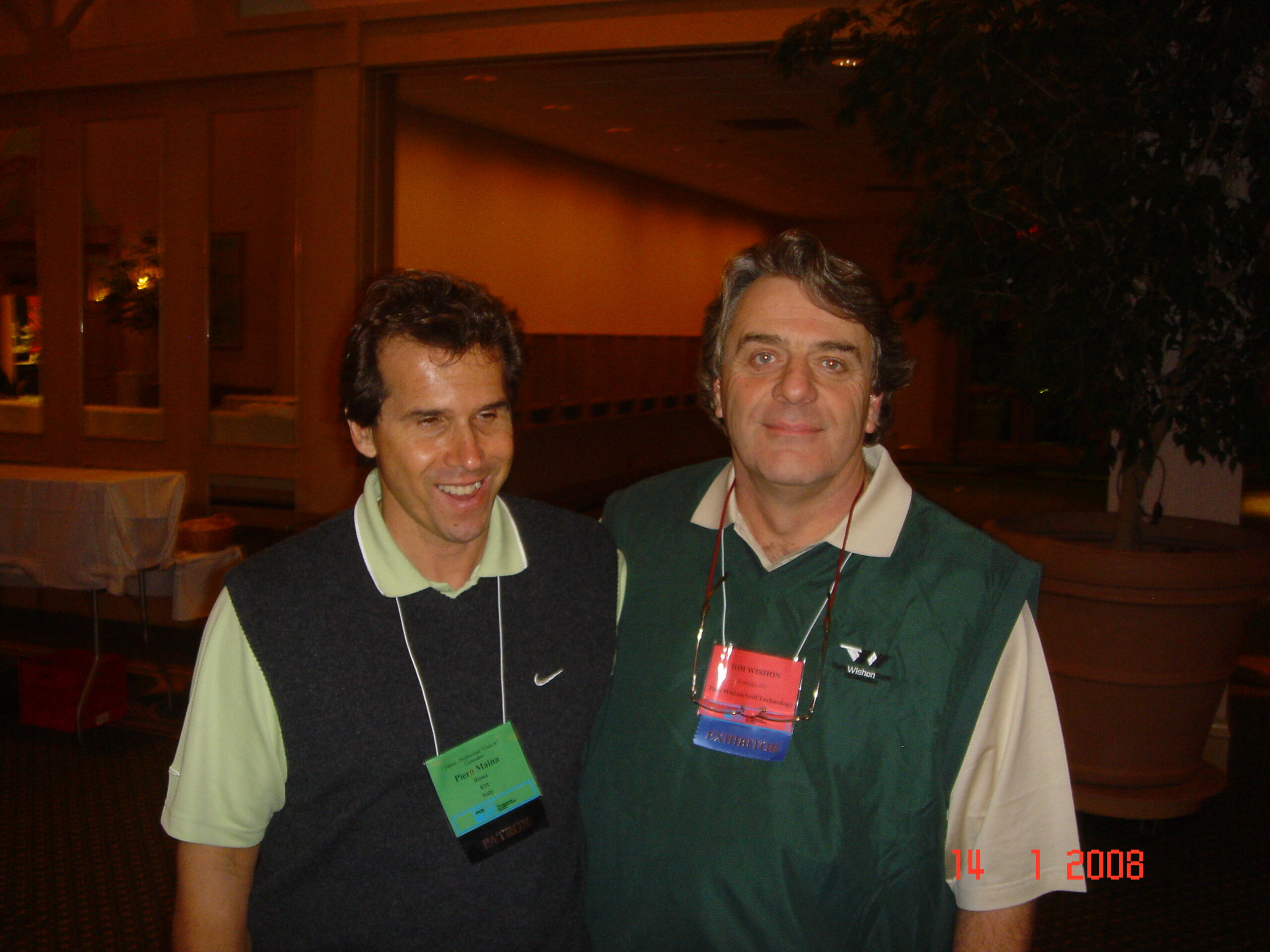
Io e Tom Wishon – Tampa (FL) USA – 2008
Tom Wishon è sicuramente uno dei più grandi esperti viventi in termini di conoscenza dei bastoni da golf, con 38 anni di studio dei bastoni e fondatore e presidente della Tom Wishon Golf Technology, ex professionista di golf della PGA Americana, per 11 anni nel panel tecnico di Golf Digest, ha progettato oltre 50 nuove teste di bastoni con innovazioni che lo consacrano come l’unico nel mondo dei progettisti di bastoni da golf ad avere fatto ciò e i suoi modelli hanno vinto sia sul PGA Americano che in Ryder Cup. E’ stato il clubfitter del compianto Payne Stewart e Scott Verplank oltre ad altri giocatori di fama internazionale e di due presidenti degli Stati Uniti. Ho avuto l’onore di conoscere Tom Wishon, oltre a partecipare a seminari dove lui era relatore, di studiare i suoi libri e anche di avere degli scambi di idee via e-mail direttamente con lui.
Vediamo di seguito quali sono le 22 variabili suddivise per area:
Set Make-Up (Composizione dei bastoni nella sacca)
Ora, non è che quando un giocatore si presenta chiedendo un bastone su misura con delle richieste del tipo: colpire la palla lunga,diritta e forte e fare par su tutte le buche , magari essendo un giocatore dalle capacità golfistiche limitate e non proprio atleticamente in forma, noi saremo in grado di accontentarlo; perchè pur migliorando sensibilmente la qualità dei suoi colpi, il suo livello medio basso non gli permetterà comunque di diventare un giocatore scratch con la sola attrezzatura personalizzata. Lo stesso dicasi se la richiesta fosse per ottenere un drive che gli permetta di mandare la palla a 250mt. Se la bassa velocità della testa del bastone e le scarse caratteristiche dello swing non saranno consone, non sarà possibile raggiungere quel risultato. D’altro canto come ho scritto sopra se lo stesso giocatore insiste a giocare con attrezzatura sbagliata, una volta creato il drive adatto a lui la distanza aumenterà esponenzialmente e anche la precisione, ma i 250 mt. resteranno un sogno, a meno che anche le prestazioni fisiche e lo swing non crescano altrettanto nella giusta direzione.
Come mia abitudine cerco di spiegare meglio che posso, approfondendo, ma senza entrare troppo nel tecnico e spero di esserci riuscito, altrimenti faremmo un corso di clubmaking/fitting. Vorrei concludere aggiungendo gli effetti primari “A” e secondari “B” delle 22 variabili presentate qui sopra nell’articolo così che anche voi possiate comprenderne la correlazione:
DISTANZA
Effetto “A”
Loft
Lunghezza del bastone
Peso totale
Peso dello shaft
Swingweight/MOI
Roll (Drive)
Effetto “B”
Momento d’Inerzia (MOI riferito all’asse del centro di gravità)
Roll (Legni da terra)
Posizione del Centro di Gravità
Set Make-Up (Composizione dei bastoni nella sacca)
Flessibilità dello shaft
Profilo della flessibilità dello shaft
Disegno della faccia
PRECISIONE
Effetto “A”
Angolo di lie (Ferri corti e medi, Wedges, putter)
Lunghezza
Angolo della faccia (legni)
Effetto “B”
Face Progression/Hosel Offset
Shaft Torque (Legni)
Momento d’inerzia della testa del bastone (asse dello shaft)
Posizione del Centro di gravità
Peso Totale
Set Make-Up (Composizione dei bastoni nella sacca)
Diametro del grip
Peso dello shaft
Distribuzione del peso/Punto di bilanciamento dello Shaft
Swingweight/MOI del bastone
TRAIETTORIA
Effetto “A”
Loft
Roll (Drive)
Effetto “B”
Face Progression/Hosel Offset (Legni,Ibridi)
Posizione del Centro di Gravità
Flessibilità dello shaft
Profilo della flessibilità dello shaft
Roll (Legni da terra)
CONSISTENZA
Effetto “A”
Angolo di lie (ferri, wedges, putter)
Angolo della faccia (legni)
Lunghezza del bastone
Swingweight/MOI
Set Make-Up (Composizione dei bastoni nella sacca)
Effetto “B”
Roll (Legni)
Bounce (Ferri, wedges)
Raggio e larghezza della suola (Ferri,wedges)
Peso dello Shaft
Momento d’Inerzia della testa del bastone (asse della testa)
Diametro del grip
Peso totale
Posizione del Centro di Gravità
FEEL/SENSAZIONI
Effetto “A”
Tipo di Grip/composizione
Diametro del grip
Swingweight/Moi
Set Make-Up (Composizione dei bastoni nella sacca)
Peso dello shaft
Peso Totale
Flessibilità dello shaft (legni)
Profilo della flessibilità dello shaft (legni)
Effetto “B”
Momento d’Inerzia della testa del bastone (asse della testa)
Flessibilità dello shaft (ferri)
Posizione del centro di gravità
Lunghezza del bastone
Profilo della flessibilità dello shaft (Ferri)
Bene, direi che una volta in possesso di queste informazioni, saremo in grado di intervenire “primariamente” su quelle specifiche che sono di maggior importanza sull’effetto del gioco, con un po’ di allenamento si arriverà a padroneggiarle e quindi a comprendere meglio su quali caratteristiche del bastone operare. Ricordiamoci inoltre che le specifiche sopra riportate sono inerenti solo ed esclusivamente per i bastoni e se la palla volerà alta per un difetto di “swing”, la correzione che ne deriverà cambiando o modificando tale specifica ce ne farà notare il cambiamento senza aver modificato il nostro swing.
Concludendo, ecco perchè non si possono confrontare dei bastoni di serie con quelli costruiti “realmente” su misura. Per realmente intendo dire con cognizione di causa e giusti materiali assemblati al fine di ottenere le migliori performances per quel giocatore. Per ripetermi, non è che se avrò dei “super componenti” e li “incollerò” insieme otterrò un bastone “super” per forza, il solo top di gamma non giustifica la perfetta riuscita e viceversa. Bisogna avere componenti di buona/ottima qualità, ma soprattutto che le specifiche una volta assemblati i componenti, siano quelle corrette per il golfista che dovrà giocare con quel bastone.
Come per un vestito, se avete avuto l’occasione di provare vestiti fatti su misura per voi fatti da un buon sarto e soprattutto quando le vostre caratteristiche fisiche non sono proprio “classiche” capirete cosa voglio dire. Buon gioco!
5 Tips to Avoid Plateaus and Metabolic Slowdown By Tom Venuto www.BurnTheFat.com!
QUESTION:Tom, Is it possible to not lose body fat because you’re eating too little? -Linda
ANSWER: Yes and no. This gets a little complicated so let me explain both sides.
Part one of my answer: I say NO, because if you are in a calorie deficit you WILL lose weight.
Most people have heard anecdotes of the dieter who claims to be eating 800 calories a day or some starvation diet level of intake that is clearly in a deficit and yet is not losing fat. Like the mythical unicorn, such an animal does not exist.
Every time you take a person like that and put them in a hospital research center or metabolic ward where their food can be counted, weighed, measured and almost literally “spoon fed” to them, a calorie deficit always produces weight loss.
There are no exceptions, except possibly in rare diseases or mutations. Even then metabolic or hormonal defects or diseases merely lead to energy imbalance via increases in appetite, decreases in energy expenditure or changes in energy partitioning. So at the end of the day it’s STILL calories in versus calories out.
In other words, NO – it’s NOT your thyroid (unless you’ve got a confirmed diagnosis as such…and then guess what… it’s STILL calories in vs calories out, you’re just not burning as many as someone should at your height and weight).
One famous study that was published in the New England Journal of Medicine years ago proved this point rather dramatically. After studying obese people – selected specifically because they swore they were eating less than 1200 calories but could not lose weight – Steven Lichtman and his colleages at St. Luke’s Roosevelt Hospital in New York came to the following conclusion:
“The failure of some obese subjects to lose weight while eating a diet they report as low in calories is due to an energy intake substantially higher than reported and an overestimation of physical activity, not to an abnormality in thermogenesis.”
That’s right – the so-called “diet-resistant” subjects were eating more than they thought and moving less than they thought. This was probably the single best study ever published that debunks the “I’m in a calorie deficit but I can’t lose weight” myth:
Part two of my answer, YES, because: 1) Energy intake increases.
Eating too little causes major increases in appetite. With hunger raging out of control, you lose your deficit by overeating. This happens in many ways, such as giving in to cravings, binge eating, eating more on weekends or simply being inconsistent, so some days you’re on your prescribed 1600 calories a day or whatever is your target amount, but on others you’re taking in 2200, 2500, 3000 etc and you don’t realize it or remember it. The overeating days wipe out the deficit days. 2) Metabolism decreases due to smaller body mass.
Any time at all when you’re losing weight, your metabolism is slowly decreasing due to your reduced body mass. The smaller and lighter you get, especially if there’s a large drop in skeletal muscle mass, the fewer calories you need. So your calorie deficit slowly shrinks over time as your diet progresses. As a result, your progress slows down even though you haven’t changed how much you eat.
With starvation, you always lose weight, but eventually you lose so much weight/body mass that you can reach energy balance at the same caloric intake you used to lose weight on. You might translate that as “I went into starvation mode” which wouldn’t be incorrect, but it would be more accurate to say that your calorie needs decreased. 3) Metabolism decreases due to adaptive thermogenesis.
Eating too little also causes a starvation response (adaptive thermogenesis) where metabolic rate can decrease above and beyond what can be accounted for from the change in body mass (#2 above). This is “starvation response” in the truest sense. It does exist and it is well documented. However, the latest research says that the vast majority of the decrease in metabolism comes from reduced body mass. The adaptive component of the reduced metabolic rate is fairly small, perhaps 10% (ie, 220 calories for an average female with a 2200 TDEE). The result is when you don’t eat enough, your actual weight loss is less than predicted on paper, but weight loss doesn’t stop completely.
There is a BIG myth about starvation mode (adaptive thermogenesis) that implies that if you don’t eat enough, your metabolism will slow down so much that you stop losing weight. That can’t happen, it only appears that way because weight loss stops for other reasons. What happens is the math equation changes!
Energy balance is dynamic, so your weight loss slows down and eventually stops over time if you fail to adjust your calories and activity levels in real time each week.
I teach a system for how to adjust calories and activity weekly using a feedback loop method in my Burn The Fat, Feed The Muscle program (more info from www.BurnTheFat.com!)
So what can be done to stop this metabolic slowdown caused by low calorie dieting and the dreaded fat loss plateau that follows? I recommend the following 5 tips: 1) Lose the pounds slowly.
Slow and steady wins in long term fat loss and maintenance every time. Rapid weight loss correlates strongly with weight relapse and loss of lean body mass. Aim for one to two pounds per week, or no more than 1% of total body weight (ie, 3 lbs per week if you weigh 300 lbs). 2) Use a higher energy flux program.
If you are physically capable of exercise, then use weight training AND cardio to increase your calorie expenditure, so you can still have a calorie deficit, but at a higher food intake (also known as a “high energy flux” program, or as we like to say in Burn The Fat, “eat more, burn more.”) 3) Use a conservative calorie deficit.
You must have a calorie deficit to lose fat, but your best bet is to keep the deficit small. This helps you avoid triggering the starvation response, which includes the increased appetite and potential to binge that comes along with starvation diets. I recommend a 20% deficit below your maintenance calories (TDEE), a 30% deficit at most for those with high body fat. 4) Refeed.
Increase your calories (re-feed) for a full day periodically (once a week or so if you are heavy, twice a week if you are already lean), to restimulate metabolism. On the higher calorie day, take your calories to maintenance or even 10, 15, 20% above maintenance and add the extra calories in the form of carbs (carb cycling). The leaner you get, and the longer you’ve been on reduced calories, the more important the re-feeds will be. (You can learn more about this method in chapter 12 of Burn The Fat, Feed The Muscle at www.BurnTheFat.com!) 5) Take periodic diet breaks.
Take 1 week off your calorie restricted diet approximately every 12 weeks or so. During this period, take your calories back up to maintenance, but continue to eat healthy, “clean” foods. Alternately, go into a muscle building phase if increasing lean mass is one of your goals. This will bring metabolism and regulatory hormones back up to normal and keep lean body mass stable.
There is much confusion about how your metabolism, hormones and appetite mechanisms are affected when you’re dieting, so this was really one of the most important questions anyone could have asked.
If this didn’t REALLY click – then you may want to save this and read it again because misunderstanding this stuff leads more people to remain frustrated and stuck at plateaus than anything else I can think of.
If you’d like to learn exactly how you should be eating to lose 2 lbs of fat per week, then visit www.BurnTheFat.com!.
Train hard and expect success,
Tom Venuto, Author of Burn The Fat, Feed The Muscle www.BurnTheFat.com!
About the Author:
Tom Venuto is a natural bodybuilder, certified strength and conditioning specialist (CSCS) and a certified personal trainer (CPT). Tom is the author of “Burn the Fat, Feed The Muscle,” which teaches you how to get lean without drugs or supplements using methods of the world’s best bodybuilders and fitness models. Learn how to get rid of stubborn fat and increase your metabolism by visiting: www.BurnTheFat.com!
Ho conosciuto PSYCH-K® dopo aver letto il libro del Dr. Bruce Lipton: “La Biologia delle Credenze”, che è diventato un best seller e il relativo dvd: ” La mente è più forte dei geni. Bruce Lipton è stato il primo scienziato che ha dimostrato in laboratorio come le influenze esterne/credenze, abbiano un ruolo maggiore del DNA nello sviluppo e nella vita delle cellule arrivando addirittura a modificarle. Avendo visto le potenzialità della mente inconscia e il sabotaggio che ne deriva dalle credenze limitanti, dal principio di scarsità e separazione che spesso governa i nostri pensieri quotidiani, ho voluto conoscere più da vicino il metodo PSYCH-K®. Ho frequentato il corso base di PSYCH-K® nel 2009 e ho avuto come istruttore Duccio Locati che oltre ad essere istruttore internazionale certifcato di PSYCH-K® è un affermato osteopata e tutte le informazioni sul suo lavoro le potete trovare all’interno del suo sito qui. Sono quindi diventato “facilitatore” di PSYCH-K® , che vuol dire che sono in grado di utilizzare le tecniche di bilanciamento di PSYCH-K® sia per me stesso che per gli altri. Ho completato il percorso partecipando al corso avanzato di 4 giorni nel mese di Maggio 2012 e questo passaggio mi ha permesso di comprendere meglio il funzionamento del processo di bilanciamento, approfondendo nuove tecniche e metodiche per il cambiamento delle credenze limitanti che sono presenti nella nostra mente inconscia.
Lo scopo di PSYCH-K® è infatti quello di permettere alla nostra mente inconscia di liberarsi dalle credenze negative/limitanti e autosabotanti che sono alla base dei nostri insuccessi o per meglio dire, che sono le fondamenta dei nostri pensieri che creeranno a loro volta la nostra realtà. Ora, per chi crede che la nostra esistenza su questo pianeta sia governata da forze/cause esterne alla nostra volontà, bisognerà prima convincerlo del contrario. Per quelli che sono già coscienti che QUALUNQUE esperienza ci accada o meglio sembra accaderci è una conseguenza diretta dei nostri pensieri consci/inconsci, bisogna spiegare qual è il pezzo mancate del ragionamento. Se a livello conscio prenderò delle decisioni su quelle che vorrei fossero le mie esperienze di vita, vedrò molto probabilmente naufragare i miei progetti se non avrò altrettanto allineate le credenze a livello inconscio; il problema saranno i paradigmi, abitudini e credenze che governano e influenzano ogni attività e modi comportamentali nella vita di tutti i giorni.
Alla base di quanto detto, c’è la lotta impari fra mente conscia e mente inconscia :
Da quanto apprendiamo dalle due immagini qui sopra, scopriamo che il 95% delle azioni che compiamo quotidianamente è gestito dalla mente inconscia e quindi dalle abitudini e automatismi che risiedono là. Pertanto possiamo affermare che anche se consciamente pensiamo in una certa direzione per un certo periodo, il disco che in sottofondo “suonerà più forte” e in maniera continuativa sarà senz’altro quello della mente subconscia….una vera lotta impari vista anche la differenza in termini di capacità di elaborare le informazioni (40 Bit/sec contro 40 Mio Bit/sec). Queste conclusioni sono il frutto di esperienze passate, dell’educazione che abbiamo ricevuto in età pre-scolare e sono immagazzinate nella mente subconscia. Queste credenze subconscie, creano dei filtri attraverso i quali vediamo e affrontiamo le sfide della vita. Sono le basi per le nostre azioni o reazioni utili per affrontare ogni situazione nella nostra vita. L’abilità di agire in maniera efficace sia a livello personale che professionale, è profondamente influenzata da credenze del tipo “Sono competente”, “Sono forte”, “Sono sicuro”. Con credenze come queste possiamo intraprendere progetti importanti con sicurezza e rimanere focalizzati senza perdere il controllo della situazione. Se invece avremo credenze del tipo “Non credo di poter fare un buon lavoro”, “Non controllo l’andamento delle cose”, procederemo esitando, temendo di fare errori, di subire critiche e di sbagliare. Come disse una volta Henry Ford: ” Che tu creda di potere o non potere….hai comunque ragione!”
Il riscrivere le nostre credenze limitanti a livello subconscio è come riprogrammare un computer. Utilizzando le tecniche di PSYCH-K® come una specie di “tastiera mentale” che comunica con il cervello, potete incrementare la comunicazione incrociata tra i due emisferi cerebrali, raggiungendo uno stato di integrazione emisferica, ideale per il cambiamento delle credenze subconscie. In aggiunta, quando l’emisfero destro e sinistro sono in comunicazione e lavorano simultaneamente, le qualità e le caratteristiche di entrambi gli emisferi sono disponibili per massimizzare il vostro potenziale.
PSYCH-K® è una delle tante vie che ci vengono insegnate per riprogrammare la mente inconscia in maniera veloce, semplice, efficace e rispettosa al fine di essere noi i padroni della nostra esperienza di vita e non “vittime” come spesso siamo portati a credere in maniera errata.
Concludo riportando qui sotto le Domande/Risposte su PSYCH-K® prese dal sito di Duccio Locati.
A presto!
PSYCH-K® è una serie di principi e di processi progettati per cambiare le convinzioni a livello subconscio che limitano l’espressione del tuo pieno potenziale di creatura divina che sta vivendo una esperienza umana.
Rob Williams, ideatore di PSYCH-K
Il Segreto della Vita sono le CREDENZE. Piuttosto che i geni, sono le nostre credenze a controllare le nostre vite. PSYCH-K® è un set di tecniche semplici di auto-aiuto per cambiare le credenze e le percezioni che hanno un impatto sulla tua vita a livello cellulare.
Bruce Lipton, PhD
Cos’è PSYCH-K®?
PSYCH-K è un metodo semplice, immediato e estremamente rispettoso per l’individuo che permette di riscrivere il software della nostra mente e di cambiare la matrice della nostra vita.
Sviluppato a partire dal 1988, PSYCH-K include informazioni e processi che permettono di accelerare incredibilmente la propria crescita personale. Questa tecnica veramente unica è un insieme di diversi strumenti per il cambiamento personale, alcuni contemporanei, altri antichi. Come molte delle innovazioni più importanti ed efficaci nel mondo, PSYCH-K è nato grazie a “una serie di intuizioni” generate da anni di ricerca e da migliaia di sessioni individuali e di gruppo. PSYCH-K è quindi una tecnica estremamente sicura, non invasiva ed efficace per cambiare credenze e percezioni antiquate, radicate a livello della nostra mente subconscia.
La nostra realtà è formata dalle nostre “credenze”. Queste credenze, di solito a livello subconscio, sono il frutto di una programmazione che inizia dai primi anni della nostra vita, e influenzano in modo drammatico il nostro comportamento e il nostro modo di “percepire” la vita in tutti i suoi aspetti. Diversi studi nella branca delle neuroscienze indicano che quasi il 95% della nostra coscienza è gestita dal nostro subconscio che è il deposito per le nostre attitudini, i nostri valori e le nostre credenze. Tramite le nostre credenze creiamo quella che è la nostra percezione del mondo e di noi stessi, e tramite queste percezioni sviluppiamo i nostri comportamenti. Spesso il modo migliore per cambiare un comportamento (e spesso abbiamo il desiderio di cambiare i comportamenti che sabotano la nostra vita e gli obiettivi che vogliamo raggiungere) è cambiare le credenze a livello subconscio che lo supportano. PSYCH-K, basato su anni di ricerca riguardo alla differenziazione degli emisferi cerebrali, conosciuta anche come teoria della predominanza emisferica (Brain Dominance Theory), offre diversi metodi per identificare velocemente e trasformare le credenze che ci sabotano, in credenze che invece ci supportano in ogni area della nostra vita: affettiva, relazionale, economica, lavorativa, e quella legata alla salute.
PSYCH-K è quindi un processo che può liberare la nostra mente dalle limitazioni del passato in maniera veloce, efficace e facile.
PSYCH-K® è un “sistema di controllo mentale?”
Quando si parla di subconscio uno dei timori primari è “stai tentando di controllare la mia mente senza il mio permesso?”.
Domanda lecita dato che ormai ognuno di noi è costantemente controllato quasi in ogni ambito della propria vita (ma qui apriremmo un discorso infinito). PSYCH-K dà gli strumenti e la conoscenza per permettere alle persone di controllare la propria mente e quindi di non essere vulnerabile ai desideri e alle volontà di altre persone, quando non corrispondenti ai nostri. Quindi alla domanda “PSYCH-K è un sistema di controllo mentale?” la risposta più corretta sarà: “Si, in un certo qual modo, PERCHÉ DA A TE IL CONTROLLO SULLA TUA MENTE”.
Cos’è il Test Muscolare e come funziona?
Il Test Muscolare è stato sviluppato 40 anni fa da Geroge Goodheart, D.C. (l’ideatore della Kinesiologia Applicata) negli Stati Uniti. In PSYCH-K, il test muscolare è utilizzato come mezzo per comunicare facilmente e direttamente con il nostro subconscio.
La mente subconscia controlla il Sistema Nervoso Autonomo ed è responsabile per il controllo nelle nostre funzioni fisiche e neurologiche autonome. Ad esempio, il nostro corpo si muove perché il nostro subconscio dirige una complessa rete di segnali elettrici che vanno al muscolo appropriato nel momento appropriato per portare a termine una azione che può essere quella di prendere un oggetto. La forza del segnale elettrico, determinerà la forza della risposta nel muscolo in questione; ma l’intensità del segnale elettrico è strettamente legata a quali pensieri ha la nostra mente in quel momento. Quando la mente sta mantenendo un pensiero “stressante”, si crea un conflitto elettrico che ridurrà la forza del segnale al muscolo, con una diminuzione di forza di quest’ultimo. La stessa cosa succede quando una persona dice una frase con la quale il suo subconscio non è d’accordo, con, di conseguenza una diminuzione della forza dei muscoli di tutto il corpo. Di conseguenza, il test muscolare può essere usato per determinare quali pensieri inducono stress a livello fisico, come per trovare quali credenze sono o non sono supportate dalla nostra mente subconscia. È stato ed è tuttora utilizzato in altri ambiti per testare l’efficacia di vitamine e minerali, disequilibri a livello dei meridiani energetici, stress organici, intolleranze alimentari, allergie, ecc… È importante specificare quindi che PSYCH-K e il Test Muscolare non sono sinonimi. PSYCH-K usa il test muscolare per comunicare con la mente Superconscia e subconscia. PSYCH-K è un insieme specifico di tecniche che ci permettono di cambiare le nostre credenze, che includono il test muscolare come mezzo per comunicare con il nostro subconscio e con il nostro Superconscio. Ma ricordatevi, il nostro subconscio non è un Profeta Infallibile! State attenti a fare domande sul futuro “Devo fare…?”. Come per ogni altra cosa si può incorrere nel rischio di abusare del test muscolare. Alcuni lo usano come la più importante “sorgente di Verità”, in alternativa al discernimento della mente conscia. Il nostro subconscio rappresenta la nostra realtà, non la Verità Suprema.
Come, delle credenze e degli atteggiamenti che ho da anni possono cambiare in pochi minuti con PSYCH-K®?
Molti pensano che credenze e atteggiamenti negativi siano come degli omini nelle proprie teste che tentano in tutti i modi di rendere la loro vita miserabile.
Come analogia potremmo prendere dei documenti di Word (quello di Bill Gates) immagazzinati nel computer come “micro documenti”. Sia il software del computer che le credenze immagazzinate nella memoria di una persona sono schemi di energia mantenuti in un campo elettromagnetico. Quando il campo è disturbato, questi schemi energetici cambiano. Uno schema energetico mantenuto nel computer per 30 anni, può essere modificato o cancellato con la stessa velocità di un altro che è nel computer da soli 30 minuti! E così è esattamente anche per la nostra mente. La chiave di tutto sta nel come cambiare lo schema, non da quanto tempo lo schema è presente.
Quanto spesso devo rinforzare un bilanciamento?
Questa domanda è legata alla credenza che non si possa realmente cambiare un vecchio atteggiamento o una vecchia credenza, e che quando meno te lo aspetti, tutti i tuoi vecchi schemi saltino fuori per toglierti ogni difesa e sabotare la tua felicità.
Occasionalmente un bilanciamento può richiedere alcune attività di supporto per accelerare il processo di integrazione della nuova credenza, ma è molto raro che una persona necessiti di fare esattamente lo stesso bilanciamento, per lo stesso obiettivo, due volte (personalmente non mi è mai capitato).
Devo ricordare le passate esperienze dolorose per risolverle?
Molte forme di psicoterapia assumono che l’entrare in diretto contatto con determinate emozioni o ricordi sia un pre-requisito necessario per ottenere cambiamenti significativi.
Per PSYCH-K non è necessariamente così. Nella nostra esperienza abbiamo visto che quando il subconscio ha bisogno di accedere ad un ricordo o ad una emozione passata per cambiare una credenza, lo farà, ma quando non è necessario non creerà nessuna catarsi emozionale giusto per accontentare le aspettative del paziente, del terapista o dell’istruttore. Ogni persona è differente e le soluzioni dei problemi sono diverse da persona a persona. Quindi, l’atteggiamento migliore è quello di non avere aspettative sullo svolgimento del bilanciamento ma rimanere curiosi circa quello che può succedere e rispettare la persona qualunque sia la sua modalità.

 Burning Secrets of the World’s Best Bodybuilders and