Fb-Button
burn the fat feed the muscle - Piero Maina's Website - Never Give Up!

Piero Maina's Website – Never Give Up!

Tag: burn the fat feed the muscle

  • Burn The Fat Summer Challenge 2012….La Mia Esperienza.

    Burn The Fat Summer Challenge 2012….La Mia Esperienza.

    Burn The Fat Summer Challenge 2012

    Titolo:  Burn The Fat Summer Challenge 2012….La Mia Esperienza.

    Autore:Piero Maina

    Conteggio Parole: 2884

    Ed eccoci qui, per il terzo anno consecutivo ho concluso la “Burn The Fat Summer Challenge” la sfida di trasformazione corporea della durata di 14 settimane o 98 giorni che vede premiate le persone che ottengono la migliore trasformazione corporea nel suddetto periodo di tempo. Quindi, a meno che non si tratti di una categoria specifica, il vincitore assoluto, non sarà necessariamente quello che avrà perso più peso o il più magro o il più muscoloso, ma quello che oggettivamente avrà cambiato la sua forma fisica in meglio, perdendo la quantità maggiore di grasso, conservando o addirittura aumentando la massa muscolare/massa magra, senza aiuto di steroidi/anabolizzanti, solamente attraverso l’alimentazione e l’esercizio fisico.
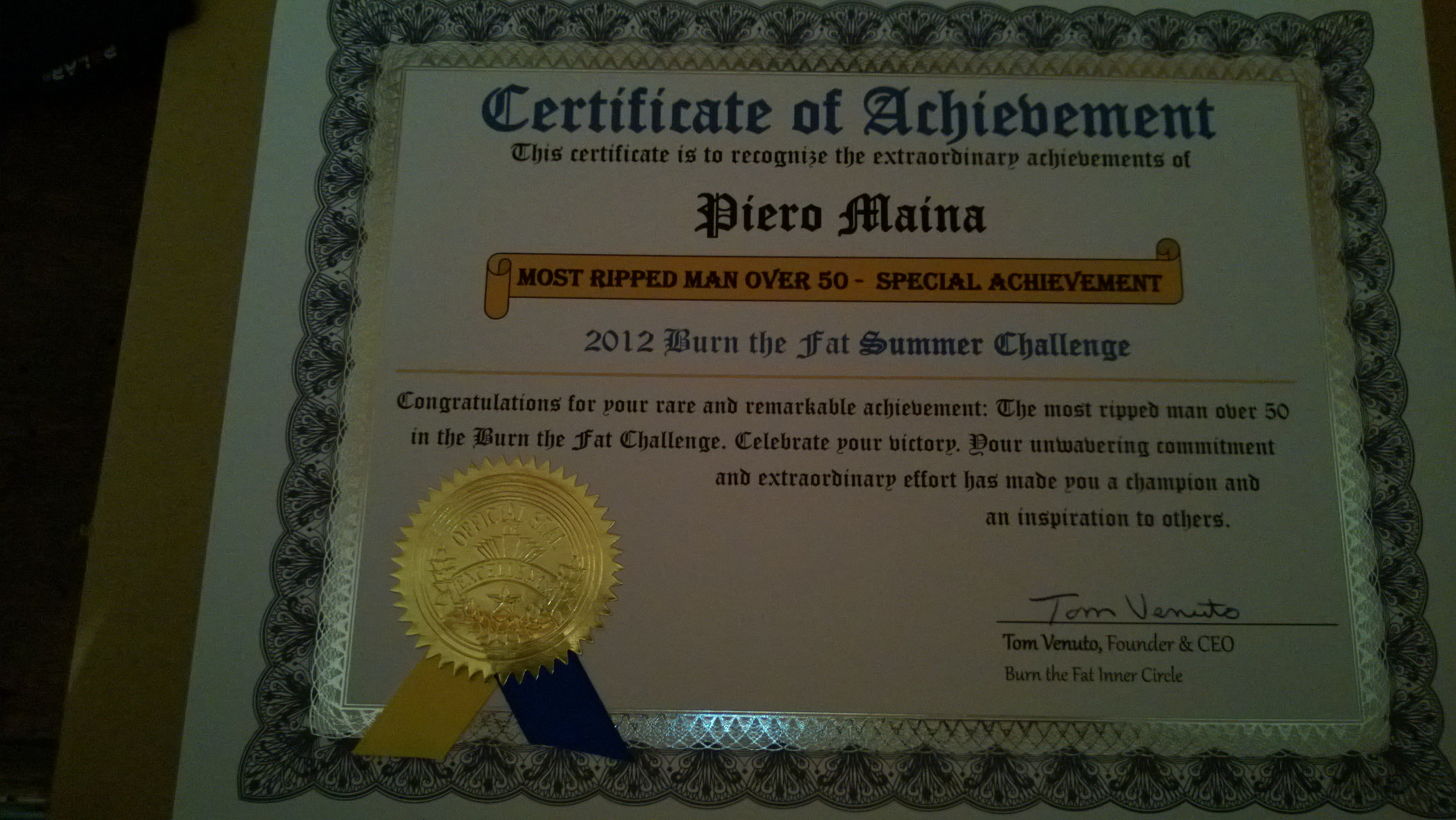
    BTF Certificate of Achievement
    Certificato del premio vinto come
    “Most Ripped Man Over 50”
    Clicca sull’immagine per ingrandirla

    Quest’anno il mio impegno è stato massimo e alla fine sono stato premiato come la muscolatura più definita fra gli uomini concorrenti oltre i 50 anni di età (Most Ripped Man Over 50. Cliccate qui per la mia intervista sul sito Burn The fat in Inglese ),  e questo comunque non in valore assoluto, ma sempre come conseguenza della migliore trasformazione corporea. Il risultato va confrontato con le condizioni iniziali, infatti un altro concorrente potrebbe anche essere più definito del sottoscritto, ma bisogna confrontare la condizione di partenza e le eventuali limitazioni fisiche a cui uno potrebbe essere soggetto. Se prendiamo il vincitore assoluto, oggi quarantunenne, che è stato premiato con un viaggio di 7 giorni alle isole Hawaii per due persone all-inclusive (lo stesso per la prima assoluta delle donne), la sua condizione iniziale era quella di un semi obeso, che in soli 98 giorni si è trasformato in un fisico asciutto e massiccio. Vorrei spiegare che il soggetto in questione quando aveva 18/20 anni giocava a football americano e faceva gli squat con 150 kg. sulle spalle e quindi i muscoli li aveva già costruiti allora. Quando vedete le trasformazioni (compresa la mia), non è che i muscoli che vedete sono il frutto di un allenamento della durata di 98 giorni, ma almeno nel mio caso, il risultato di una vita di allenamento (anche se negli ultimi 18 anni i pesi per i miei problemi di salute, non li ho più potuti utilizzare qui l’articolo che spiega il perchè). Certamente durante i 98 giorni di durata della sfida/gara, i muscoli sono stati allenati al massimo e complice anche l’alimentazione hanno ripreso vigore o sono anche aumentati. Ricordate che senza aiuti “chimici” ottenere masse enormi partendo da un fisico da “scartatore di caramelle” in 98 giorni diciamo che è impossibile. Ci sono poi individui geneticamente superdotati o i principianti della palestra che allenandosi e alimentandosi correttamente otterranno risultati molto superiori alla media, ma mai da tisico a culturista. Tornando al nostro vincitore assoluto, dopo i trascorsi da sportivo in gioventù e dopo 20 anni di matrimonio, tre figli e la vita sedentaria da poliziotto e un’alimentazione non proprio ottimale, ha visto lievitare il suo peso e la sua circonferenza a livello della vita. A suo dire era il re dei ciambelloni e dolciumi vari. Fino a quando ha preso la decisione concreta nella sua mente di cambiare, mettendo in pratica gli insegnamenti presenti nel libro/programma “BurnTheFat Feed The Muscle”  e utilizzando la Summer Challenge come motivazione per riuscire, il risultato si è realizzato e ha potuto regalarsi e regalare a sua moglie, il viaggio di nozze che 20 anni prima si erano negati per problemi economici. Certamente con circa 3.000 iscritti e tutte persone motivate, che hanno comperato il libro e che quindi conoscono le istruzioni per riuscire, non è semplice primeggiare e poi le situazioni di partenza sono profondamente diverse e anche per i giudici è come comparare mele con pere, viste le differenze fisiche e di età. Va detto che ogni anno di questi quasi 3.000 partecipanti, che all’inizio sono tutti desiderosi di primeggiare e scrivono affermazioni piuttosto presuntuose ed audaci nei propri giornali all’interno del forum di gara , solamente trecento persone circa  riescono a portare al termine la sfida  e gli altri perdono il treno o come dicono gli americani “They fall off the wagon”. Dei circa trecento, direi che un centinaio hanno postato le loro statistiche, foto iniziali e finali e hanno sempre aggiornato il loro giornale, ma a mio parere le differenze fra le foto iniziali e quelle finali, non recano sostanziali cambiamenti. Quindi direi che alla fine sono solo 150 i veri finalisti, quelli che sono visibilmente cambiati, e sono solo il 5% dei partecipanti. Ci vuole molta volontà e disciplina per avere successo, oltre ad una organizzazione maniacale per riuscire a mangiare i 5/6 pasti giornalieri  in tutte le situazioni che la vita quotidiana ci presenterà e che siano oltretutto composti da cibi giusti, nelle giuste quantità e con i macronutrienti correttamente bilanciati.  Non è che uno può mangiare ciò che vuole, certo come ho già detto sopra, ci sono eccezioni per somatotipi mesomorfi, ma mediamente e anche per loro, per raggiungere il miglior risultato è necessario mangiare al meglio. Non si può ottenere il massimo se non si va oltre il massimo. Il primo premio è il viaggio, poi esistono premi di categoria, ma non sono paragonabili al viaggio. Si va dall’iPod all’ iPad al kindle al libro firmato da Tom Venuto e i premi a disposizione non sono molti, ma vorrei far capire che già l’aver terminato la sfida è il premio più grosso. Se uno riesce nell’intento impegnandosi al massimo si ritroverà nella miglior forma fisica della sua vita e questa oltre ad essere una grande soddisfazione è realmente il premio più importante che lo/la consacrerà come vincente o come dicono gli americani come un/una “achiever”.

    Come ho già spiegato nell’ articolo Burn The Fat….La mia esperienza , sono arrivato alla mia attuale forma fisica grazie agli insegnamenti contenuti nel libro scritto da Tom Venuto (BurnTheFat Feed The Muscle ) e nonostante gli infortuni e il non potermi allenare come avrei voluto per 18 anni, posso tranquillamente affermare che è oggi che ho raggiunto il mio stato di forma migliore, oggi che ho 51 anni e il viaggio è appena cominciato. Conto di migliorare ancora e per questo ringrazio, invece di provare amarezza e frustrazione per non averne goduto prima o per essere incappato nell’infortunio della trombosi alla vena succlavia/ascellare, oltre ad altri vari incidenti più o meno gravi che hanno accompagnato la mia esistenza e questo modello di pensiero è sicuramente un valido alleato per il raggiungimento degli obiettivi che ci siamo prefissati in generale nella vita.

    Quest’anno la sfida è stata vinta grazie ad una profonda motivazione, disciplina, responsabilità, impegno, dedizione e desiderio di riuscire, focalizzando solamente l’obiettivo. Il risultato ottenuto è una sinergia di quattro elementi: La mente che ha preso una decisione, l’alimentazione che dovrà essere “pulita”, l’allenamento contro resistenza/pesi e l’allenamento cardio per bruciare più calorie e quindi perdere maggior quantità di grasso. Tutti questi quattro elementi sono necessari per la riuscita e uno non è meno importante dell’altro, ma presi singolarmente non hanno la stessa valenza esponenziale rispetto a quando vengono utilizzati in sinergia. La somma dei quattro non darà come risultato quattro, ma dieci, cento, mille.  C’è anche il quinto elemento: il supporto psicologico. Sia che provenga da un preparatore che da un amico o nel caso specifico dal Burn the fat inner circle, l’avere un gruppo di persone che ti sostenga motivandoti e consigliandoti nei momenti di crisi o quando si raggiunge la soglia del “plateau” è forse l’elemento determinante per la riuscita e il raggiungimento dell’obiettivo. Alzarsi tutte le mattine molto presto per effettuare l’allenamento cardio (corsa,bici,nuoto,etc.) o l’allenamento contro resistenza/pesi richiede una profonda motivazione. Anche gli infortuni mi hanno fatto compagnia nuovamente, non come l’anno scorso che avevo avuto una brutta distorsione alla caviglia oltre alla rottura di due costole e avevo continuato ad allenarmi nonostante i dolori. Inoltre pur vivendo in albergo a Milano e facendo la spola con Roma e mangiando sempre al ristorante o in macchina ero arrivato al 5,89% di massa grassa con un ottimo stato di forma, pur non facendo parte dei 10 finalisti uomini. Anche due anni fa mi sono infortunato, con la frattura da stress alla tibia destra (per fortuna l’ho avuta nell’ultima settimana di gara, ma mi ha accompagnato per i sei mesi successivi impedendomi qualsiasi attività che impegnasse le gambe, ma il resto del corpo è stato allenato regolarmente). Quest’anno il Neuroma di Morton nel piede destro si è risvegliato e mi ha impedito di correre come avrei voluto, nonostante ciò ho continuato lo stesso le sedute di allenamento con posture non proprio corrette e oltre al piede avevo (ed ho ancora), una brutta epicondilite al gomito destro che non mi faceva alzare nemmeno una bottiglia senza provare dolore. Quando proprio era diventato impossibile allenarsi, ho dovuto ricorrere alle infiltrazioni di cortisone. Oltre ai problemi fisici c’era il problema logistico, visto che sono rimasto lontano da casa con la famiglia per un lungo periodo e organizzarsi per mangiare 6 volte al giorno e soprattutto non cedere alle tentazioni, quando al villaggio turistico al buffet c’era ogni ben di Dio e in più con la famiglia che non mi supportava nelle mie scelte, è stata una sfida nella sfida.

    Ognuno di noi ha situazioni differenti, di metabolismo, risposte ormonali, genetica, costituzione,volontà, stili di vita, situazioni lavorative, economiche, etc. Ognuno di noi da valori ed importanza diverse a ciascuna di queste problematiche e le affronta in maniera diversa. Va detto inoltre che non esiste nè un piano alimentare che vada bene per tutti, nè una soluzione univoca, ma alla base c’è una decisione, una scelta di un individuo che decide raggiungere un obiettivo, uno scopo che a seconda di quanto quell’obiettivo sarà importante nella sua mente, sarà raggiunto. Può anche darsi che l’obiettivo finale sia troppo ambizioso e non possa essere raggiunto nelle 14 settimane a disposizione, l’importante e che noi cominciamo a muoverci verso tale obiettivo e nel tempo a nostra disposizione facendo del nostro meglio. Alla fine del periodo in questione, sia che lo avremo raggiunto, sia che non saremo riusciti, rinnoveremo il nostro nuovo obiettivo con uno più ambizioso o posticiperemo il vecchio finché non sarà stato raggiunto. Ma non saremo delusi per il mancato raggiungimento assumendo la cosa come un fallimento. Non esistono fallimenti, ma solo risultati. Guardando i nostri risultati senza perdere di vista i nostri obiettivi, saremo in grado di portare le dovute correzioni per proseguire il “viaggio”, ma non rinunceremo scoraggiati perchè abbiamo fallito. Questa è la differenza fra chi riesce e chi rinuncia. E non fatevi fuorviare dai comuni “perdenti” che troverete sul vostro cammino che faranno di tutto per farvi diventare “realisti” e vi diranno che non serve a nulla se per raggiungere il vostro obiettivo dovrete forse impiegare 10 anni o più e magari sarete già vecchi. Qui dovrei divagare parlandovi di come viene vissuto il tempo, soprattutto da parte mia, ma entrerei in discorsi di metafisica troppo complicati e andremmo fuori tema. Vi invito comunque a cercare di visualizzare dove vorreste essere, (in questo caso a livello di forma fisica, ma il discorso vale veramente per tutto il resto nella vita) e proviate a muovervi verso quel risultato, accettando tutti i passaggi, anche molto difficili che incontrerete, fino a che sarete arrivati a destinazione.

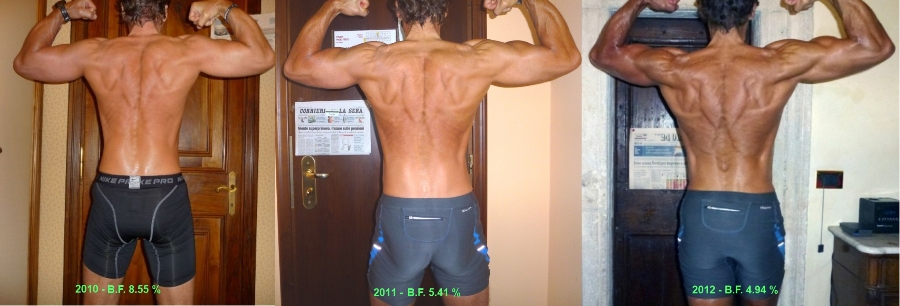
    Chiudo inserendo le foto iniziali e finali della Summer Challenge 2012. Metto quelle laterali e di schiena che sono state pubblicate sul sito http://www.burnthefatinnercircle.com  e poi ho fatto un collage con le foto di schiena delle tre Summer Challenge dal 2010 al 2012 così che possiate notare le differenze nei tre anni in esame.
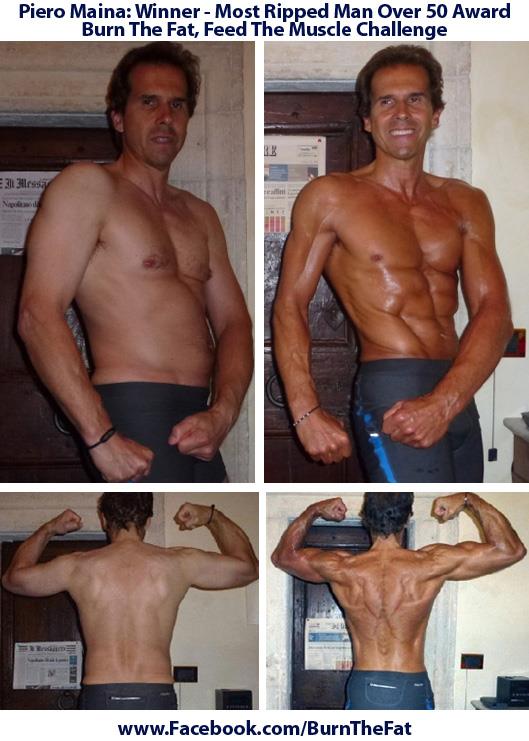
    Foto pubblicata sul sito Burn The Fat.com
    Trasformazione ottenuta in 98 giorni
    Cliccate per ingrandire

    Per chi parla Inglese,queste le parole che Tom Venuto ha scritto sul suo profilo facebook riguardanti il mio premio/risultato:
    More Amazing Body Transformations! This year, the Burn the Fat Challenge had more competition for the “most ripped” title and “most transformed over 50” than ever, so, we created a new award… Introducing, Piero Maina of Italy – The “Most Ripped Man Over 50! Click LIKE if you think is incredible for age 51 (or any age!)… like something Michelangelo carved out! 🙂

    E ancora aggiungo, sempre in Inglese le motivazioni per la nomination al mio premio, che è stato istituito dopo la nomina dei 10 finalisti uomini, (dove ancora una volta non ero presente) e del vincitore per la miglior trasformazione uomini over 50. Il vincitore di quella categoria a cui anche io aspiravo è stato un uomo di 56 anni con diversi problemi di salute che da uno stato di obesità molto marcata ha trasformato drasticamente il suo fisico (non è minimamente definito come me, ma ha perso un’enorme quantità di grasso e ha eliminato un addome da donna incinta decadente quasi completamente in 98 giorni e meritava quindi e giustamente il premio). Qui sotto le parole dell’annuncio di Tom Venuto sul forum di Burn The Fat Inner circle:

    RE: 2012 SUMMER CHALLENGE AWARDS ANNOUNCEMENT THREADPosted Wednesday, September 26, 2012 at 11:51 PM
    SPECIAL AWARD ANNOUNCEMENT

    This was our 6th season of the burn the fat challengeDuring the judging process, in many of our contests of the past, and especially in this one, we noticed one or more faces / names (bodies) popping up more than once during the voting for potential nominees or finalists. Sometimes a person pops up MULTIPLE TIMES, with multiple nominations.That’s exactly what happened here, during the judging for the 2012 summer challenge, for one man.When the first round of individual contest finalist nominations came in, (narrowing the entire field down to potential finalists or standouts, his name was there. When the second round came in (narrowing down to smaller list of potential top 10), his name was there again.Then, when the most ripped competition came around, his name was in the nominations again. That was the third time we saw him. (he was ripped!)And, when the most transformed over 50 round nominations came in, guess who’s name showed up yet again?  Yep same guy, He just turned 51.So why haven’t we seen him in the list before? Well, the top 10 were not only extremely close and difficult to judge in general, it was filled with men of different body shapes and totally different starting and ending points. The judges narrowed it down by personal improvement from start to finish and it was no easy task comparing the amount of improvement from a man of one body type and starting point to a man of another. Many of the men in the 11th, 12th, 13th, etc spots were all phenomenal. It was just a close contest.The most ripped award. That was an amazing turnout of potential nomiinees, but we had an amazing overall champion there who won that award unanimously. But, the guys in 2nd 3rd, 4th, 5th, etc were also PHENOMENAL.Same thing for most transformed over 50 category.  picking a winner was tough and there were MANY nominations for that category. We dont think we’ve ever seen so many fantastic over 50 burners.So after the “regular” awards were given, we simply couldnt stop thinking about some of these men who were so close to the top. But one in particular was so close in every category, we simply KNEW we had to give him some serious kudos. We have done it before in many of our contests, and we are pleased to announce that we are doing it again. We have created a new special category, just for this challenge because of a unique achievement.
    THE MOST RIPPED MAN OVER 50
    And the recipient of this award is Piero Maina!
    Piero, your achievements display improvements across multiple categories – in fact, we could probably say your results also embody a “most inspirational” element because of what you’ve had to work through and overcome to achieve this.
    You deserve the recognition and the prizes that come with a special category award. Congratulations!

    Devo aggiungere due righe per chi eventualmente dopo avere visto le immagini possa pensare che i risultati raggiunti siano stati ottenuti con l’aiuto di sostanze anabolizzanti, come anche qualche mio amico scherzosamente, ma non troppo , ha detto. Faccio presente che se realmente avessi usato steroidi, le mie masse muscolari sarebbero aumentate notevolmente e questo non è successo. E’ nei miei piani di aumentare di massa magra/muscolo di almeno 6/8 kg. ma perchè questo accada, utilizzando metodi naturali devo allenarmi e mangiare in un certo modo e sarà necessaria una certa quantità di tempo più o meno lunga. Va da se che per aumentare di massa io debba mangiare di più di quello che consumo, ma è ovvio che possa aumentare anche di grasso, cosa che molti bodybuilder fanno nel periodo lontano dalle gare per poi “tirarsi” nelle 12/14 settimane pre gara cercando di mantenere quanto più possibile il muscolo “guadagnato” durante la fase di “bulk”…esistono poi differenti metodi di carico/scarico dei carboidrati,ma questa è un’altra storia. Quindi tornando a me l’effetto della riduzione drastica del grasso e degli allenamenti di forza e cardio fanno sembrare le cose come non sono.
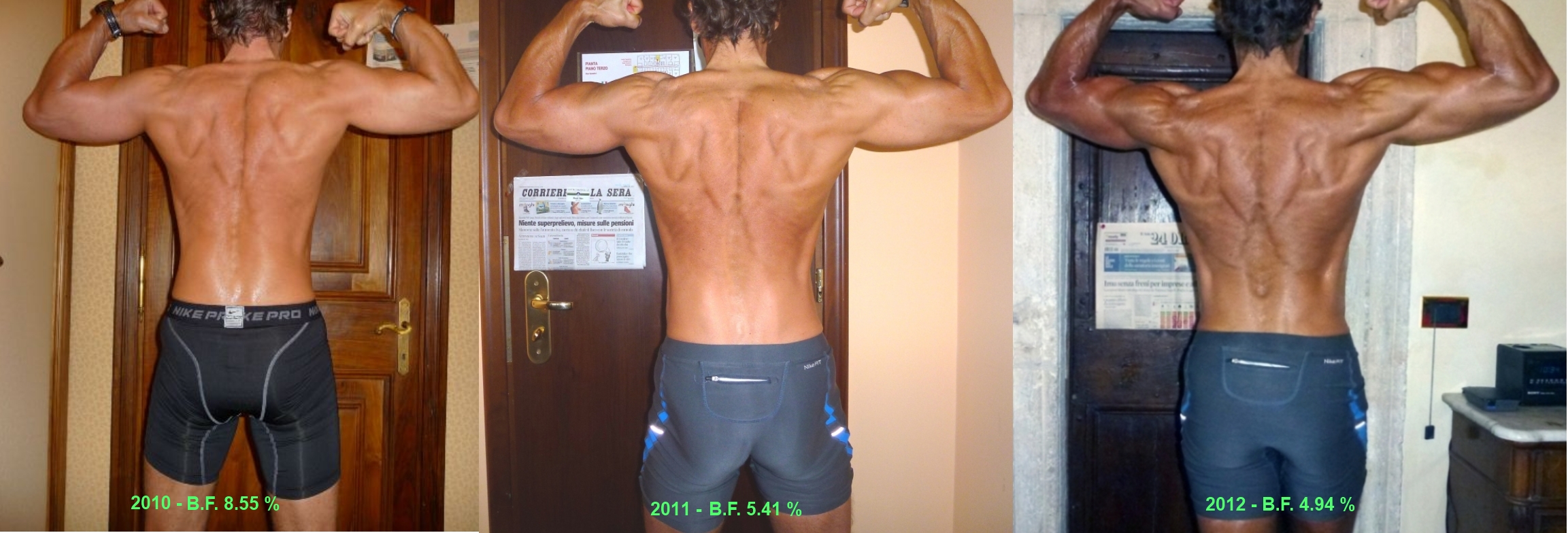
    Comparazione Back view Summer Challenge 2010-2011-2012
    Cliccate sull’immagine per ingradirla

    Spero che attraverso questo articolo le persone che credono di voler/dover apportare dei cambiamenti sia a livello fisico che in generale nella propria vita, trovino una valida motivazione sapendo che realmente gli unici limiti sono molto spesso solo ed esclusivamente nella propria mente. Fate un piccolo passo in avanti e “volate”.

    © Copyright Piero Maina – Tutti i diritti riservati

  • An Insanely Effective Type of Interval Training

    An Insanely Effective Type of Interval Training

    Title: An Insanely Effective Type of Interval Training

    By line: By Tom Venuto

    URL: www.BurnTheFat.com!

    Word count: 1165 words

    An Insanely Effective Type of Interval Training By Tom Venuto www.BurnTheFat.com

    www.BurnTheFat.comsquare

    High intensity interval training can be done in a variety of different ways. Here’s a wickedly-effective type of interval training: it requires no machines or fancy equipment, you can do it outside in the sunshine and fresh air, it develops killer conditioning, carves out legs like a sprinter, and burns calories at an accelerated rate…

    In other articles about running/aerobics and high intensity interval training, as well as in my Fat loss books, I’ve written about how you can integrate both traditional steady state cardio as well as high intensity interval training into your training program for optimal body composition improvement, health and increased fitness – you don’t have to choose one form of cardio or the other. In fact, settling into dogmatic views about cardio will only limit you.

    Traditional steady state cardio is pretty much self-explanatory and intuitive. But many people are still confused about the best way to do interval training.

    An Insanely Effective Way To Do Interval Cardio

    I’m not sure if there is a single best way to do intervals because there are so many choices and everyone is different in their goals, interests and personal preferences, so “best” is a relative thing. But let me give you one of my personal favorites that is breathtakingly effective:

    Stair sprinting!

    Your typical interval workout in the gym might be on a stationary cycle, treadmill or stairclimber with short 30-60 second bursts of high speed and/or resistance, followed by a 60-120 second period of low intensity recovery. That’s usually a 1:1 or 1:2 work to recovery interval. You then rinse and repeat for the desired number of intervals, usually between 6 and 12.

    I sometimes have access to a great set of university stadium steps with a straight shot right up – 52 steps.

    Sprinting it takes about 10 seconds or so, walking down about 30 seconds. Those are short intervals with a 1:3 work to recovery interval ratio. That wasn’t by design, it just happens to be how long it takes to run up and walk down that particular flight of stairs, but co-incidentally, that fits within common recommendations for short sprint-style intervals.

    I make sure I’m warmed up first, I usually start with a couple flights up at a slow jog then a run, before sprinting, usually 10-12 rounds.

    Even if you jog/run instead of sprint, (or pause briefly at the bottom of the stairs), when you do the math, you can figure that this usually doesn’t take more than 10-12 minutes.

    Why do I like stadium step sprinting?

    1. Stair sprinting is a time saver. Like other forms of interval training, it’s entirely possible to get as much if not more cardiovascular conditioning in 10-15 minutes than you’d get from a much longer session of slower cardio (depending on the intensity and effort levels).

    2. Stair sprinting is engaging. Many people get bored doing long slow to medium intensity cardio sessions. This is a great way to break up the monotony of traditional cardio workouts. Even though it’s tough, it’s actually kind of fun.

    3. Stair sprinting is incredible for leg development. As a bodybuilder, I like to look at all types of training not only in terms of conditioning, fat loss and health, but also whether they will add or detract from the physique. I find that brief but intense stair workouts are amazing for leg development – quads, hamstrings, glutes and even your calves. In fact, I started training on the stairs more than 20 years ago, and I always considered it as much if not more of a leg workout than anything else.

    4. Stair sprinting can be done outside. If you have access to stadium steps, as opposed to just a stairwell, you can enjoy the sun and fresh air.

    How to integrate stair running into your training program

    If you’re an overachiever type, you might be tempted to do these sprint workouts in addition to your current strength training and cardio workload.

    However, keep in mind that intensity and duration are inversely proportional. When you do high intensity cardio or all out sprints, you are condensing more work into less time. That means the best part is, you can do a brief but intense stair workout instead of one of your long cardio sessions rather than in addition to them.

    Recommendation: Start with one session per week, then progress to two if you choose. You can do traditional cardio the other days of the week if you want or need additional calorie-burning. Lower intensity cardio in between weight training and interval workouts can also serve as active recovery.

    Not everyone has access to a full flight of stadium steps, as you might find at a local University. Running flights of stairs in a high rise is another effective and no-cost way to train on stairs. Although you can’t truly sprint with twists and turns on each floor, you can jog/run.

    No stairs? Hills will get the job done too and they may provide you with more flexibility in the length/duration of your intervals. I’ve found some big hills at just the right grade of incline that I can do 30-45 second runs up, with about 90-120 seconds walk down. Grassy hills are nice, when available, as they spare you some of the impact from running on the concrete.

    Sprinting up stairs is not for everyone. If you have a history of health problems or orthopedic issues, check with your doctor before doing any kind of high intensity training and of course, don’t train through the pain of injury. If you are significantly overweight, it may be a challenge just to walk up stairs, let alone run up, not to mention it might create undue stress on your joints. But as you get lighter and fitter, it’s a challenge you might slowly work toward.

    Be sure to build up gradually and adjust the workout based on your current health and fitness level. You could start with as few as 4-6 rounds and build up from there. You can also start with jogging up the stairs, then progress to running, then move to sprints. Be sure you are fully prepared and warmed up before attempting all out sprints as sprinting when unprepared is a notorious source of hamstring pulls.

    Some coaches believe that running uphill is safer than sprinting flat surfaces. Writing for Staley Training.com, Coach Steven Morris says, “Another great reason to hill sprint: even an athlete with horrendous running form will be safe running hills. This is simply because the hill does NOT allow the athlete to over-stride nor does it allow them to reach top speed, both major factors in hamstring injuries.”

    Stair sprinting is a perfect complement to the cardio portion in my Burn The Fat, Feed The Muscle program. If you’re healthy and already fit, try this advanced interval workout and I think you’ll be pleasantly surprised with the results!

    Train hard and expect success!

    Tom Venuto, author of Burn The Fat Feed The Muscle www.BurnTheFat.com!

    Founder & CEO of Burn The Fat Inner Circle Burn the fat inner circle

    About the Author:

    Tom Venuto is the author of the #1 best seller, Burn the Fat, Feed the Muscle: Fat Burning Secrets of the World’s Best Bodybuilders and

    Fitness Models. Tom is a lifetime natural bodybuilder

    and fat loss expert who achieved an astonishing 3.7%

    body fat level without drugs or supplements. Discover

    how to increase your metabolism and burn stubborn

    body fat, find out which foods burn fat and which foods

    turn to fat, plus get a free fat loss report and mini course

    by visiting Tom’s site at: www.BurnTheFat.com!

  • Once an Endomorph Always an Endomorph? (Can Your Body Type Change?)

    Once an Endomorph Always an Endomorph? (Can Your Body Type Change?)

    Title: Once an Endomorph Always an Endomorph? (Can Your Body Type Change?)

    By line: By Tom Venuto

    URL: www.BurnTheFat.com!

    Word count: 1299

    Once an Endomorph Always an Endomorph? (Can Your Body Type Change?) By Tom Venuto www.BurnTheFat.com!


     Are you an ectomorph, mesomorph or endomorph body type? To maximize your results, regardless of whether your goal is fat loss or muscle gain, it’s helpful to know your body type and adjust your approach according to your type. But a big question that almost no one has ever answered is, “Does your body type change over time?” If so, then what? Do you have to totally change your nutrition and training again? And if your body type doesn’t change, does this mean you are stuck being a fat endomorph for the rest of your life, doomed because of genetics? Read on to find out.

    Somatotype is a 3-part, 7-point body type rating scale developed by a guy named Sheldon back around 1940 or so. Ectomorphs are the linear, bony, lean types, mesomorphs are the naturally muscular body types (yeah, the ones we hate!), and endormorphs are the ones with the round body shapes and the genetic tendency toward storing more body fat.

    Generally, you have a combination body type, which is why you are scored with 3 numbers (Arnold Schwarzenneger in his bodybuilding prime: think pure mesomorph with the highest score of 7).

    The question is, Does somatotype change? this is a very interesting question that has been asked and debated before both by the layperson (often bodybuilding and fitness enthusiasts) and by scientists.

    Two of those scientists were JE Lindsay Carter, a physical education professor from San Diego State University and Barbara Heath, and Anthropologist from the University of Pennsylvania.

    There was initially a lot of debate and antagonism provoked by the classic Sheldon system of classifying human body types (“somatotyping”), because initially, Sheldon was very rigid in his insistence that body types were permanent and did not change.

    However, Heath and Carter proposed that it was plain to see that body types DID change due to normal growth, aging, physical training and dietary deprivation (they cited the Minnesota starvation study, where subjects started out looking somewhat mesomorphic and ended up looking like ectomorphs (like POW camp victims, literally).

    Heath and Carter weren’t trying to dismiss somatotpying, they supported it and wanted to validate it.

    However, they wanted to address the shortcomings of the somatotyping method and one of those was the fact that the Sheldon system didn’t accommodate for changes in physique as a result of training and nutrition.

    In their voluminous 1990 textbook on the subject, Heath and Carter define somatotype as:

    “A quantitative description of the present shape and composition of the human body. It is expressed in a 3 number rating, representing three components of physique: (1) endomorphy, (2) mesomorphy and (3) ectomorphy. The somatotype can be used to record changes in physique and to estimate gross biological differences and similarities among human beings. This method of somatotyping is sensitive to changes in physique over time and is used for rating both sexes at all ages.”
    john_bartlett.jpg
    Look at a guy like John Bartlett for example, one of our inner circle contributing authors and an outstanding natural competitive bodybuilder. When you see him today and you ask what is his body type, you would say, “MESOMORPH all the way!”

    That’s because today he is ripped and muscular

    But if you look at his before picture and ask “what is this guy’s body type” you would say, “Endomorph” all the way or at least “endo-mesomorph” because he did have a solid and stocky build before, but also a high body fat percentage.

    Well, which is it? Or did his body type change? Clearly, John gained a lot of muscle and lost a lot of fat and looks totally different today. So could we say his body type changed? If we go by current outward appearance, then yes, absolutely.

    But does this mean his body type really changed or did he overcome an inherent endomorph body type to achieve where he is now?

    Or, to play devil’s advocate here, was he always a mesomorph inherently and he just really let himself go for a while and he was just returning to his normal body type of mesomorph?

    These are interesting questions. The Heath-Carter method simply includes body composition as part of the rating scale of a person’s body type and says that you can rate someone based on how they look now. That includes bone structure (which changes little or not at all after adulthood) AND body composition (which can change throughout life). So you could say John was an Endomorph and is now a Mesomorph. Predominantly Mesomorph is his present classification.

    However, at the same time, we could say that a person DOES have an inherent body type or set point – a physique that they will gravitate towards in the absence of circumstances or concerted efforts to change it.

    I addressed this issue of changing body types versus an inherent (or “permanent” body type) in www.BurnTheFat.com (BFFM). The way I explained it is that I said your true body type is what you will gravitate to naturally when you are not in a highly trained state. It’s your inherent tendency. In that respect, you could say somatotype does not change, while body composition does.

    In chapter 5 of BFFM, I said there were three additional ways to know your inherent body type beyond Sheldon’s scale, which takes into account changes in physique due to training and nutrition:

    1. How you looked before you took up training (your “natural” body shape)
    2. How you respond to training and nutrition (ease of muscle gain or fat loss)
    3. How you respond to de-training (how well you retain lean mass and low body fat or how quickly you lose lean mass and gain fat on cessation of training)

    If you wanted to make this even MORE complex, we could look at somatotyping by considering not just the outward bone structure and body composition of an individual, but also the metabolic (interior) characteristics.

    My “Burn The Fat” system of body typing is like a combination of:

    (1) Metabolic typing (internal metabolic characteristics like carb tolerance)
    (2) Somatotyping (external body shape – linearity or roundness, fatness or leanness)
    (3) Miscellaneous other genetic factors.

    That would be a pretty good three-part body typing system that covers the concerns about changing body types, individual metabolic types (“carb intolerant types” or protein types, etc), and genetics (which is especially relevant since obesity genes have been identified fairly recently).

    I hear criticisms of the somatotyping system all the time, where people say it is not useful. I disagree. Yes, it’s perhaps too crude of a system to base your entire training and nutrition plan upon, but I believe it’s very helpful as a general tool to “KNOW THYSELF”.

    In other words, if you are inherently an endomorph and you KNOW IT, then you know darn well what happens when you don’t do any cardio. You know what happens when you cheat four or five times in a week. You know what happens when you slack off. You gravitate towards gaining fat, because that is your body type’s tendency! So you can adjust your training, nutrition and lifestyle accordingly.

    If you are an ectomorph, then you know what happens when you skip meals… you don’t gain any muscle! You know what happens when you do too much cardio… you don’t gain any muscle, or you lose some!, etc. etc.

    And if you’re a mesomorph…. did I mention…. we hate you!

    If you’d like to learn more, chapter 5 in www.BurnTheFat.comis about body typing. It’s full of some really valuable and motivating lessons about knowing yourself, your body and your genetics and understanding the importance of taking personal responsibility, regardless of your hereditary predispositions. If you already have the book, it’s worth re-reading periodically.

    Tom Venuto, author of
    Burn The Fat Feed The Muscle
    www.BurnTheFat.com!

    Founder & CEO of
    Burn The Fat Inner Circle
    Burn the fat inner circle

    P.S. Just kidding mesomorphs… we don’t really hate you, we just envy you!

    About the Author:

    Tom Venuto is a fat loss expert, lifetime natural (steroid-free) bodybuilder, freelance

    writer, and author of the #1 best selling diet e-book, Burn

    The Fat, Feed The Muscle: Fat-Burning Secrets of The

    World’s Best Bodybuilders & Fitness Models (e-book)

    which teaches you how to get lean without drugs or

    supplements using secrets of the world’s best

    bodybuilders and fitness models. Learn how to get rid of

    stubborn fat and increase your metabolism by visiting: www.BurnTheFat.com! or Burn the fat inner circle

  • New HIIT Research: A Practical Model For High Intensity Interval Training

    New HIIT Research: A Practical Model For High Intensity Interval Training

    Title: New HIIT Research: A Practical Model For High Intensity Interval Training

    By line: By Tom Venuto

    URL: www.BurnTheFat.com!

    Word count: 766 words

    New HIIT Research: A Practical Model For High Intensity Interval Training By Tom Venuto www.BurnTheFat.com!

    High intensity interval training, also known as HIIT, has become immensely popular in the last decade. HIIT involves alternating brief bursts of very high intensity exercise (work intervals) with brief segments of lower intensity exercise (recovery intervals). One problem with some types of HIIT is that they call for such high intensity bursts – literally all out sprints – that they’re not practical for everyone, and possibly not even safe for older or overweight individuals. A recent study out of McMaster University has tested a protocol for HIIT that produces impressive results in a short period of time without the need for “all-out” sprints…

    Many of the previous studies on HIIT used ALL-OUT intervals on a specialized cycle ergometer, pedaling against a high resistance.

    This type of training takes a high level of commitment and motivation and can result in feelings of severe discomfort and even nausea.

    One of my colleagues mentioned in our Burn the Fat Forums that he remembers exercise physiology class in college where they did all out cycle ergometer interval sprint testing and nearly everyone either puked or passed out.

    The Tabata protocol for example, is a brief but brutal 4 minute HIIT workout often spoken of by trainers and trainees alike with both appreciation and dread. It’s no walk in the park.

    The truth is, some HIIT protocols which have been tested in the lab to produce big improvements in cardiovascular function and conditioning in a short period of time, may not be practical or safe, especially for beginners, obese or older adults.

    In this new study out of McMaster University, a HIIT protocol that was more practical and attainable for the general population was tested to see how the results would compare to the more “brutal” very short, but extremely intense types of HIIT.

    Here’s what the new HIIT protocol looked like:

    Study duration: 2 weeks Frequency: 3 sessions per week (mon, wed, fri) Work intervals: 60 seconds @ constant load Intensity Work intervals: “high intensity cycling at a workload that corresponded to the peak power achieved at the end of the ramp VO2peak test (355 +/- 10W)” Recovery intervals: 75 seconds Intensity Recovery Intervals: Low intensity cycling at 30W” Rounds: 8-12 intervals Progression: 8 intervals 1st two workouts, 10 intervals second two workouts, 12 intervals last 2 workouts. Warm up: 3 min: Duration of work intervals: 8-12 minutes Total time spent: 21-29 minutes.

    Results: In just 2 weeks, there were significant improvements in functional exercise performance and skeletal muscle adaptations (mitochondrial biogenesis). Subjects did not report any dizziness, nausea, light headedness that is often reported with all-out intervals.

    They concluded that HIIT does not have to be all-out to produce significant fitness improvements and yet the total weekly time investment could remain under 1 hour.

    On a personal note, I REALLY like this kind of interval training: 60 second work intervals repeated 8-12 times. Here’s why:

    Body composition was not measured in this study, but I believe that enough energy expenditure can be achieved with 20-30 minutes of this style of interval training to make significant body comp improvements in addition to all the cardiovascular conditioning improvements.

    That’s another problem with super-brief and super intense HIIT programs: The cardio and heart benefits are amazing, but you can only burn so many calories per minute, no matter how intensely you work. To call a 4-minute workout a “good fat burner” in the absolute sense is ridiculous.

    Somewhere in between long duration slow/moderate steady state cardio and super short super-intense HIIT lies a sweet spot for fat-burning benefits… a place where intensity X duration yield an optimal total calorie expenditure at a reasonable time investment. Perhaps this 20-30 minute HIIT workout is it?

    If you’ve read any of my other articles on cardio, you’ll know that I’m not against steady state cardio, walking or even light recreational exercise and miscellaneous activity as part of a fat loss program. All activity counts towards your total daily energy expenditure, and in fact, the little things often add up during the day more than you would imagine (just look up N.E.A.T. and see what you find).

    But for your formal “cardio training” sessions, if you’re going to use traditional cardio modes (stationary cycle, etc.) and if your goal includes fat burning, and if your time is limited, then this type of HIIT is a great choice and you can now say it is research proven…

    Not to mention… the excuse, “I don’t have enough time” has been officially busted!

    Train hard and expect success!

    Tom Venuto, author of Burn The Fat Feed The Muscle www.BurnTheFat.com!

    Founder,CEO of Burn The Fat Inner Circle Burn the fat inner circle

    About the Author:

    Tom Venuto is the author of the #1 best seller, Burn the Fat, Feed the Muscle: Fat Burning Secrets of the World’s Best Bodybuilders and Fitness Models. Tom is a lifetime natural bodybuilder and fat loss expert who achieved an astonishing 3.7% body fat level without drugs or supplements. Discover how to increase your metabolism and burn stubborn body fat, find out which foods burn fat and which foods turn to fat, plus get a free fat loss report and mini course by visiting Tom’s site at: www.BurnTheFat.com!

  • What No One Is Telling You About Calories In VS Calories Out

    What No One Is Telling You About Calories In VS Calories Out

    Title: What No One Is Telling You About Calories In VS Calories Out

    By line: By Tom Venuto

    URL: www.BurnTheFat.com!

    Word count: 776 words

    I’m going to share with you the most crucial weight loss strategy that will literally make or break your success. This is the number one fat loss tip I could ever give you. If you don’t get this right, you can kiss your fat loss results goodbye. This is the one absolute requirement for weight loss, and it’s something you’ve probably heard of before. However, there’s one critical distinction about this familiar advice that you might not have considered – and this one thing makes all the difference in the world…

    Let me quote Melvin Williams, PhD, professor emeritus of exercise science at Old Dominion University and author of the textbook Nutrition for Health, Fitness and Sport (McGraw Hill):

    “Human energy systems are governed by the same laws of physics that rule all energy transformations. No substantial evidence is available to disprove the caloric theory. It is still the physical basis for bodyweight control.”

    There are a variety of diet programs and weight loss “gurus” who claim that calories don’t count. They insist that if you eat certain foods or avoid certain foods, that’s all you have to do to lose weight. Dozens, maybe hundreds of such diets exist, with certain “magic foods” put up on a pedestal or certain “evil fat-storing foods” banished into the forbidden foods zone.

    Other weight loss “experts” invoke the insulin/carbohydrate hypothesis which claims that carbs drive insulin which drives body fat. That’s akin to saying “Carbs are the reason for the obesity crisis today, not excess calories.”

    They are all mistaken.

    Of course, there IS more to nutrition than calories in vs calories out. Food quality and nutrition content matters for good health. In addition, your food choices can affect your energy intake. We could even point the finger at an excess of refined starches and grains, sugar and soft drinks (carbs!) as major contributing factors to the surplus calories that lead to obesity.

    However, that brings us back to excess calories as the pivotal point in the chain of causation, not carbs. A caloric deficit is a required condition for weight loss – even if you opt for the low carb approach – and that’s where your focus should go – on the deficit.

    Now, here’s that critical distinction…

    You’ve heard it said, “exercise more and eat less” a million times. However, saying “focus on the calorie deficit” is NOT the same thing. If you don’t understand the difference, you could end up spinning your wheels for years.

    You could exercise more, but if you compensate by eating more, you cancel your deficit.

    You could eat less, but if you compensate by moving less, again you cancel your deficit.

    This type of compensation can happen unconsciously, which leads to confusion about why you’re not losing weight or why you’re gaining. That often leads you to make excuses or blame the wrong thing… anything but the calories.

    Therefore, “focus on the calorie deficit” more accurately states the most important key to weight loss than “exercise more and eat less.” Make sure you understand this distinction and then follow this advice.

    Last but not least, keep in mind that there are a lot of ways to establish a deficit and many of those ways are really dumb. Eating nothing but grapefruits, cabbage, twinkies… but in a deficit?… Dumb!

    The bottom line is that a calorie deficit is required for fat loss, but once your deficit is established, the composition of your hypo-caloric diet DOES matter. That’s why any good fat loss program starts with “calories in vs calories out” but doesn’t stop there – you also need to look at protein, essential fats, macronutrients, micronutrients, food quality and how the diet you choose fits into your lifestyle. This is the pivotal strategy that my entire Burn The Fat, Feed The Muscle system hinges upon.

    Don’t let the simplicity of this idea fool you. This is the #1 key to your successful weight loss now and in the future: Focus on the deficit!

    Train hard and expect success,

    Tom Venuto, author of Burn The Fat Feed The Muscle www.BurnTheFat.com!

    About the Author:

    Tom Venuto is a fat loss expert, lifetime natural (steroid-free) bodybuilder, freelance writer, and author of the #1 best selling diet e-book, Burn The Fat, Feed The Muscle: Fat-Burning Secrets of The World’s Best Bodybuilders & Fitness Models (e-book) which teaches you how to get lean without drugs or supplements using secrets of the world’s best bodybuilders and fitness models. Learn how to get rid of stubborn fat and increase your metabolism by visiting: www.BurnTheFat.com!

  • The Doctor Says, “Aerobics Will Kill You!”

    The Doctor Says, “Aerobics Will Kill You!”

    Title: The Doctor Says, “Aerobics Will Kill You!”

    By line: By Tom Venuto

    URL: www.BurnTheFat.com!

    Word count: 1492 words

    The Doctor Says, “Aerobics Will Kill You!” By Tom Venuto www.BurnTheFat.com!

    I recently got an email from a reader who was told by a fairly prominent doctor/authorthat aerobics and running will “kill you” (that was more or less the gist of it). As a result, you should avoid aerobics like the plague, says this MD. Since I’ve tolerated enough “steady state cardio is dead” and “aerobics doesn’t work” nonsense over the last few years, despite the success stories I keep churning out that clearly show otherwise, (not to mention my own bodybuilding success, which includes regular cardio), I thought I should not only answer my reader, but also make this topic into an article for anyone else who may have doubts.

    Here’s the “killer cardio” question and my response:


    ——————————————————————————————
    BURN THE FAT READER EMAIL:
    ——————————————————————————————

    Tom, your articles are great. Here’s the problem. More runners die from sudden heart attack and stroke than any other form of exercise on the planet.
    It’s because nothing is more foreign to human beings than getting their heart rate up and keeping it there for long periods of time.
    Recent studies have shown that while there are benefits to aerobics, (like weight loss), in the long term, statistics show a direct increase in heart disease.
    Part of the reason for this is that in an effort to adapt to the unnatural demands being put on the body, to economize, the heart and lungs actually shrink.
    Just look at the long list of joint, bone, and muscle injuries that come along with running (it’s right there in the magazines).
    As I know you know, a serious weight lifter, if he’s paying attention to form, should almost never suffer injury from weight training. The same is true for the following:
    Instead of unnatural, self-abusive aerobics, the best way to actually increase heart and lung capacity and size is to go beyond aerobics. In short, spurts of intense exercise, such as wind-sprints, you move past your ability to produce ATP with oxygen as fast as you are using it, causing your muscles to become ATP depleted.
    That’s the point at which your anaerobic energy system kicks in. This is also known as crossing your aerobic threshold.
    Burst training, sprints, whatever you want to call it, it shouldn’t be done in addition to aerobics, it should be done in place of aerobics.
    Incidentally, I am not saying that one shouldn’t walk, jog, bicycle, swim, etc, just be reasonable.
    I had a heart condition that has been totally alleviated. Monday, Tuesday, Thursday and Friday of each week, I go through a 45 minute weight training session, followed by a 20 minutes of the interval program.
    Check it out, I think this sort of thing would be a great addition to your already good program.
    -Jeff

    ————————————————- RESPONSE: ————————————————

    While I agree with much of what you said about the benefits of intense “burst” exercise, I find the anti-running and anti-aerobics arguments promoted by these “experts” to be horribly inflexible, dogmatic and, unlike what you suggested, totally UNreasonable.

    Based on the science, I also find the argument that traditional cardio or aerobics is “unhealthy” to be wholly unconvincing. That doctor isn’t giving the full picture.

    I subscribe to many sports medicine and exercise science journals and I’ve certainly seen research papers looking at sudden death in elite runners, etc. But most of them were case studies and epidemiology. Believe me, there’s another side to the story.

    Marathon running is a highly publicized sport, and the media loves bad news, so the oxymoron of a runner dying of a heart attack makes a great story, which means greater visibility for what is actually a very rare occurrence.

    It’s also easy to cherry pick case studies on just about anything to start up a big scare.

    This comes from the American Journal of Cardiology:

    “The overall prevalence of sudden cardiac death during the marathon was only 0.002%, strikingly lower than for several other variables of risk for premature death calculated for the general U.S. population.”

    Although highly trained athletes such as marathon runners may harbor underlying and potentially lethal cardiovascular disease, the risk for sudden cardiac death associated with such intense physical effort was exceedingly small.”

    I also find comparing serious endurance athletes pushing their physical limits to regular cardio for general fitness training to be an inappropriate comparison.

    What does a rare cardiac event during a 26 mile run have to do with you doing 30 or 45 minutes of jogging or me doing 40 minutes of moderate work on the stairmaster to get cut for a bodybuilding contest?

    Even sillier are the people who keep using the late marathon runner and running author Jim Fixx as an example of anything but a guy who had a genetic predisposition for heart disease (gun was loaded). Rumor has it he was a long time smoker, too.

    I know some bodybuilders and weight lifters who died of heart attacks in the gym. Should we argue against against weight lifting too? Should we just play it safe and stay on the couch? Freak incidents happen and heredity is a factor.

    Please note, I’m saying all this as a strength/physique athlete (bodybuilder), who understands full well that excessive aerobics is counterproductive to my goals and that weight training is priority #1.

    But in the right amounts, balanced with proper recovery (as you said, “reasonable”) regular cardio can be instrumental in helping me lower my body fat and it can benefit you in many other ways, physically and mentally.

    There are MANY ways to do cardio and all of them have their place at certain times for certain people.

    What you’re talking about with sprints or burst training is also known as High Intensity Interval Training or HIIT for short.

    HIIT can be a great way to get cardiovascular conditioning and burn a lot of calories in a very time efficient manner.

    Furthermore, a paper just published recently in the ACSM’s Exercise and Sport Sciences Review (July 2009) discussed the research suggesting that intense aerobic interval training provides greater benefits for the heart than low or moderate intensity exercise.

    The benefits discussed included:

    • Increased maximal oxygen uptake
    • Improved heart muscle contractile function
    • Improved heart muscle calcium handling
    • reduced cardiac dysfunction in metabolic syndrome
    • Reversed pathological cardiac hypertrophy
    • Increased physiological hypertrophy of the heart muscle
    • Overall improved quality of life and length of life by avoiding fatal heart attacks.

    This is NOT an argument AGAINST regular cardio, it is evidence in favor of intense cardio.

    I like HIIT and intense types of cardio! I don’t need to add it to my program because it’s already a part of it.

    My first book about fat loss, BurnTheFat Feed The Muscle was first published in 2002 and I recommended HIIT way back then – as well as regular cardio, not one or the other. I Still do!

    There were also people promoting HIIT long before me. It’s not any revolutionary idea – people just keep putting new names and spins on it for marketing purposes.

    The problem is, to argue in favor of HIIT should not be construed as arguing against conventional cardio or aerobics.

    Many of the world’s best bodybuilders and fitness models used slow, steady state cardio exclusively prior to competitions and they got ripped right down to the six pack abs. They didn’t die of a heart attack and they didn’t lose muscle either.

    In fact, many bodybuilders opt for low intensity cardio specifically for muscle retention when they get to the tail end of contest prep where body fat stores are getting low and food intake is low. Adding more high intensity training on top of all the weight training is often catabolic in that caloric deficit situation.

    Listen, HIIT and other types of intense cardio are great. It’s time efficient, making it ideal for the busy person, and its very effective for both fat loss and cardiovascular conditioning. It’s also more engaging, as many people find longer, slower sessions of cardio boring.

    If you have a history of heart disease and you smoke like a chimney and at the same time you decide you want to take up marathon running, ok, I’ll concede to some caution.

    But, “Aerobics is going to kill you!”??????

    GIVE ME A BREAK!

    Perfect marketing hook for a cultish “HIIT is the only way” type of program… little more.

    Bottom line: sure, do your HIIT, do your sprints, do your Tabatas….

    OR…

    Do your regular steady state aerobics or running too…

    Or, do a little bit of everything like I do!

    Be sure weight training is your foremost training priority and then do whatever type of cardio you enjoy and whatever type gets you the best results.

    If you like to run, then RUN, and tell the “experts” who say otherwise to BUZZ OFF and take their sensationalistic journalism and marketing with them!

    Train hard and expect success!

    Tom Venuto, author of Burn The Fat Feed The Muscle

    Founder & CEO of Burn The Fat Inner Circle at www.BurnTheFat.com!

    About the Author:

    Tom Venuto is the author of the #1 best seller, Burn the Fat, Feed the Muscle: Fat Burning Secrets of the World’s Best Bodybuilders and Fitness Models. Tom is a lifetime natural bodybuilder and fat loss expert who achieved an astonishing 3.7% body fat level without drugs or supplements. Discover how to increase your metabolism and burn stubborn body fat, find out which foods burn fat and which foods turn to fat, plus get a free fat loss report and mini course by visiting Tom’s site at: www.BurnTheFat.com!

  • 5 Tips to Avoid Plateaus and Metabolic Slowdown

    5 Tips to Avoid Plateaus and Metabolic Slowdown

    Title: 5 Tips to Avoid Plateaus and Metabolic Slowdown

    By line: By Tom Venuto, CSCS, NSCA-CPT

    URL: www.BurnTheFat.com!

    Word count: 1340 words

    5 Tips to Avoid Plateaus and Metabolic Slowdown By Tom Venuto www.BurnTheFat.com!

    QUESTION:Tom, Is it possible to not lose body fat because you’re eating too little? -Linda

    ANSWER: Yes and no. This gets a little complicated so let me explain both sides.
    Part one of my answer: I say NO, because if you are in a calorie deficit you WILL lose weight.
    Most people have heard anecdotes of the dieter who claims to be eating 800 calories a day or some starvation diet level of intake that is clearly in a deficit and yet is not losing fat. Like the mythical unicorn, such an animal does not exist.
    Every time you take a person like that and put them in a hospital research center or metabolic ward where their food can be counted, weighed, measured and almost literally “spoon fed” to them, a calorie deficit always produces weight loss.
    There are no exceptions, except possibly in rare diseases or mutations. Even then metabolic or hormonal defects or diseases merely lead to energy imbalance via increases in appetite, decreases in energy expenditure or changes in energy partitioning. So at the end of the day it’s STILL calories in versus calories out.
    In other words, NO – it’s NOT your thyroid (unless you’ve got a confirmed diagnosis as such…and then guess what… it’s STILL calories in vs calories out, you’re just not burning as many as someone should at your height and weight).
    One famous study that was published in the New England Journal of Medicine years ago proved this point rather dramatically. After studying obese people – selected specifically because they swore they were eating less than 1200 calories but could not lose weight – Steven Lichtman and his colleages at St. Luke’s Roosevelt Hospital in New York came to the following conclusion:
    “The failure of some obese subjects to lose weight while eating a diet they report as low in calories is due to an energy intake substantially higher than reported and an overestimation of physical activity, not to an abnormality in thermogenesis.”
    That’s right – the so-called “diet-resistant” subjects were eating more than they thought and moving less than they thought. This was probably the single best study ever published that debunks the “I’m in a calorie deficit but I can’t lose weight” myth:
    Part two of my answer, YES, because:
    1) Energy intake increases.
    Eating too little causes major increases in appetite. With hunger raging out of control, you lose your deficit by overeating. This happens in many ways, such as giving in to cravings, binge eating, eating more on weekends or simply being inconsistent, so some days you’re on your prescribed 1600 calories a day or whatever is your target amount, but on others you’re taking in 2200, 2500, 3000 etc and you don’t realize it or remember it. The overeating days wipe out the deficit days.
    2) Metabolism decreases due to smaller body mass.
    Any time at all when you’re losing weight, your metabolism is slowly decreasing due to your reduced body mass. The smaller and lighter you get, especially if there’s a large drop in skeletal muscle mass, the fewer calories you need. So your calorie deficit slowly shrinks over time as your diet progresses. As a result, your progress slows down even though you haven’t changed how much you eat.
    With starvation, you always lose weight, but eventually you lose so much weight/body mass that you can reach energy balance at the same caloric intake you used to lose weight on. You might translate that as “I went into starvation mode” which wouldn’t be incorrect, but it would be more accurate to say that your calorie needs decreased.
    3) Metabolism decreases due to adaptive thermogenesis.
    Eating too little also causes a starvation response (adaptive thermogenesis) where metabolic rate can decrease above and beyond what can be accounted for from the change in body mass (#2 above). This is “starvation response” in the truest sense. It does exist and it is well documented. However, the latest research says that the vast majority of the decrease in metabolism comes from reduced body mass. The adaptive component of the reduced metabolic rate is fairly small, perhaps 10% (ie, 220 calories for an average female with a 2200 TDEE). The result is when you don’t eat enough, your actual weight loss is less than predicted on paper, but weight loss doesn’t stop completely.
    There is a BIG myth about starvation mode (adaptive thermogenesis) that implies that if you don’t eat enough, your metabolism will slow down so much that you stop losing weight. That can’t happen, it only appears that way because weight loss stops for other reasons. What happens is the math equation changes!
    Energy balance is dynamic, so your weight loss slows down and eventually stops over time if you fail to adjust your calories and activity levels in real time each week.
    I teach a system for how to adjust calories and activity weekly using a feedback loop method in my Burn The Fat, Feed The Muscle program (more info from www.BurnTheFat.com!)
    So what can be done to stop this metabolic slowdown caused by low calorie dieting and the dreaded fat loss plateau that follows? I recommend the following 5 tips:
    1) Lose the pounds slowly.
    Slow and steady wins in long term fat loss and maintenance every time. Rapid weight loss correlates strongly with weight relapse and loss of lean body mass. Aim for one to two pounds per week, or no more than 1% of total body weight (ie, 3 lbs per week if you weigh 300 lbs).
    2) Use a higher energy flux program.
    If you are physically capable of exercise, then use weight training AND cardio to increase your calorie expenditure, so you can still have a calorie deficit, but at a higher food intake (also known as a “high energy flux” program, or as we like to say in Burn The Fat, “eat more, burn more.”)
    3) Use a conservative calorie deficit.
    You must have a calorie deficit to lose fat, but your best bet is to keep the deficit small. This helps you avoid triggering the starvation response, which includes the increased appetite and potential to binge that comes along with starvation diets. I recommend a 20% deficit below your maintenance calories (TDEE), a 30% deficit at most for those with high body fat.
    4) Refeed.
    Increase your calories (re-feed) for a full day periodically (once a week or so if you are heavy, twice a week if you are already lean), to restimulate metabolism. On the higher calorie day, take your calories to maintenance or even 10, 15, 20% above maintenance and add the extra calories in the form of carbs (carb cycling). The leaner you get, and the longer you’ve been on reduced calories, the more important the re-feeds will be. (You can learn more about this method in chapter 12 of Burn The Fat, Feed The Muscle at www.BurnTheFat.com!)
    5) Take periodic diet breaks.
    Take 1 week off your calorie restricted diet approximately every 12 weeks or so. During this period, take your calories back up to maintenance, but continue to eat healthy, “clean” foods. Alternately, go into a muscle building phase if increasing lean mass is one of your goals. This will bring metabolism and regulatory hormones back up to normal and keep lean body mass stable.
    There is much confusion about how your metabolism, hormones and appetite mechanisms are affected when you’re dieting, so this was really one of the most important questions anyone could have asked.
    If this didn’t REALLY click – then you may want to save this and read it again because misunderstanding this stuff  leads more people to remain frustrated and stuck at plateaus than anything else I can think of.
    If you’d like to learn exactly how you should be eating to lose 2 lbs of fat per week, then visit www.BurnTheFat.com!.
    Train hard and expect success,
    Tom Venuto, Author of Burn The Fat, Feed The Muscle www.BurnTheFat.com!

    About the Author:
    Tom Venuto is a natural bodybuilder, certified strength and conditioning specialist (CSCS) and a certified personal trainer (CPT). Tom is the author of “Burn the Fat, Feed The Muscle,” which teaches you how to get lean without drugs or supplements using methods of the world’s best bodybuilders and fitness models. Learn how to get rid of stubborn fat and increase your metabolism by visiting: www.BurnTheFat.com!

  • How I Got “Ripped” Abs For The Very First Time

    How I Got “Ripped” Abs For The Very First Time

    Title: How I Got “Ripped” Abs For The Very First Time

    By line: By Tom Venuto, CSCS, NSCA-CPT

    URL: www.BurnTheFat.com!

    Word count: 2222 words

    I’ll never forget the very first time I got ripped, how I did it and how it felt. I’ve never told this entire story before or widely published my early photos either. Winning first place and seeing my abs the first time was sweet redemption. But before that, it was a story of desperation…

    I started lifting weights for bodybuilding when I was 14 years old, but I never had ripped abs until I was 20. I endured six years of frustration and embarrassment. Being a teenager is hard enough, but imagine how I felt being a self-proclaimed bodybuilder, with no abs or muscle definition to show for it. Imagine what it was like in swimming class or when we played basketball in gym class and I prayed to be called out for “shirts” and not ‘”skins” because I didn’t want any one seeing my “man-boobs” and ab flab jiggling all over the court.

    Oh, I had muscle. I started gaining muscle from the moment I picked up a barbell. I got strong too. I was benching 315 at age 18. But even after four years of successful strength training, I still hadn’t figured out this getting ripped thing. Muscle isn’t very attractive if it’s covered up with a layer of fat. That’s where the phrase “bulky” really comes from – fat on top of muscle. It can look worse than just fat.

    I read every book. I read every magazine. I tried every exercise. I took every supplement in vogue back in the 80’s (remember bee pollen, octacosanol, lipotropics and dessicated liver?) I tried not eating for entire days at a time. I went on a rope skipping kick. I did hundreds of crunches and ab exercises. I rode the Lifecycle. I wore rubber waist belts.

    The results were mediocre at best. When I made progress, I couldn’t maintain it. One step forward, one step back. Even when I got a little leaner, it wasn’t all the way. Still no ripped abs. When I played football and they beat the crap out of us at training camp, I lost weight, but STILL didn’t get all the way down to those elusive six pack abs. In fact, it was almost like I got “skinny fat.” My arms and legs lost some muscle but the small roll of ab fat was still there.


    Why was it so hard? What was I doing wrong? It was driving me crazy!

    My condition got worse in college because I mixed with a party crowd. With boozing came eating, and the “bulk” accumulated even more. At that point, the partying and social life were more important to me than my body. I was still lifting weights, but wasn’t living a fitness lifestyle.

    Mid way through college I changed my major from business management to exercise science, having made up my mind to pursue a career in fitness. That’s when I started to feel something wasn’t right. The best word for it is “incongruence.” That’s when what you say you want to be and what you really are don’t match. Being a fitness professional means you have to walk the talk and be a role model to others. Anything else is hypocrisy. I knew I had to shape up or forget fitness as a career.

    But after four years, I STILL didn’t know how to get ripped! Nothing I learned in exercise physiology class helped. All the theory was interesting, but when theory hit the real world, things didn’t always work out like they did on paper. My professors didn’t know either. Heck, most of them weren’t even in shape! Two of them were overweight, including my nutrition professor.

    However, out of my college experience did come the seeds of the solution and my first breakthrough.

    In one of my physical education classes, we were required to do some running and we were instructed to keep track of our performance and resting heart rates. Somehow, even though I was a strength athlete, I got hooked on running. After the initial discomfort of hauling around a not so cardio-fit 205 pound body, I started to get a lot of satisfaction out of watching my resting heart rate drop from the 70’s into the 50’s and seeing my running times get better and better. And then it happened: I started getting leaner than I ever had before.

    The results motivated me to no end, and I kept after it even more. My runs would be 5 or 6 days a week and I’d go for between 30 minutes to an hour. Sometimes I had a circular route of about 6 miles and I would run it for time, almost always pushing for a personal record. When I finished, I was spent, drenched in sweat and sometimes just crashing when I got home. And I kept getting even leaner.

    That’s when I started to figure it out. If you’re expecting me to say that running is the secret, no, that’s NOT it per se. I was thinking bigger picture. In fact, I noticed that my legs had lost some muscle size, so I knew that over-doing the runs would be counter productive, ultimately, and I don’t run that much anymore these days. But that’s how I did it the first time and I had never experienced fat loss like that before. The fat was falling off and I had barely changed my diet.

    My “aha moment” was when I realized the pivotal piece in the puzzle was calories. It wasn’t the type of exercise, it wasn’t the specific foods and it wasn’t supplements. Today I realize that it’s the calorie deficit that matters the most, not whether you eat less or burn more per se, but in my case creating a large deficit by burning the calories was the absolute key for me.

    These runs were burning an enormous number of calories. Everything I had done before wasn’t burning enough to make a noticeable difference in a short period of time. 10-15 minutes of rope skipping wasn’t enough. 45 minutes of slow-go bike riding wasn’t burning enough. Hundreds of crunches weren’t enough. I put 1+1+1 together and realized it was intensity X duration X frequency = highest the total calorie burn for the week. How much simpler could it be? It wasn’t magic. It was MATH!

    It was consistency too. This was the first time in SIX YEARS I stuck with it. Body fat comes off by the grams every day – literally. Kilos and pounds of body weight may come off quickly, but they come back just as fast. Body fat comes off slowly and if you have no patience or you jump to one program to the next without following through with the one you started, you’re doomed. In six years, I had “tried everything”… except consistency and patience.

    Then the stakes went up. I had finally gotten lean, but there was another level beyond lean… RIPPED! My buddies at the gym noticed me getting leaner and then they popped the question: Why don’t you compete? My training partner Steve had already competed 3 years earlier and won the Teenage Mr. America competition. Since then, I had been all talk and no walk. “Yeah, I’m going to compete one of these days too… I’m going to be the next Mr. America.” Days turned into weeks, weeks into months, and months into years. The only title I had won was “Mr. Procastinator.” Then finally, Steve and my other friends challenged me almost in an ultimatum type of way. Well, the truth is, I set myself up for it with my big mouth and they called me out, so I would have been the laughing stock of our gym if I didn’t follow through.

    The first time you do a real cut – all the way down to contest-ready – is the hardest. Not as much physically as psychologically, simply because you’ve never done it before. Doing something you’ve done before is no big deal. Doing something you’ve never done before causes uncertainty and fear, sometimes even terror! I was plagued with self-doubt the entire time, never sure if I was ever going to get there. It seemed like it was taking forever. But failure was not an option. Not only did I have an entire gym full of friends rooting me on, I had great training partner who was natural Mr. Teenage America! The pressure was on. I had to do it. There was no way out. No excuses.

    Some other day, I’ll tell you all the details of the emotional roller coaster ride that was my first contest diet, but let it suffice to say, at that point, I still didn’t know what I was doing. It was only later that I went into “human guinea pig” mode with nutritional experiments and finally pinned down the eating side of the equation to a science (and gained 20 lbs of stage-weight muscle as a result).

    In the late 1980’s, the standard bodybuilding diet was high carb, low fat. For that first competition, I was on 60% carbs – including pancakes, boxed cereal, whole grain bread, and pasta – so I guess you can toss out the idea that it’s impossible to get ripped on high carbs – although high carb is NOT the contest diet I use today. But it didn’t matter, because I had already learned the critical piece in the fat loss puzzle – the calorie balance equation. Understanding that one aspect of physiology was enough to get me ripped. It only got better later.

    In the end, I took 2nd place at my very first competition, the Natural Lehigh Valley, and one month later, I won first place at the Natural New Jersey. Seven months later, the overall Natural Pennsylvania.

    Looking back, was all the effort worth it? Well, my good friend Adam Waters, who is an accountability coach, teaches his students about using “redemption” as a motivator. Remember the Charles Atlas ad where the skinny kid got sand kicked in his face and then came back big and buffed and beat up the bully? That’s redemption. Or the dateless high school nerd who comes back to the 10 year class reunion driving a Mercedes with the prom queen on his arm? That’s redemption.

    After all the doubt, heartache and frustration I went through for six years, I not only had my trophies, my abs were on the front page of the sports section in our small Pennsylvania town newspaper. The following year, I was on the poster for a bodybuilding competition… as the previous year’s champion. THAT’S REDEMPTION. You tell me if it was worth it.

    There are 7 lessons from my story that I want to share with you because even if you have a different personal history than I do, these 7 lessons are the keys to achieving any previously elusive fitness goal for the first time and I think they apply to everyone.

    1. Set the big goal and go for it. If your goal doesn’t excite you and scare you at the same time, your goal is too small. If you don’t feel fear or uncertainty, you’re inside your comfort zone. Puny goals aren’t motivating. Sometimes it takes a competition or a big challenge of some kind to get your blood boiling.

    2. Align your values with your goals. I understood my values and made a decision to be congruent with who I really was and who I wanted to be. When you know your values, get your priorities straight and align your goals with your values, then doing what it takes is easy.

    3. Do the math. Stop looking for magic. A lean body does not come from any particular type of exercise or foods per se, it’s the calories burned vs calories consumed that determines fat loss or fat gain. You might do better by decreasing the calories consumed, whereas I depended more on increasing the calories burned, but either way, it’s still a math equation. Deny it at your own risk.

    4. Get social support. Support and encouragement from your friends can help get you through anything. Real time accountability to a training partner or trainer can make all the difference.

    5. Be consistent. Nothing will ever work if you don’t work at it every day. Sporadic efforts don’t just produce sporadic results, sometimes they produce zero results.

    6. Persist through difficulty and self doubt. If you think it’s going to be smooth sailing all the way with no ups and downs, you’re fooling yourself.. For every sunny day, there’s going to be a storm. If you can’t weather the storms, you’ll never reach new shores.

    7. Redeem yourself. Non-achievers sit on the couch and wallow in past failures. Winners use past failures as motivational rocket fuel. It always feels good to achieve a goal, but nothing feels as good as achieving a goal with redemption.

    Postscript: My journey continued. Since that initial first place trophy, I have competed as a natural for life bodybuilder 26 more times, including 7 first place awards and 7 runner up awards. And yes, I finally nailed down the nutrition side of things too. You can read more about that and the fat loss program that developed as a result at www.BurnTheFat.com!


    Tom Venuto Newspaper Photo

    Train hard and expect success always,

    Tom Venuto, NSCA-CPT, CSCS Fat Loss Coach www.BurnTheFat.com!

    About the Author:
    Tom Venuto is a natural bodybuilder, certified personal trainer and freelance fitness writer. Tom is the author of “Burn the Fat, Feed The Muscle,” which teaches you how to get lean without drugs or supplements using secrets of the world’s best bodybuilders and fitness models. Learn how to get rid of stubborn fat and increase your metabolism by visiting: www.BurnTheFat.com!

  • The Truth About Fast Weight Loss

    The Truth About Fast Weight Loss

    Title: The Truth About Fast Weight Loss

    By line: By Tom Venuto

    URL: www.BurnTheFat.com!

    Word count: 1356 words

    WEIGHT LOSS POP QUIZ: What are 3 things that ALL 8 of these advertisements have in common?

    “Burn 30 lbs in 3 weeks – no diet!”

    “Lose 9 Pounds Every 11 Days!”

    “Lose a pound a day without diet or exercise!”

    “Lose 2 pounds a day without dieting!”

    “Lose 30 pounds In 30 Days!”

    “Lose 20 lbs in 3 weeks!”

    “Burn 30 lbs in 25 days!”

    “Lose 10 Pounds This Weekend!”

    ANSWER: (1) They are all FALSE, (2) they are all DECEPTIVE…

    I just did an Internet search for “how fast should you lose weight” and these are just a small sample of ACTUAL ADS that are running this very moment. They sure are enticing, aren’t they? They play on your emotions and on your desire for instant gratification.

    But did you know that…

    (3) these claims are all actually ILLEGAL, says the Federal Trade Commission (FTC)

    “We have known for some time now that there is a serious problem with weight-loss product advertising,” said FTC Chairman Timothy J. Muris. “Reputable marketers continue to take care to avoid false and misleading claims, but it appears that too many unscrupulous marketers are making false claims promising dramatic and effortless weight loss to sell their products. It is not fair to consumers; it is not fair to legitimate businesses, it is illegal, and it will not be tolerated.”

    You might be asking, “Ummm, if it will not be tolerated, then why do we keep seeing these ads?” Ah yes, well, God bless the Internet, On Google, you can put up an ad and have it showing in 15 minutes. You can then have it taken down just as fast. Same goes for websites. The FTC couldn’t keep up with OFFLINE false advertising, how are they possibly going to keep up with it ONLINE??? And it’s only going to get worse.

    There’s only so much the FTC and other consumer watchdog organizations can do. It’s up to YOU to educate YOURSELF and know the red flags and warning signs of bogus weight loss claims.

    Here’s what else the FTC says about why these types of advertising claims are so damaging:

    • “The deceptive promotion of quick and easy weight loss solutions potentially fuels unrealistic expectations on the part of consumers. consumers who believe that it really is possible to lose a pound (of fat) a day may quickly lose interest in losing a pound a week.”
    • “The proliferation of “fast and easy” fixes undermines the reality of what it takes to lose weight. People who need to lose weight are buying empty promises.”

    I believe that the weight loss education industry has been knocked a few steps backward in the last few years due to (1) the internet and (2) the horrendous reality TV shows that actually encourage people to attempt “extreme” body makeovers or see who can lose weight the fastest. The winners (or shall we say, the “losers”, as if that’s a flattering title to earn), are rewarded generously with fortune, fame and congratulations.

    These shows are damaging and despicable. I’m shocked that so many millions tune in and I’m even more surprised how many people think this garbage is “inspiring.”

    Let’s face it. Everyone wants to get the fat off as quickly as possible – and having that desire is not wrong – it’s simply human nature. Patience is the one thing you never seem to have when you’ve got a body fat problem. You want the fat gone and you want it gone now!

    Like the FTC said, with what we see on TV these days and with web page after web page of fast weight loss claims, you actually start to believe it’s doable and you’re no longer interested in a healthy 1-2 lbs weight loss per week. In fact, you even see people with your own eyes losing weight incredibly fast. How do you deny it’s possible when you see THAT?

    Well, the answer comes to you when you expand your time perspective and see where those people are 6, 12, 18 months from now. Deep in your heart, you KNOW the answer…

    The faster you lose weight, the more muscle you will lose right along with the fat, and that can really mess up your metabolism.

    An even bigger problem with fast weight loss is that it just won’t last. The faster you lose, the more likely you are to gain it back. It’s the the “yo-yo diet effect” – weight goes down, but always comes back up.

    What Really Matters Is Not How Much WEIGHT You Lose, But How Much FAT You Lose

    Where did your weight loss come from? Did you lose body fat or lean body mass? “Weight” is not the same as “fat.” Weight includes muscle, bone, internal organs as well as lots and lots of water…

    Don’t Be Fooled By Water Weight Losses

    One thing you should also know is that it’s very common to lose 3 – 5 pounds in the first week on nearly any diet and exercise program and often even more on low carb diets (because low carb diets deplete glycogen and every gram of glycogen holds 3 grams of water). Just remember, its NOT all fat – WATER LOSS IS NOT FAT LOSS – AND WATER LOSS IS TEMPORARY!

    The only way to know if you’ve actually lost FAT is with body composition testing. For home body fat self-testing, I recommend the Accu-Measure skinfold caliper as first choice. Even better, get a multi site skinfold caliper test from an experienced tester at a health club, or even an underwater (hydrostatic) or air (bod pod) displacement test.

    From literally hundreds of client case studies, I can confirm that it’s rare to lose more than 2 to 3 lbs of weight per week without losing some muscle along with it. If you lose muscle, you are damaging your metabolism and this will lead to a plateau and ultimately to weight relapse.

    The Biggest Weight Loss Mistake That Is FATAL To Your Long Term Success

    Lack of patience is one of the biggest mistakes people make when it comes to losing body fat. If you want to lose FAT, not muscle, and if you want to keep the fat off for good, then you have to take off the pounds slowly (of course, if you want to crash diet the weight off fast, lose muscle with the fat and gain all the fat back later, be my guest!).

    This is one of the toughest lessons that overweight men and women have to learn – and they can be very hard learners. They fight kicking and screaming, insisting that they CAN and they MUST lose it faster.

    Then you have these TV shows that encourage the masses that rapid, crash weight loss is okay. To the producers of these shows, I say SHAME ON YOU! To the personal trainers, registered dieticians and medical doctors who are associated with these programs, I say DOUBLE SHAME ON YOU, because you of all people should know better. These shows are not “motivating” or “inspiring” – they are DAMAGING! They are a DISGRACE!

    The rapid weight loss being promoted by the media for the sake of ratings and by the weight loss companies for the sake of profits makes it even harder for legitimate fitness and nutrition professionals because our clients say, “But look at so and so on TV – he lost 26 pounds in a week!”

    Sure, but 26 pounds of WHAT – and do you have any idea what the long term consequences are?

    Short term thinking… foolish.

    Do it the right way. The healthy way. Take off pounds slowly, and steadily with a sensible lifestyle program like my BurnTheFat Feed the Muscle System that includes the important elements of cardio training, strength training and proper nutrition.

    Measure your body fat, not just your body weight, and make this a new lifestyle, not a race, and you will never have to take the pounds off again, because they will be gone forever the first time.

    Tom Venuto, author of Burn The Fat Feed The Muscle www.BurnTheFat.com!

    About the Author:

    Tom Venuto is the author of the #1 best seller, Burn the Fat, Feed the Muscle: Fat Burning Secrets of the World’s Best Bodybuilders and Fitness Models. Tom is a lifetime natural bodybuilder and fat loss expert who achieved an astonishing 3.7% body fat level without drugs or supplements. Discover how to increase your metabolism and burn stubborn body fat, find out which foods burn fat and which foods turn to fat, plus get a free fat loss report and mini course by visiting Tom’s site at: www.BurnTheFat.com!

  • No Pain No Gain: Fitness Myth or Ultimate Fitness Truth?

    No Pain No Gain: Fitness Myth or Ultimate Fitness Truth?

    Title: No Pain No Gain: Fitness Myth or Ultimate Fitness Truth?

     By line: By Tom Venuto URL: www.BurnTheFat.com!

    Word count: 1086 words

    No Pain, No Gain. Is this aphorism just a fitness myth and downright bad advice? A lot of people seem to think so. As a bodybuilder with 25 years of training experience and more than two dozen trophies on my shelf, I have another perspective to offer you. Success with your body and in every area of your life is all about stepping outside of your comfort zone and that means embracing pain.

    To reach high levels of physical and personal success you must approach your training, and your entire life, as an endeavor in constant growth. The ultimate truth is, you are either moving forward or moving backward; growing or dying. There’s no such thing as comfortably maintaining.

    To grow, you must step above past achievements; beyond your perceived boundaries and limits. That means stepping out of the known, into the unknown; out of the familiar and into the unfamiliar; out of the comfortable into the uncomfortable. You must get out of your comfort zone.

    The Late Cavett Robert, who was founder of the National Speakers Association, said something I’ll never forget: “Most people are running around their whole lives with their umbilical cords in their hands and they’re looking for some place to plug it back in.”

    Most people are scared of the unknown. They prefer to stay in that womb of comfort. When the going gets tough; when the effort gets painful, when the work gets hard, they always pull back into safety. But the extraordinary people do the opposite. They know they have to get out of the comfort zone, and into new territory or they’ll stagnate and die.

    Walt Disney once said that he never wanted to repeat a past success. He was always creating something new. They called it “Imagineering.” Disney’s mission was to continuously dream up and create things they had never done before, and look at what Disney has become today.

    Here’s a little quote that you should post on your bulletin board, your computer desktop or somewhere you will always see it:

    “Do what you always did, get what you always got.”

    You can’t grow or change by doing what you’ve already done. You’ve got to train just to prevent yourself from going backwards. Maintenance doesn’t occur when you do nothing, maintenance is working to fight entropy, the tendency for things to naturally deteriorate.

    Still, most people won’t leave their comfort zones. They won’t do it in business, they won’t do it in their personal lives. They won’t do it in their sport. They won’t do it for personal health and fitness. Why? The answer is simple… It hurts.

    By definition, what’s it like outside the comfort zone? It’s UN-COMFORTABLE, right? Change is uncomfortable. Sometimes it’s physically painful, but it’s always mentally and emotionally painful, in the form of discipline, sacrifice, uncertainty and fear.

    The maxim, “no pain no gain” gets knocked all the time as if it were bad advice. The fact of life is that you don’t grow unless you’ are constantly stepping outside the comfort zone, and outside the comfort zone is discomfort and pain.

    I find that it’s mostly the non-achievers who make out “no pain, no gain” to be a bad thing. But the winners get it. The champions understand stepping outside the comfort zone in a healthy context, so they embrace it.

    When you’re talking about the Olympics, or pro bodybuilding or the Super Bowl or a world championship, you’d better believe it’s physical pain, it’s discipline, it’s sacrifice, it’s blood, sweat, and tears – literally. But for most people who simply want to go from unfit to fit, from overweight to ideal weight, it’s not so much about physical “pain”; it’s more like stretching yourself.

    How do you develop flexibility? What does your trainer tell you? You stretch to the point of discomfort, but not to the point of pain, right? You get into a position of slight discomfort and you hold it just long enough, then what happens? The discomfort goes away, because the muscle becomes more pliable, and the range of motion is increased.

    Each time, you stretch a little further, just barely into the range you’ve never been in before, and eventually, you’re doing the splits. And why do you approach it like that? Because you don’t want to injure yourself. Stretch too far, too fast and your muscle tears.

    The elite athletes and high achievers really have to push themselves; they’re going to push their boundaries and test their limits. But if you’re not an elite athlete or seasoned bodybuilder, and you take the advice, “no pain, no gain” too literally, you’re going to end up getting injured.

    I always say to my training partner when I watch him cringing during a set and he finishes up with that pained look on his face, “Are you injured, or just hurt?” He knows what I’m talking about. If he says he’s hurt, I say, “OK, good. As long as you’re not injured. Let’s get on with it. Next set.”

    It’s not about injury. That is bad pain. That is stupidity. But do stretch yourself. You can’t improve unless you stretch yourself. If that’s what some people want – if they just want to “stay fit” – OK fine. It actually doesn’t take that much to stay fit, once you’ve already achieved it.

    But what if you want to improve? What if you want a new body? What if you want to change? If that’s what you want, you’ve got to push yourself a little. You’ve got to break comfort zones. And if your body is not changing, then I don’t care how hard you think you’re working, whatever you’re doing right now is inside your comfort zone.

    The statement “no pain, no gain” has been misinterpreted, criticized and labeled a fallacy by many. However, the people doing the criticizing are almost always comfort zoners who haven’t achieved much. Don’t listen to them. Instead, follow the small percentage of people who step out and achieve great things. If you don’t like the sound of it, then say, “No effort, no gain.” We’re still talking about the same thing.

    Embrace the discomfort like the champions do. Soon it subsides, you enjoy the benefits of the change and the pain is forgotten. You’ve reached a new, higher plateau of achievement. Enjoy the view for a short while. But be on guard because it’s not long before that higher level becomes your new comfort zone and then its time to press on again.

    About the author
    Tom Venuto is a lifetime natural (steroid-free) bodybuilder, freelance writer and best selling author of www.BurnTheFat.com,Feed The Muscle: Fat Burning Secrets of the World’s Best Bodybuilders and Fitness Models. Tom has been featured in IRONMAN, Australian IRONMAN, Italian IRONMAN (Olympian’s News), Natural Bodybuilding and Fitness, Muscular Development, Men’s Exercise, and Men’s Fitness Magazines. Tom’s hard work, no-quick fixes approach has won him multiple titles in drug tested bodybuilding including Mr. Natural Pennsylvania, Natural New Jersey, Natural New York State, Natural Mid Atlantic States and NPC Natural Eastern Classic championships. More important, tens of thousands of people in 141 countries have used Tom’s Burn The Fat program to lose as much as 253 pounds or just the last stubborn 5-10 pounds and achieve that coveted 6-pack of abs. To learn more about Tom’s all-natural approach to fat burning, visit his site at www.BurnTheFat.com!