Fb-Button
Tenersi in forma – Pagina 4 – Piero Maina's Website – Never Give Up!

Piero Maina's Website – Never Give Up!

Categoria: Tenersi in forma

  • The Low Carb Diet Cheat Sheet Accelerate Your Fat Loss With 1 Simple Food Tweak

    The Low Carb Diet Cheat Sheet Accelerate Your Fat Loss With 1 Simple Food Tweak

    Title: The Low Carb Diet Cheat Sheet Accelerate Your Fat Loss With 1 Simple Food Tweak

    By  Line: Tom Venuto

    Website: www.BurnTheFat.com!

    Word Count: 2000

    carbs - evil or just optional

    I like reducing carbs for maximizing fat loss.

    That’s why I’m always surprised when I get an email or see a comment from someone who thinks I’m against low carb diets or that low carbing doesn’t work or that low carb is just a fad.Not true. In fact, I’ve used a special variation of the reduced carb diet for years to prepare for bodybuilding contests or when I want to get my body fat extremely low (the “ripped abs” look).

    The best fat loss diet of all?

    I’ll even go as far as saying that, although there are many diets that can work, restricting carb calories is probably the most effective approach of them all… if it’s done intelligently.

    Why do some people think I’m anti-low carb? I don’t know. Maybe it’s because I’ve spoken out against the old school low carb thinking, where some devotees still believe carbs are inherently fattening, “bad” (even “evil”) foods and that carbs and insulin drive fat gain, independent of excess calories.

    Maybe it’s because they’ve seen my muscle-building (aka “bulking”) meal plans, which have  large amounts of carbs – usually at least half my total calories from carbs.

    Or maybe it’s because they see my fat loss meal plans and they notice I still eat 150 to 200 grams of carbs per day (the woman’s equivalent might be 120-130 grams). Some low carbers wouldn’t dream of eating that many carbs even on the long-term maintenance phase.

    What IS “low carb?” How Low is Low?

    Now that I’ve made it clear that I’m NOT against low carbing, a good question is, what IS a low carb diet? There are so many different types of reduced carb diets out there, the definition of low carb has gotten pretty fuzzy.

    For example, I’ve seen diet reviews that call the Zone diet “low carb” even though it prescribes 40% of the calories from carbs. I’ve heard many people refer to paleo as low carb, when the carbs, according to Loren Cordain, could run anywhere from 22% to 40% (Cordain refers to this as “moderate” carb).

    On the other end, some people don’t think anything is “low carb” unless it’s under 100 grams a day or even a full-blown ketogenic diet.

    So the first thing I want to do is clarify the TYPE of reduced carb diet I use:

    I use the bodybuilding low carb, high protein diet. If your goal is less fat and more muscle, you can use it too, so keep reading – even if you’re not a bodybuilder – because this melts fat like a blowtorch on butter.

    Bodybuilding nutrition, which I’ve been teaching to my readers of all ages and backgrounds for years in BurnTheFat Feed The Muscle, has phases that you shift in and out of based on your goal at the moment:

    Phase I is “baseline nutrition” for maintenance, muscle gain and long-term lifestyle (lots of carbs). Phase II is for maximized fat loss (moderate carbs), and Phase III is the contest diet (low carbs) – the strictest and lowest carb of the three.

    The fat loss phases (Phase I or Phase II) have the following characteristics:

    1. The diet is low to medium carb; it is not zero carb, very low carb or ketogenic.
    2. The diet does not prescribe one amount of carbs for everyone – it acknowledges individual body types and allows a customized approach.
    3. Carb amounts are the most you can get away with (and still lose fat), not the least you can tolerate.
    4. The diet usually uses “carb cycling”, a method of non-linear dieting .
    5. The diet is high in protein.

    I fully acknowledge that some people succeed on ketogenic diets, which are extremely low in carbs and higher in fat (with less protein). A handful of people may even thrive on them and get better health outcomes (contrary to conventional wisdom).

    However, after experimenting with keto diets years ago, I found they didn’t suit me or support my intensive weight training. I found the near-complete removal of carbs distasteful and difficult to live with – physically AND mentally. I prefer the cyclical low or medium carb bodybuilding diet and after I discovered how to do it, I never turned back.

    For active, metabolically healthy people who want BODY COMPOSITION and PHYSIQUE DEVELOPMENT, the bodybuilder’s way is the best way.

    The bodybuilder’s way supports intense training and is designed for improving body composition, not just losing weight. When you talk about low carb diet weight loss, you really have to discuss the type of weight, since water and glycogen weight can make up so much of the early poundage lost and lean tissue loss may be a concern.

    Remember, there’s weight loss, and then there’s a HOT, HARD BODY! – big difference!

    Phase I: Baseline nutrition

    In my fat loss system, BurnTheFat, Feed The Muscle, there are three phases, from basic to advanced. The first phase is the baseline nutrition plan. This is designed to be very balanced and maintainable. Carbs are usually not restricted, but they are carefully chosen healthy and nutrient-dense carbs.

    There are 3 parts to a fat-burning or muscle-building meal in Phase I: 
    1. Lean protein
    2. Fibrous carb
    3. Starchy carb

    Here’s an example of a typical lunch or dinner using this baseline (Phase I) template:
    1. Baked tilapia (lean protein)
    2. Broccoli (fibrous carb)
    3. Brown rice (starchy carb)

    Here’s an example of a typical breakfast – Phase I:
    1. 1 whole egg, 5 egg whites scrambled (lean protein)
    2. Omelet veggies – mushrooms, bell peppers, tomato, etc (fibrous carb)
    3. Oatmeal (starchy carb)
    * a fruit could easily be substituted for the veggies – example, berries or an apple

    Phase II: Maximized Fat Loss

    When your goal shifts from muscle gain or maintenance into fat loss, what you need to focus on first is CALORIES, NOT CARBS. Even if this is just semantics or a technicality (because carbs have calories), please let this point sink in or you will end up like those (well-meaning, but wrong) low carb zealots who think “carbs are bad” and calories don’t matter.

    To lose fat, you need a calorie deficit, so that means you have to reduce calories below maintenance level. What I’m asking you to think about, is where do you pull out the calories?  You could cut calories across the board – just eat less of everything in the Phase I meal plan – and yes, that absolutely will work.

    But the ideal way to create your calorie deficit is to drop down the starchy carbs.

    Why? Because keeping protein high on a hypocaloric fat loss diet is important for retaining lean body mass, protein controls appetite, starches are calorie dense, starches are easy to overeat, extreme carb restriction may have negative hormonal consequences, you need to keep the fiber up, and you also need healthy fats for reasons too numerous to list.

    So the no-brainer place to create a calorie deficit is by cutting back on starchy carbs and grains. If you were taking in a lot of refined grains or sugars, they are actually the first to go, but I’m assuming you’re not eating a ton of sugar and refined carbs to begin with – we don’t do that even on phase I baseline plan.

    Lunch or dinner example – Phase II: 
    1. Baked tilapia (lean protein)
    2. Broccoli (fibrous carb)
    3. Brown rice (starchy carb) – Reduced portion

    Breakfast example – Phase II: 
    1. 1 whole egg, 5 egg whites scrambled (lean protein)
    2. Omelet veggies – mushrooms, peppers, tomato, etc (fibrous carb)
    3. Oatmeal (starchy carb) – Reduced portion
    * a fruit could easily be substituted for the veggies – example, berries

    Phase III: The “Contest Diet”

    As a diet progresses, fat loss typically slows down as your body adapts in various ways to the weight loss and calorie restriction. Almost everyone can relate to how the last bit of fat can seem like the most stubborn or difficult to lose.

    To get past this plateau, and reach your peak condition or final goal, you can take another calorie reduction. Again, you want to leave those vital lean proteins and fibrous carbs alone, so you reduce the starchy carbs even more.

    For some people, almost all the starchy carbs are removed. For others, especially those who are large and training very hard, they remain, but in small quantities and only after training sessions (and also most commonly, for breakfast to get a good start on the day).

    Lunch or dinner example – Phase III: :
    1. Salmon (lean protein with healthy fat)
    2. Broccoli (fibrous carb)
    * no starchy carb except in post-workout meal and or breakfast

    Breakfast example – Phase III:
    1. 1 whole egg, 5 egg whites scrambled (lean protein)
    2. Omelet veggies – mushrooms, peppers, tomato, etc (fibrous carb)
    * no starchy carb except in post-workout meal and or breakfast

    And there you have it! The contest diet is mostly lean proteins, fibrous carbs (green veggies, salad veggies and other non-starchy vegetables). Healthy fats are always included somewhere in the daily meal plan – or provided by supplements – and if the calories get too low (in the absence of concentrated carbs), the percentage of fats can be increased further.

    Did you catch the 1 simple food tweak?

    At this point, most people have a million  questions about specifics: what foods to eat or how many grams of each macro or what time to eat or when do do the carb cycling and so on, some of which are relevant or even important. But this is where we end today’s lesson because the purpose of this article has been to simplify and make one major point.  More details would only serve to complicate.

    Bottom line: Don’t look at those starchy carbs as bad, dirty, forbidden or… “evil!” Instead, let’s call them “optional.” Better still, let’s call them a “variable” – an “X factor.”  You eat more of them during maintenance or muscle gain programs. As your goal shifts to fat loss and as your fat loss phase progresses, speeding up fat loss or getting past sticking points is a simple matter of adjusting your calories by tweaking the X factor.

    You’re basically manipulating 1 thing: starchy carbs. Everything else stays mostly the same!  Keep your lean protein high and eat a lot of fibrous carbs and green veggies (think “LEAN AND GREEN!”)  Be sure to keep some healthy fats in the plan too.

    Keep it Simple!

    I am a “structure and details” guy and I DO make my meal plans by the numbers on spreadsheets.  But this low carb technique is so simple, so easy, if you did NOTHING but drop some starchy carbs (and of course sugar) – and if all else remained equal, you would start losing more fat – without counting anything.

    That’s the short and sweet “cheat sheet” summary, but if you want ALL the details of the “cyclical low carb diet”, then review chapter 12 inBurnTheFat, Feed The Muscleif you already have it.
    OR, if you are new to our community and you want to see the complete system for yourself (now in the completely updated 2nd edition), visit the home page here (it’s an e-book, so it’s an instant download) ====>  Burn the Fat, Feed the Muscle Fat-Burning System.

    Train hard and expect success,

    Tom Venuto, Fat Loss Coach, Author of Burn The Fat, Feed The Muscle,
    www.BurnTheFat.com!

    PS. We’ve seen people transform their bodies in as little as 49 days with Burn the Fat, Feed the Muscle. Busy father of four James used it to cut his body fat below 5% and get ripped abs! Shannon melted her belly fat and added lean muscle even though she struggled with hypothyroidism and major fat gain after her second child was born.

    burn the fat challenge


    Success Story! MEN CLICK HERE to discover how to burn belly fat and transform your body from fat to muscle in 49 days or less with secrets from the world’s best bodybuilders and fitness models!
    womens fat loss diet presentation! WOMEN CLICK HERE to learn the simple tricks to shedding fat from your most stubborn areas – in 49 days – without ever going hungry, and with the right amount of carbs for YOUR body type
  • Tom Venuto’s Holiday Fitness Challenge to You

    Tom Venuto’s Holiday Fitness Challenge to You

    Title: Tom Venuto’s Holiday Fitness Challenge to You

    By line: By Tom Venuto

    URL: www.BurnTheFat.com

    Word count: 2066 words

    Tom Venuto’s Holiday Fitness Challenge to You
    By Tom Venuto, NSCA-CPT, CSCS www.BurnTheFat.com

    Every year as Thanksgiving gets closer, you’ve probably seen the depressing reports: “Most people gain between 5 and 10 pounds of body fat in the six weeks between Thanksgiving and Christmas.”  I’m not sure if this worries you or not, but a lot of people are terrified about getting fatter in the next two months. They anticipate the workouts falling by the wayside and the holiday food calling out to them irresistibly, defeating even the strongest willpower. There’s good news and bad news about this.

    Good news: According to the New England Journal of Medicine, the average amount gained is much more modest – just over a pound.

    Bad news: A study by the National Institutes of Health found that this seasonal weight gain – even just a pound – is the kind of weight gain  that most people don’t lose when the holidays are over; it simply adds to the “weight creep” that “sneaks up” on you as you get older.

    People often wonder how it’s possible to wake up one morning at age 40 or 45 and  “suddenly” they’re 30 pounds fatter  – or more – than they were in college. Mystery solved.

    Of course, some people really do pack it on over the holidays, but whether its a pound or ten pounds, did you ever ask yourself why does holiday weight gain happen at all?

    In previous years, I’ve asked my readers and here are some common answers I was given:

    Holiday Excuse Survey Says…

    “I’m too busy over the holidays to work out as often as usual.”

    “I’m more stressed over the holidays, and the food is there, so I eat more.”

    “I have at least three parties to attend and then there’s Christmas and New Year’s, so it’s impossible to stay on a diet”

    “No one can tell me not to enjoy myself over the holidays so I’m just going to eat whatever I want.”

    These answers all have a few things in common:

    “Either/Or” Thinking and “Reverse Goal Setting” Exposed

    First, they assume that you can EITHER get in better shape OR enjoy yourself, but not both. Stated in reverse: You can either deprive yourself of holiday enjoyments or gain weight, but it has to be one or the other. The truth is, “either/or thinking” is neurotic thinking and a great killer of fitness programs.

    Second, these are all excuses or rationalizations. “I’m too busy” for example, is always an excuse, because I have never known someone who was too busy to make time for his her highest life priorities. We all have the same amount of time – 24 hours a day – the real problem is, most people don’t make exercise and healthy eating a priority.  And remember, words mean little. Actions reveal a person’s true priorities.

    Third, none of these are the real reasons most people gain weight over the holidays to begin with. The real reason is because an intention was never set for the opposite: To get in better shape over the holidays.

    Most people set a “goal” to get in worse shape over the holidays. It’s not consciously set, of course, as few people would intentionally set out to get fatter. They simply do it by default. In their minds, they accept that it must be just about impossible to stay in shape with everything going on over the holiday season, so why bother?

    Rationing Lies For Holiday Failure

    Once the decision has been made, then the rationalizing continues:

    “Why should I deprive myself?” “Family is more important” “Worrying about diet and exercise during the holidays is neurotic” “I don’t care if I gain a few pounds, I’m going to enjoy myself anyway” “It’s only these two or three weeks that I let myself go wild” “I’ll start the first week in January and lose the weight then.”

    As a result of this “negative goal-setting,” they expect to work out less, eat more and gain a few pounds, and they don’t seem to even consider alternatives.

    But what would happen if you…

    SET A GOAL TO GET IN BETTER shape over the holidays?

    What would happen if you decided that it was not an all or nothing proposition and that you could enjoy the holidays and all it has to offer and get in better shape at the same time?

    And what if you decided that your health and your body were the highest priorities in your life, because you realized that can’t enjoy anything else in life, including family or holidays, if you don’t have your health?

    Here’s what would happen: You’d get in better shape!

    I’m not all that different from you just because I’m a bodybuilder and fitness professional. I have many of the same problems, concerns and struggles as you do. Although today I always get in better shape between Thanksgiving and New Year’s, that’s a result of a conscious choice, a close examination of my old belief systems and a lot of action. For me, it all started about eight years ago.

    For most of my adult life, I wasn’t much of a traveler and I didn’t enjoy flying or staying in hotels. For one thing, I had so many business commitments in the East Coast health club business, that I seldom left town for long, as I had to “tend to the stores.” But I also had a belief that if I traveled, my workouts and nutrition would suffer. After all, “it would be hard to stick with my usual bodybuilding diet, and I wouldn’t have access to my usual gyms”, I told myself. For these reasons, I never did much travel..

    Then I was forced to take some trips for business reasons. Predictably enough, my nutrition and workouts suffered while I was spending time in airplanes and in hotels. With my experience having confirmed my beliefs, I re-affirmed to myself, “See, travelling is nothing but a pain. You just can’t stay on a diet and training program when you’re out of town.”

    After several more trips, I noticed that something very negative happened: I surrendered. I had resigned myself to “not bother” while I was on the road. I let my expectations create my reality.

    But I didn’t let it go on for long. As soon as I became aware of what was happening, I decided that I wouldn’t tolerate it, so I challenged myself and my previous limiting beliefs. I asked myself, “Why the heck not? Why let myself backslide? Why even settle for maintaining? Why not challenge myself to improve while I’m traveling?” The answer was: There was no good reason, there were only excuses.

    From that day forward, I set a challenge for myself…

    To come back from every trip or vacation in better shape than when I left.

    Of course there were exceptions, as when I went on a vacation for total R & R. But I never let travel get in my way again. I prepared food that I would eat on the planes so airline food was never an excuse… I usually chose hotels that had kitchens, so I could cook my own food. I went food shopping immediately after check-in. I wrote my training schedule and scouted gyms in advance… And I actually found myself training harder than usual.

    No matter where I was training – it could even be some “dungeon” of a gym in the middle of nowhere – it didn’t matter because my mind was focused on improving and looking better when I came home than when I left. I had a goal to motivate me!

    What do you think happened? It’s not hard to guess: I always came home in better shape than when I left.

    Since then, my “travel challenge” has become somewhat of a ritual in my life. When I’m away from my “home-base” it becomes a “fitness road trip.” I search the Internet or yellow pages or ask locals to help me find the most hard-core gym nearby wherever I will be staying (Gold’s Gym works for me!) When I get there, I train every bit as hard as if I had a competition just weeks away. I look forward to it now. In fact, this is what led me to my “holiday fitness challenge” idea.

    Like many people, I travel over the holidays, so I’m automatically in “travel challenge” mode at thanksgiving, Christmastime and New Year’s. But with the additional temptations and busyness that the holidays bring on top of the usual travel stresses, I saw fit to declare a new challenge: “The Holiday Challenge.” The difference was that for my “holiday challenge,” I pledged to not only to return home in better shape than when I left, but to enjoy the holidays to the fullest at the same time.

    can you eat this

    People who think I deprive myself to look the way I do would be shocked: I eat like a KING over the holidays including Pumpkin (or apple) Pie at Thanksgiving and OF COURSE my mom’s famous red and green Jell-O Christmas cake. Then on New Year’s I’m usually toasting champagne and having a blast with friends or family….

    The difference is, I don’t eat like that very often.

    Every other meal stays right on schedule and I work out hard and consistently over the holidays; I don’t let everything fall apart just because ‘tis the season.’

    The idea that you can EITHER enjoy the holidays OR stay in shape – but not both – is wrong, it’s damaging and it’s  limiting.

    Life is not an either or proposition; it’s a matter of balance.

    Success does not mean going to extremes. Success can be a simple matter of re-examining your beliefs, rearranging your priorities, setting goals, changing the questions you ask yourself and re-evaluating your expectations.

    Your expectations will become your reality. What are you expecting? Are you expecting success? Are you expecting to be in better shape after holiday parties, celebrations, banquets, dinners, and desserts? If not, then why not? What’s preventing you from enjoying all of the above and still getting in better shape? Do you have a limiting belief which dictates that it’s one or the other? Could it be that you never set a goal, intention or expectation to do it? Could it be that you’re rationalizing or making excuses? If so, then I challenge you to change it this year.

    As of this writing, there are less than two months until the end of the year. Why not see how much you can improve your physique over the holidays, without depriving yourself of any holiday enjoyments or festivities? Just step up your expectations. Step up your standards. Step up your nutrition. Step up your training. Step up your action. Step up and accept the “Burn The Fat holiday fitness challengeand see what happens!

    That’s right… The First Annual Burn The Fat Holiday Fitness challenge contest is open from Wednesday November 18th to Wednesday November 25th.

    Over the course of a “50-Day Burn” which spans all three major holidays – Thanksgiving (US), Christmas and New Year’s – you’ll have the motivation, the accountability and structured program to end the year strong, start the new year on the foot and possibly get in the best shape of your life.

    Even better, you’ll be able to eat delicious Holiday Food and enjoy yourself to the fullest at the same time because this is a lifestyle program which allows your favorite foods in moderation and balance.

    And the best part of all: I’m sending the winners of the contest to Hawaii islands to show off their new bodies on the beach in 2013!

    Taking the Burn The Fat Challenge is simple. You can enter the contest two ways:

    (1) Purchase the Burn The Fat e-book from www.BurnTheFat.com! or

    (2) Join the Burn The Fat Inner Circle fitness support community (“contest central”) at http://www.BurnTheFatInnerCircle.com.

    You’ll be automatically enrolled with either purchase.

    Train hard and expect success!

    -Tom Venuto, Author of Burn The Fat, Feed The Muscle Founder/CEO, Burn The Fat Inner Circle

    About the author:
    Tom Venuto is a natural bodybuilder, certified personal trainer and freelance fitness

    writer. Tom is the author of “Burn the Fat, Feed The

    Muscle,” which teaches you how to get lean without

    drugs or supplements using secrets of the world’s best

    bodybuilders and fitness models. Learn how to get rid of

    stubborn fat and increase your metabolism by visiting:

    www.BurnTheFat.com

  • How To Go From Calorie Clueless To Calorie Competent

    How To Go From Calorie Clueless To Calorie Competent

    Title: How To Go From Calorie Clueless To Calorie Competent

    By line: By Tom Venuto

    URL: www.BurnTheFat.com!

    Word count: 856 words

    How To Go From Calorie Clueless To Calorie Competent By Tom Venuto www.BurnTheFat.com


    Why is it that any time you hear the words “calorie counting” or “food journaling”, people start running for the hills? If creating menus, counting calories and keeping a food journal are research-proven, effective tools for nutrition awareness, education, motivation and accountability (they are), then why is there so much resistance to it?

    One reason is because it’s perceived as work and hard work doesn’t sell! Another reason is that skeptics say, “What about intuitive eating?” “What about people who lose fat without counting calories?”

    Sure, you could choose not to count calories and eat what you “feel” your body is asking for, but if you do, that’s called guessing. If you guess correctly and eat the right amount, you lose weight. I would call that luck! Would you rather roll the nutritional dice or bet on a sure thing?

    Nutrition journaling and menu planning replace guesswork with precision.

    Perhaps even more important, they are also crucial parts of the learning process to raise nutritional awareness. There’s only ONE WAY to truly understand food and how it affects YOUR body: You have to go through all four stages of the learning process:

    Stage 1: Unconscious incompetence – you are eating the wrong foods in the wrong amounts and you’re not even aware of it. (You don’t know what you’re doing and you don’t know that you don’t know what you’re doing)

    Stage 2: Conscious incompetence – you are eating the wrong foods in the wrong amounts, but for some reason, you now become aware of it. This is often because of a “hitting bottom” experience or an “I’m not gonna live like this anymore” epiphany. (You don’t know what you’re doing and now you know that you don’t know what you’re doing!)

    Stage 3: Conscious competence – you educate yourself and begin to eat the right foods, but it takes a lot of thought and effort to eat the right things in the right amounts. (You know what you’re doing, but you have to think about it and work very hard to make it happen because you’re using willpower and still learning)

    Stage 4: Unconscious competence – you’ve made the conscious effort to eat the right foods in the right amounts and you’ve counted calories and kept a nutrition journal for long enough and with enough repetition that these behaviors become habits and a part of your lifestyle. (You know what you’re doing and you do it easily and automatically without having to think about it).

    I think the concept of intuitive eating has merit. If we listened to our body’s true signals, I believe that our appetite, our activity and our body weight would properly regulate themselves. The problem is, in our Western, technologically-advanced culture with an obesogenic environment, a sedentary lifestyle, social pressure and food cues tempting us at every turn, our intuitive bodily wisdom constantly gets short-circuited.

    In our modern society, being able to eat by instinct and successfully guesstimate your nutrition or trust your feelings of hunger and satiety are not things that come naturally or easily.

    The only sure-fire way to reach that hallowed place of unconscious competence where eating the right foods in the right amounts becomes automatic and you truly understand YOUR body is by going through the nutrition education process.

    Two simple ways to count calories and get this nutrition education you need are the meal plan method and the nutrition journal method.

    The Meal Plan method

    Using software or a spreadsheet, create a menu plan meal by meal, with calories, macronutrients and serving sizes calculated properly for your goals and your energy needs. You can create 2 or more menu plans if you want the variety. Then, follow your menu plan every day. You simply weigh and measure your food portions to make sure your actual intake matches your written plan. With this method, you really only need to “count calories” once when you create your menus. This is a method I use and recommend in my Burn the Fat Feed the Muscle program

    The Nutrition Journal (Food Diary) Method

    Another way to track your nutrition intake is to keep a nutrition journal or food diary, either on paper or with an electronic device, software or website. This is more like “calorie counting” in the traditional sense. Throughout the day, after each meal, you log in what you just ate, or at the end of the day, you log in all your food for the entire day. The former is the best option, since people seem to get really bad cases of “eating amnesia” if they wait too long before writing it down.

    I recommend counting calories and keeping a nutrition journal at least once in your life for at least 4-12 consecutive weeks or until you achieve unconscious competence. At that point, it becomes optional because habit and intuition take over.

    You can come back to your meal-planning and journaling any time in the future if you slip back or if you have a very important goal you want to work on. It’s a tool that will always be there for you if you need it.

    Tom Venuto, author of www.Burn The Fat Feed The Muscle

    Founder & CEO of Burn the fat inner circle

    About the Author:

    Tom Venuto is a fat loss expert, lifetime natural (steroid-free) bodybuilder, freelance

    writer, and author of the #1 best selling diet e-book, Burn

    The Fat, Feed The Muscle: Fat-Burning Secrets of The

    World’s Best Bodybuilders & Fitness Models (e-book)

    which teaches you how to get lean without drugs or

    supplements using secrets of the world’s best

    bodybuilders and fitness models. Learn how to get rid of

    stubborn fat and increase your metabolism by visiting:

    www.BurnTheFat.com or http://www.BurnTheFatInnerCircle.com

  • The 2 Pounds Per Week Rule and How to Burn Fat Faster

    The 2 Pounds Per Week Rule and How to Burn Fat Faster

    Title: The 2 Pounds Per Week Rule and How to Burn Fat Faster

    By line: By Tom Venuto

    URL: www.BurnTheFat.com!

    Word count: 1884 words

    The 2 Pounds Per Week Rule and How to Burn Fat Faster

    By Tom Venuto www.BurnTheFat.com

    Why do you always hear that 2 pounds per week is the maximum amount of fat you should safely lose? If you train really hard while watching calories closely shouldn’t you be able to lose more fat without losing muscle or damaging your health? What if you want to lose fat faster? How do you explain the fast weight losses on The Biggest Loser? These are all good questions that I’ve been asked many times. With the diet marketplace being flooded every day with rapid weight loss claims, these questions desperately need and deserve some honest answers. Want to know where that 2 pounds per week rule comes from and what it really takes to burn more than 2 pounds of fat per week? Read on.

    Why Only 2 Pounds Per Week?

    The truth is, two pounds is not the maximum amount you can safely lose in a week. That’s only a general recommendation and a good benchmark for setting weekly goals. It’s also sensible and realistic because it’s based on average or typical results.

    The actual amount of fat you can lose depends on many factors. For example, weight losses tend to be relative to body size. The more body fat you carry, the more likely you’ll be able to safely lose more than two pounds per week. Therefore, we could individualize our weekly guideline a bit by recommending a goal of 1-2 lbs of fat loss per week or up to 1% of your total weight. If you weighed 300 lbs, that would be 3 lbs per week.

    Body Weight Vs Body Composition

    Weight loss is somewhat meaningless unless you also talk about body composition; the fat to muscle ratio, as well as water weight. Ask any wrestler about fast weight loss and he’ll tell you things like, “I cut 10 lbs overnight to make a weight class. It was easy – I just sweated it off.”

    You’ve also probably seen people that went on some extreme induction program or a lemon juice and water fast for the first week and dropped an enormous amount of weight. But once again, you can bet that a lot of that weight was water and lean tissue and in both cases, you can bet that those people put the weight right back on.

    The main potential advantage of any type of induction period for rapid weight loss in the first week is that a large drop on the scale is a motivational boost for many people (even if it is mostly water weight).

    Why do you hear so many diet and fitness professionals insist on 2 lbs a week max? Where does that number come from? Well, aside from the fact that it’s a recommendation in government health guidelines and in position statements of most nutrition and exercise organizations, it’s just math. The math is based on what’s practical given the number of calories an average person burns in a day and how much food someone can reasonably cut in a day.

    How Do You Lose More Than 2 Pounds Per Week?

    Can you lose more than 2 lbs of pure fat in a week? Yes, although it’s easier in the beginning. It gets harder as your diet progresses. How do you do it? My rule is, extraordinary results require extraordinary efforts. An extraordinary effort means a particularly strict diet, as well as burning more calories through training because you can only cut your calories so far from food before you’re starving and suffering from severe hunger.

    Simply put, you need a bigger calorie deficit.

    If you have a 2500 calorie daily maintenance level, and you want to drop 3 lbs of fat per week withe diet alone, you’d need a huge daily deficit of 1500 calories, which would equate to eating 1000 calories per day. You would lose weight rapidly for as long as you could maintain that deficit (although it would slow down over time). Most people aren’t going to last long on so little food and they often end with a period of binge eating. It’s not practical (or fun) to cut calories so much and in some cases it could be unhealthy.

    The other alternative is to train for hours and hours a day, literally. People ask me all the time, “Tom, how is it possible for the Biggest Loser contestants to lose so much weight? Well first of all they’re not measuring body fat, only body weight. Then you have the high starting body weights and the large water weight loss in the beginning. After that, just do the math – they’re training hours a day so they’re creating a huge calorie deficit.

    But without that team of trainers, dieticians, teammates, a national audience and all that prize money, do you think they’d be motivated and accountable enough to do anywhere near that amount and intensity of exercise in the real world? Would it even be possible if they had a job and family? Not likely, is it? It’s not practical to do that much exercise, and it’s not practical to cut your calories below a 1000 a day and remain compliant. If you manage to achieve the latter, it’s very difficult not to rebound and regain the weight afterwards for a variety of physiological and psychological reasons.

    For Fast Fat Loss: Less Food Or Harder Training?

    Trainers are becoming more inventive these days in coming up with high intensity workouts that burn a large amount of calories and really give the metabolism a boost. This can help speed up the fat loss within a given amount of time. But as you begin to utilize higher intensity workouts, you have to start being on guard for overtraining or overuse injuries.That’s why strict nutrition with an aggressive calorie deficit is going to have to be a major part of any fast fat loss strategy. Unfortunately, very low calorie dieting has its own risks in the way of lean tissue loss, slower metabolism, extreme hunger, and greater chance of weight re-gain.

    My approach to long term weight control is to lose weight slowly and patiently and follow a nutrition plan that is well balanced between lean protein, healthy fats and natural carbs and doesn’t demonize any entire food group. To lose fat, you simply create a caloric deficit by burning more and eating less (keeping the nutrient density of those calories as high as possible, of course).

    But to achieve the extraordinary goals such as photo-shoot-ready, super-low body fat or simply faster than average fat loss, while minimizing the risks, I often turn to a stricter cyclical low carb diet for brief “peaking” programs. I explain this method in chapter 12 of my e-book Burn The Fat, Feed The Muscle (it’s my “phase III” or “competition” diet).

    The cyclical aspect of the diet means that after three to six days of an aggressive calorie deficit and strict diet, you take a high calorie / high carb day to re-feed the body and re-stimulate the metabolism. Essentially, this helps reduce the starvation signals your body is receiving. It’s also a psychological break from the deprivation which helps improve compliance and prevent relapse.

    The higher protein intake can help prevent lean tissue loss and curb the hunger. A high protein diet also helps by ramping up dietary thermogenesis. A high intake of greens, fibrous vegetables and low calorie fruits can help tip the energy balance equation in your favor as fibrous veggies are very low in calorie density and some of the calories in the fiber are not metabolizable. Healthy fats are added in adequate quantities, while the calorie-dense simple sugars and starchy carbs are kept to a minimum except on refeed days and after (or around) intense workouts.

    There’s No Magic, Just Math

    In my experience, a high protein, reduced carb approach in conjunction with weights and cardio can help maximize fat loss – both in terms of increasing speed of fat loss and particularly for getting rid of the last of the stubborn fat. It helps with appetite control too. But always bear in mind that the faster fat loss occurs primarily as a result of the larger calorie deficit (which is easily achieved with sugars and starches minimized), not some type of “low carb magic.” If your diet were high in natural carbs but you were able to diligently maintain the same large calorie deficit, the results would be similar.

    I’m seeing more and more advertisements that not only promise rapid weight loss, but go so far as saying that you’re doing it wrong if you’re losing “only” two pounds per week. “Why settle” for slow weight loss, they insist. Well, it’s certainly possible to lose more than two pounds per week, but it’s critically important to understand that there’s a world of difference between rapid weight loss and permanent fat loss.

    It’s also vital to know that there’s no magic in faster fat loss, just math. All the new-fangled dietary manipulations and high intensity training programs that really do help increase the speed of fat loss all come full circle to the calorie balance equation in the end, even if they claim their method works for other reasons and they don’t mention calories burned or consumed at all.

    Beware of The Quick Fix

    Faster fat loss IS possible. My question is, are you willing to tolerate the hunger, low calories and high intensity exercise for that kind of deficit? Do you have the work ethic? Do you have the supreme level of dietary restraint necessary to stop yourself from bingeing and putting the weight right back on when that aggressive diet is over? Or would you rather do it in a more moderate way where you’re not killing yourself, but instead are making slow and steady lifestyle changes and taking off 1-2 lbs of pure fat per week, while keeping all your hard-earned muscle?

    Remember, 1-2 pounds per week is 50-100 pounds in a year. Is that really so slow or is that an astounding transformation? You don’t gain 50-100 pounds over night, so why should anyone expect to take it off overnight? Personally, I think short-term thinking and the pursuit of quick fixes are the worst diseases of our generation.

    If you want to be one of those “results not typical” fat loss transformations, it can be done and it may be a perfectly appropriate short-term goal for the savvy and sophisticated fitness enthusiast. It’s your call. But when you set your goals, it might be wise to remember that old fable of the tortoise and the hare, and buyer beware if you go shopping for a fast weight loss program in today’s shady marketplace.

    Train hard and expect success,

    Tom Venuto Fat Loss Coach www.BurnTheFat.com

    About the Author:

    Tom Venuto is a fat loss expert, lifetime natural (steroid-free) bodybuilder, independent

    nutrition researcher, freelance writer, and author of the

    #1 best selling diet e-book, Burn The Fat, Feed The

    Muscle: Fat-Burning Secrets of The World’s Best

    Bodybuilders & Fitness Models (e-book) which

    teaches you how to get lean without drugs or

    supplements using secrets of the world’s best

    bodybuilders and fitness models. Learn how to get rid of stubborn fat and increase your

    metabolism by visiting: www.burnthefat.com


  • P90X – P90X2 Hybrid. Per me un risultato eccellente.

    P90X – P90X2 Hybrid. Per me un risultato eccellente.

    Titolo:  P90X – P90X2 Hybrid. Per me un risultato eccellente.

    Autore:Piero Maina

    Conteggio Parole: 1006

    Ciao a tutti. Oggi voglio parlarvi del piano di allenamento che ho utilizzato per il raggiungimento del mio risultato nella gara estiva di 98 giorni di trasformazione del fisico/perdita di grasso “Burn The Fat Summer Challenge 2012” . Si tratta del P90XP90X2 Hybrid. Non so se sapete che esistono diversi tipi di P90X  Hybrid, (Ibrido) e forse il più famoso fra questi è quello che lo vede alternato ad insanity che è decisamente un programma orientato più verso il cardio training. In questo articolo invece come già detto, vi parlerò dell’unione del classico P90X e del relativamente nuovo (ha un anno) P90X2. Quindi ho utilizzato parte degli esercizi presenti nel P90X e parte del P90X2 per un risultato a mio avviso straordinario, grazie ad una confusione muscolare ancora maggiore che ha stimolato la tonicità dei miei muscoli, sia sotto il punto di vista della definizione muscolare che a livello di forza e mobilità. Naturalmente il tutto ha avuto successo grazie al regime alimentare da me seguito che come sempre rimane quello di  Burn The Fat Feed The Muscle e senza il quale, anche se mi fossi allenato il doppio, a livello visivo non avrebbe dato questi risultati. Pur avendo i muscoli, questi sarebbero rimasti al coperto sotto una più o meno spessa coltre di di grasso. Allora andiamo a vedere da vicino in cosa consiste questo programma ibrido che utilizza in sinergia i due famosi programmi di Tony Horton.

    Si tratta sempre di un programma di 90 giorni e naturalmente contenendo esercizi di due programmi diversi, bisognerà disporre dei DVD dei due programmi da utilizzare alternativamente.

    Primo Mese:

    Prima/Seconda Settimana

    1. P90X – Chest & Back + Ab Ripper X

    2. P90X – Plyometrics

    3. P90X – Shoulders & Arms + Ab Ripper X

    4. Yoga X

    5. P90X –  Legs & Back + Ab Ripper X

    6. Kenpo X

    7. Riposo o X Stretch

    Terza/Quarta Settimana

    1. P90X – Chest, Shoulders, & Triceps + Ab Ripper X

    2. P90X – Plyometrics

    3. P90X –  Back & Biceps + Ab Ripper X

    4. Yoga X

    5. P90X – Legs & Back + Ab Ripper X

    6. Kenpo X

    7. Riposo o X Stretch

    Secondo Mese :

    Quinta/Sesta Settimana

    1. P90X2 – Chest + Back + Balance + X2 Ab Ripper

    2. P90X2 – Plyocide

    3. Riposo o  X2 Recovery + Mobility

    4. X2 Shoulders + Arms + X2 Ab Ripper

    5. X2 Yoga

    6. P90X2 – Base + Back + X2 Ab Ripper

    7. Riposo o  X2 Recovery + Mobility

    Settima/Ottava Settimana

    1. P90X2 – V Sculpt + X2 Ab Ripper

    2. P90X2 Plyocide

    3. Riposo o  X2 Recovery + Mobility

    4. P90X2 – X2 Chest + Shoulders + Tris + X2 Ab Ripper

    5. X2 Yoga

    6. P90X2 Base + Back + X2 Ab Ripper

    7. Riposo o  X2 Recovery + Mobility

    Terzo Mese :

    Nona Settimana

    1. P90X – Chest & Back + Ab Ripper X

    2. P90X – Plyometrics

    3. P90X – Shoulders & Arms + Ab Ripper X

    4. Yoga X

    5. P90X – Legs & Back + Ab Ripper X

    6. Kenpo X

    7. Riposo o  X Stretch

    Decima Settimana

    1. P90X2 – Chest + Back + Balance + X2 Ab Ripper

    2. P90X2 – Plyocide

    3. Riposo o X2 Recovery + Mobility

    4. X2 Shoulders + Arms + X2 Ab Ripper

    5. X2 Yoga

    6. P90X2 – Base + Back + X2 Ab Ripper

    7. Riposo or X2 Recovery + Mobility

    Undicesima Settimana

    1. P90X – Chest, Shoulders  & Triceps + Ab Ripper X

    2. P90X – Plyometrics

    3. P90X Back & Biceps + Ab Ripper X

    4. Yoga X

    5. P90X – Legs & Back + Ab Ripper X

    6. Kenpo X

    7. Riposo o  X Stretch

    Dodicesima Settimana

    1. P90X2 –  V Sculpt + X2 Ab Ripper

    2. P90X2 – Plyocide

    3. Riposo o  X2 Recovery + Mobility

    4. P90X2 – X2 Chest + Shoulders + Tris + X2 Ab Ripper

    5. X2 Yoga

    6. P90X2 – Base + Back + X2 Ab Ripper

    7. Riposo o  X2 Recovery + Mobility

    Settimana di Recupero

    Come sapete il P90X prevede una settimana di recupero ogni tre di esercizio mentre il P90X2 non prevede necessariamente la settimana di recupero dopo la terza settimana di allenamento e la durata delle serie può salire anche a sei settimane. In generale consiglio di inserirla ugualmente ogni 3/5 settimane con le seguenti modalità:

    P90X – Revovery week

    1. Yoga X

    2. Core Synergistics

    3. Kenpo X

    4. X Stretch

    5. Core Synergistics

    6. Yoga X

    7. Riposo o X Stretch

    P90X2 – Recovery Week

    1. X2 Recovery + Mobility

    2. X2 Yoga

    3. X2 Recovery + Mobility

    4. X2 Yoga

    5. X2 Recovery + Mobility

    6. X2 Yoga

    7. Riposo o  X2 Recovery + Mobility

    Nota: Potete alternare le settimane di recupero in maniera discrezionale e a piacimento, così come ad esempio io per lo yoga ho sempre utilizzato il programma del P90X2 e mai quello del P90X. Cercate solo di rispettare i giorni di allenamento principale per gli esercizi di forza, addominali e Plyo.

    Al momento in cui scrivo sto utilizzando ancora questa versione ibrida del P90X e i risultati continuano a confermarsi all’altezza delle aspettative. Sul piano dell’alimentazione sto seguendo un periodo di manipolazione dei carboidrati con tecnica zig-zag 3:3. Il che vuol dire che mangerò circa il 15% di calorie in più di quelle che consumo assumendo maggiori quantità di carboidrati “A” per tre giorni, lasciando praticamente invariate le proteine e i grassi. Per quantificare, diciamo circa 6 gr. di carboidrati per kg. di peso. E mangerò un 20% -30% in meno di calorie totali rispetto a quelle consumate diminuendo i carboidrati drasticamente, ma non totalmente ed aumentando le proteine di conseguenza e un poco i grassi. Per quantificare diciamo circa 2 gr. di carboidrati “A” per kg di peso e continuando ad allenarmi. In questa maniera dovremmo assistere ad un aumento della massa magra/muscolo e contestualmente dovremmo riuscire a non aumentare a livello di grasso/massa grassa. Vedrete solo la difficoltà, nei giorni in cui assumerete meno carboidrati , ad allenarvi e anche a livello di lucidità mentale e tono dell’umore. Di converso nei giorni in cui farete “il pieno” sarà come andare ad una festa.

    Un ultima cosa va detta a riguardo dell’alimentazione per quanto riguarda la manipolazione dei carboidrati e della tecnica zig-zag. Personalmente sono in una condizione di massa grassa ad una cifra e per l’esattezza mi trovavo al di sotto del 5% due mesi fa ed ora sono intorno al 7%. Pertanto questo metodo ha la sua valenza. Se invece vi trovate in una condizione ancora lontana dalla definizione muscolare o per meglio intenderci siete ancora al di sopra del 10%-14%  o  anche più di massa grassa, vi converrà prima ricercare un regime alimentare finalizzato alla sola perdita del grasso e quindi con programmi alimentari sostanzialmente diversi da quanto ho evidenziato qui sopra.

    Buon allenamento!

    © Copyright Piero Maina – Tutti i diritti riservati

  • Burn The Fat Summer Challenge 2012….La Mia Esperienza.

    Burn The Fat Summer Challenge 2012….La Mia Esperienza.

    Titolo:  Burn The Fat Summer Challenge 2012….La Mia Esperienza.

    Autore:Piero Maina

    Conteggio Parole: 2884

    Ed eccoci qui, per il terzo anno consecutivo ho concluso la “Burn The Fat Summer Challenge” la sfida di trasformazione corporea della durata di 14 settimane o 98 giorni che vede premiate le persone che ottengono la migliore trasformazione corporea nel suddetto periodo di tempo. Quindi, a meno che non si tratti di una categoria specifica, il vincitore assoluto, non sarà necessariamente quello che avrà perso più peso o il più magro o il più muscoloso, ma quello che oggettivamente avrà cambiato la sua forma fisica in meglio, perdendo la quantità maggiore di grasso, conservando o addirittura aumentando la massa muscolare/massa magra, senza aiuto di steroidi/anabolizzanti, solamente attraverso l’alimentazione e l’esercizio fisico.

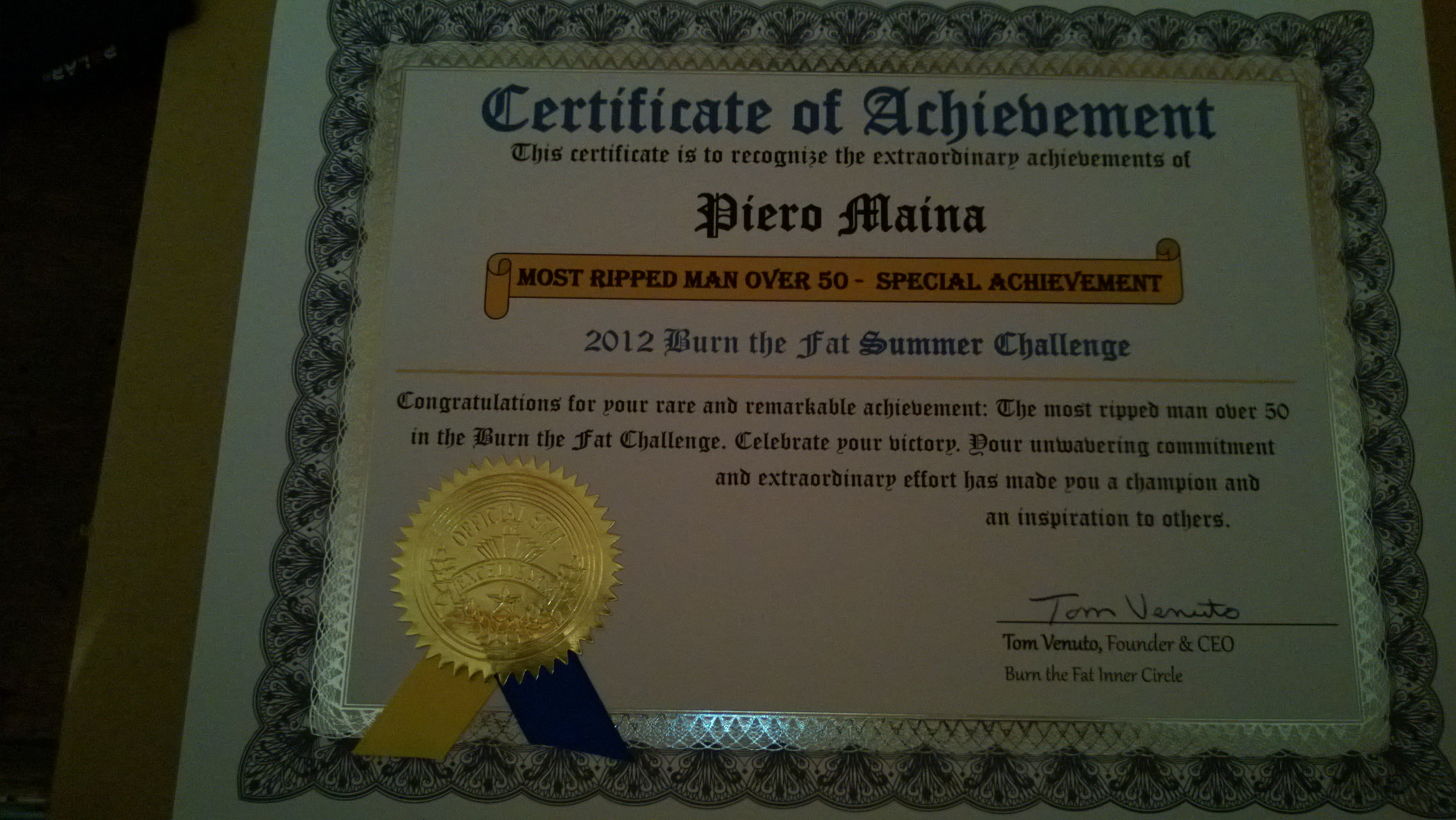
    BTF Certificate of Achievement
    Certificato del premio vinto come
    “Most Ripped Man Over 50”
    Clicca sull’immagine per ingrandirla

    Quest’anno il mio impegno è stato massimo e alla fine sono stato premiato come la muscolatura più definita fra gli uomini concorrenti oltre i 50 anni di età (Most Ripped Man Over 50. Cliccate qui per la mia intervista sul sito Burn The fat in Inglese ),  e questo comunque non in valore assoluto, ma sempre come conseguenza della migliore trasformazione corporea. Il risultato va confrontato con le condizioni iniziali, infatti un altro concorrente potrebbe anche essere più definito del sottoscritto, ma bisogna confrontare la condizione di partenza e le eventuali limitazioni fisiche a cui uno potrebbe essere soggetto. Se prendiamo il vincitore assoluto, oggi quarantunenne, che è stato premiato con un viaggio di 7 giorni alle isole Hawaii per due persone all-inclusive (lo stesso per la prima assoluta delle donne), la sua condizione iniziale era quella di un semi obeso, che in soli 98 giorni si è trasformato in un fisico asciutto e massiccio. Vorrei spiegare che il soggetto in questione quando aveva 18/20 anni giocava a football americano e faceva gli squat con 150 kg. sulle spalle e quindi i muscoli li aveva già costruiti allora. Quando vedete le trasformazioni (compresa la mia), non è che i muscoli che vedete sono il frutto di un allenamento della durata di 98 giorni, ma almeno nel mio caso, il risultato di una vita di allenamento (anche se negli ultimi 18 anni i pesi per i miei problemi di salute, non li ho più potuti utilizzare qui l’articolo che spiega il perchè). Certamente durante i 98 giorni di durata della sfida/gara, i muscoli sono stati allenati al massimo e complice anche l’alimentazione hanno ripreso vigore o sono anche aumentati. Ricordate che senza aiuti “chimici” ottenere masse enormi partendo da un fisico da “scartatore di caramelle” in 98 giorni diciamo che è impossibile. Ci sono poi individui geneticamente superdotati o i principianti della palestra che allenandosi e alimentandosi correttamente otterranno risultati molto superiori alla media, ma mai da tisico a culturista. Tornando al nostro vincitore assoluto, dopo i trascorsi da sportivo in gioventù e dopo 20 anni di matrimonio, tre figli e la vita sedentaria da poliziotto e un’alimentazione non proprio ottimale, ha visto lievitare il suo peso e la sua circonferenza a livello della vita. A suo dire era il re dei ciambelloni e dolciumi vari. Fino a quando ha preso la decisione concreta nella sua mente di cambiare, mettendo in pratica gli insegnamenti presenti nel libro/programma “BurnTheFat Feed The Muscle”  e utilizzando la Summer Challenge come motivazione per riuscire, il risultato si è realizzato e ha potuto regalarsi e regalare a sua moglie, il viaggio di nozze che 20 anni prima si erano negati per problemi economici. Certamente con circa 3.000 iscritti e tutte persone motivate, che hanno comperato il libro e che quindi conoscono le istruzioni per riuscire, non è semplice primeggiare e poi le situazioni di partenza sono profondamente diverse e anche per i giudici è come comparare mele con pere, viste le differenze fisiche e di età. Va detto che ogni anno di questi quasi 3.000 partecipanti, che all’inizio sono tutti desiderosi di primeggiare e scrivono affermazioni piuttosto presuntuose ed audaci nei propri giornali all’interno del forum di gara , solamente trecento persone circa  riescono a portare al termine la sfida  e gli altri perdono il treno o come dicono gli americani “They fall off the wagon”. Dei circa trecento, direi che un centinaio hanno postato le loro statistiche, foto iniziali e finali e hanno sempre aggiornato il loro giornale, ma a mio parere le differenze fra le foto iniziali e quelle finali, non recano sostanziali cambiamenti. Quindi direi che alla fine sono solo 150 i veri finalisti, quelli che sono visibilmente cambiati, e sono solo il 5% dei partecipanti. Ci vuole molta volontà e disciplina per avere successo, oltre ad una organizzazione maniacale per riuscire a mangiare i 5/6 pasti giornalieri  in tutte le situazioni che la vita quotidiana ci presenterà e che siano oltretutto composti da cibi giusti, nelle giuste quantità e con i macronutrienti correttamente bilanciati.  Non è che uno può mangiare ciò che vuole, certo come ho già detto sopra, ci sono eccezioni per somatotipi mesomorfi, ma mediamente e anche per loro, per raggiungere il miglior risultato è necessario mangiare al meglio. Non si può ottenere il massimo se non si va oltre il massimo. Il primo premio è il viaggio, poi esistono premi di categoria, ma non sono paragonabili al viaggio. Si va dall’iPod all’ iPad al kindle al libro firmato da Tom Venuto e i premi a disposizione non sono molti, ma vorrei far capire che già l’aver terminato la sfida è il premio più grosso. Se uno riesce nell’intento impegnandosi al massimo si ritroverà nella miglior forma fisica della sua vita e questa oltre ad essere una grande soddisfazione è realmente il premio più importante che lo/la consacrerà come vincente o come dicono gli americani come un/una “achiever”.

    Come ho già spiegato nell’ articolo Burn The Fat….La mia esperienza , sono arrivato alla mia attuale forma fisica grazie agli insegnamenti contenuti nel libro scritto da Tom Venuto (BurnTheFat Feed The Muscle ) e nonostante gli infortuni e il non potermi allenare come avrei voluto per 18 anni, posso tranquillamente affermare che è oggi che ho raggiunto il mio stato di forma migliore, oggi che ho 51 anni e il viaggio è appena cominciato. Conto di migliorare ancora e per questo ringrazio, invece di provare amarezza e frustrazione per non averne goduto prima o per essere incappato nell’infortunio della trombosi alla vena succlavia/ascellare, oltre ad altri vari incidenti più o meno gravi che hanno accompagnato la mia esistenza e questo modello di pensiero è sicuramente un valido alleato per il raggiungimento degli obiettivi che ci siamo prefissati in generale nella vita.

    Quest’anno la sfida è stata vinta grazie ad una profonda motivazione, disciplina, responsabilità, impegno, dedizione e desiderio di riuscire, focalizzando solamente l’obiettivo. Il risultato ottenuto è una sinergia di quattro elementi: La mente che ha preso una decisione, l’alimentazione che dovrà essere “pulita”, l’allenamento contro resistenza/pesi e l’allenamento cardio per bruciare più calorie e quindi perdere maggior quantità di grasso. Tutti questi quattro elementi sono necessari per la riuscita e uno non è meno importante dell’altro, ma presi singolarmente non hanno la stessa valenza esponenziale rispetto a quando vengono utilizzati in sinergia. La somma dei quattro non darà come risultato quattro, ma dieci, cento, mille.  C’è anche il quinto elemento: il supporto psicologico. Sia che provenga da un preparatore che da un amico o nel caso specifico dal Burn the fat inner circle, l’avere un gruppo di persone che ti sostenga motivandoti e consigliandoti nei momenti di crisi o quando si raggiunge la soglia del “plateau” è forse l’elemento determinante per la riuscita e il raggiungimento dell’obiettivo. Alzarsi tutte le mattine molto presto per effettuare l’allenamento cardio (corsa,bici,nuoto,etc.) o l’allenamento contro resistenza/pesi richiede una profonda motivazione. Anche gli infortuni mi hanno fatto compagnia nuovamente, non come l’anno scorso che avevo avuto una brutta distorsione alla caviglia oltre alla rottura di due costole e avevo continuato ad allenarmi nonostante i dolori. Inoltre pur vivendo in albergo a Milano e facendo la spola con Roma e mangiando sempre al ristorante o in macchina ero arrivato al 5,89% di massa grassa con un ottimo stato di forma, pur non facendo parte dei 10 finalisti uomini. Anche due anni fa mi sono infortunato, con la frattura da stress alla tibia destra (per fortuna l’ho avuta nell’ultima settimana di gara, ma mi ha accompagnato per i sei mesi successivi impedendomi qualsiasi attività che impegnasse le gambe, ma il resto del corpo è stato allenato regolarmente). Quest’anno il Neuroma di Morton nel piede destro si è risvegliato e mi ha impedito di correre come avrei voluto, nonostante ciò ho continuato lo stesso le sedute di allenamento con posture non proprio corrette e oltre al piede avevo (ed ho ancora), una brutta epicondilite al gomito destro che non mi faceva alzare nemmeno una bottiglia senza provare dolore. Quando proprio era diventato impossibile allenarsi, ho dovuto ricorrere alle infiltrazioni di cortisone. Oltre ai problemi fisici c’era il problema logistico, visto che sono rimasto lontano da casa con la famiglia per un lungo periodo e organizzarsi per mangiare 6 volte al giorno e soprattutto non cedere alle tentazioni, quando al villaggio turistico al buffet c’era ogni ben di Dio e in più con la famiglia che non mi supportava nelle mie scelte, è stata una sfida nella sfida.

    Ognuno di noi ha situazioni differenti, di metabolismo, risposte ormonali, genetica, costituzione,volontà, stili di vita, situazioni lavorative, economiche, etc. Ognuno di noi da valori ed importanza diverse a ciascuna di queste problematiche e le affronta in maniera diversa. Va detto inoltre che non esiste nè un piano alimentare che vada bene per tutti, nè una soluzione univoca, ma alla base c’è una decisione, una scelta di un individuo che decide raggiungere un obiettivo, uno scopo che a seconda di quanto quell’obiettivo sarà importante nella sua mente, sarà raggiunto. Può anche darsi che l’obiettivo finale sia troppo ambizioso e non possa essere raggiunto nelle 14 settimane a disposizione, l’importante e che noi cominciamo a muoverci verso tale obiettivo e nel tempo a nostra disposizione facendo del nostro meglio. Alla fine del periodo in questione, sia che lo avremo raggiunto, sia che non saremo riusciti, rinnoveremo il nostro nuovo obiettivo con uno più ambizioso o posticiperemo il vecchio finché non sarà stato raggiunto. Ma non saremo delusi per il mancato raggiungimento assumendo la cosa come un fallimento. Non esistono fallimenti, ma solo risultati. Guardando i nostri risultati senza perdere di vista i nostri obiettivi, saremo in grado di portare le dovute correzioni per proseguire il “viaggio”, ma non rinunceremo scoraggiati perchè abbiamo fallito. Questa è la differenza fra chi riesce e chi rinuncia. E non fatevi fuorviare dai comuni “perdenti” che troverete sul vostro cammino che faranno di tutto per farvi diventare “realisti” e vi diranno che non serve a nulla se per raggiungere il vostro obiettivo dovrete forse impiegare 10 anni o più e magari sarete già vecchi. Qui dovrei divagare parlandovi di come viene vissuto il tempo, soprattutto da parte mia, ma entrerei in discorsi di metafisica troppo complicati e andremmo fuori tema. Vi invito comunque a cercare di visualizzare dove vorreste essere, (in questo caso a livello di forma fisica, ma il discorso vale veramente per tutto il resto nella vita) e proviate a muovervi verso quel risultato, accettando tutti i passaggi, anche molto difficili che incontrerete, fino a che sarete arrivati a destinazione.

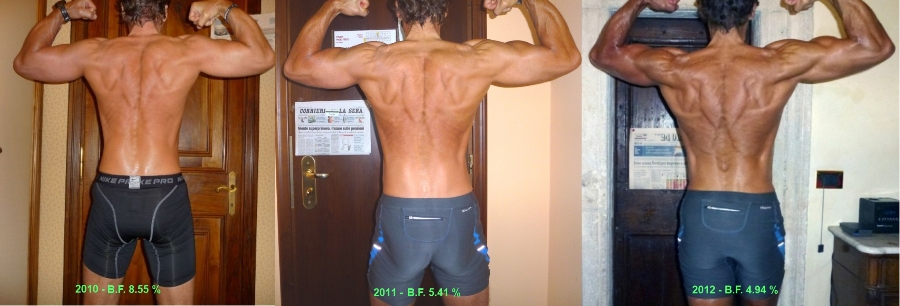
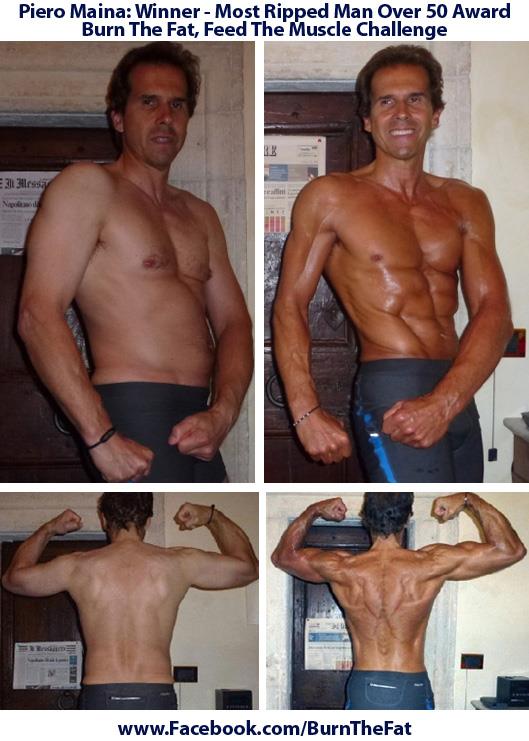
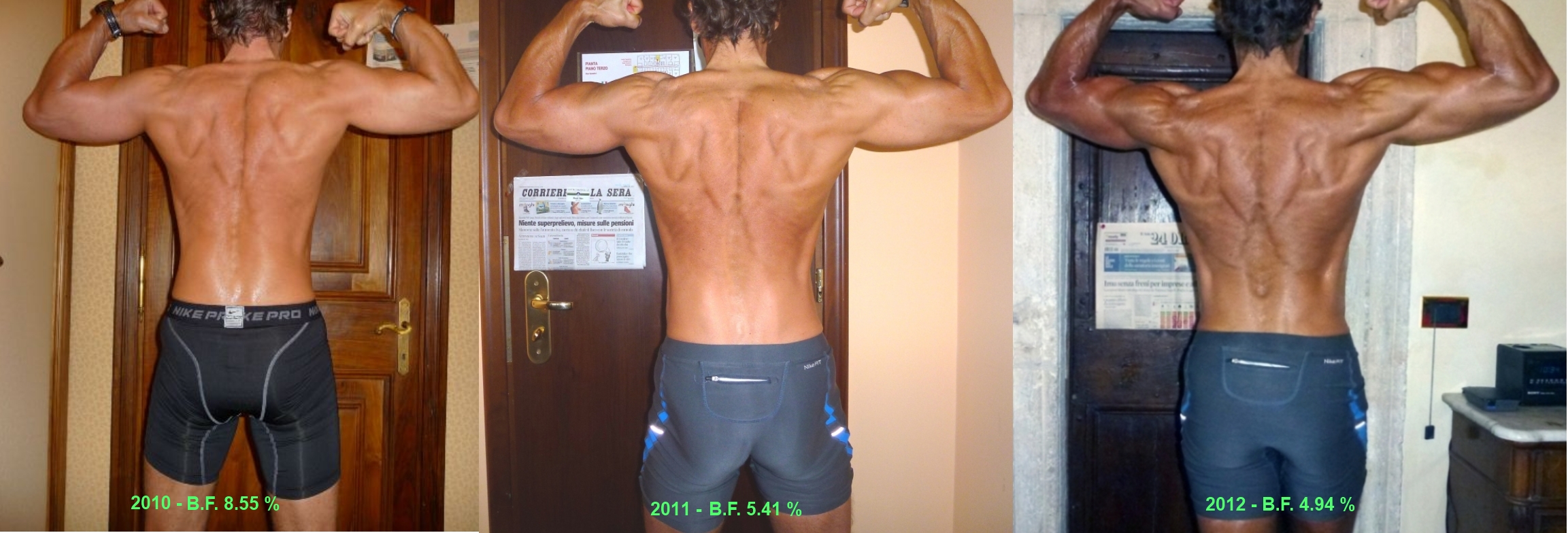
    Chiudo inserendo le foto iniziali e finali della Summer Challenge 2012. Metto quelle laterali e di schiena che sono state pubblicate sul sito http://www.burnthefatinnercircle.com  e poi ho fatto un collage con le foto di schiena delle tre Summer Challenge dal 2010 al 2012 così che possiate notare le differenze nei tre anni in esame.

    Foto pubblicata sul sito Burn The Fat.com
    Trasformazione ottenuta in 98 giorni
    Cliccate per ingrandire

    Per chi parla Inglese,queste le parole che Tom Venuto ha scritto sul suo profilo facebook riguardanti il mio premio/risultato:
    More Amazing Body Transformations! This year, the Burn the Fat Challenge had more competition for the “most ripped” title and “most transformed over 50” than ever, so, we created a new award… Introducing, Piero Maina of Italy – The “Most Ripped Man Over 50! Click LIKE if you think is incredible for age 51 (or any age!)… like something Michelangelo carved out! 🙂

    E ancora aggiungo, sempre in Inglese le motivazioni per la nomination al mio premio, che è stato istituito dopo la nomina dei 10 finalisti uomini, (dove ancora una volta non ero presente) e del vincitore per la miglior trasformazione uomini over 50. Il vincitore di quella categoria a cui anche io aspiravo è stato un uomo di 56 anni con diversi problemi di salute che da uno stato di obesità molto marcata ha trasformato drasticamente il suo fisico (non è minimamente definito come me, ma ha perso un’enorme quantità di grasso e ha eliminato un addome da donna incinta decadente quasi completamente in 98 giorni e meritava quindi e giustamente il premio). Qui sotto le parole dell’annuncio di Tom Venuto sul forum di Burn The Fat Inner circle:

    RE: 2012 SUMMER CHALLENGE AWARDS ANNOUNCEMENT THREADPosted Wednesday, September 26, 2012 at 11:51 PM
    SPECIAL AWARD ANNOUNCEMENT

    This was our 6th season of the burn the fat challengeDuring the judging process, in many of our contests of the past, and especially in this one, we noticed one or more faces / names (bodies) popping up more than once during the voting for potential nominees or finalists. Sometimes a person pops up MULTIPLE TIMES, with multiple nominations.That’s exactly what happened here, during the judging for the 2012 summer challenge, for one man.When the first round of individual contest finalist nominations came in, (narrowing the entire field down to potential finalists or standouts, his name was there. When the second round came in (narrowing down to smaller list of potential top 10), his name was there again.Then, when the most ripped competition came around, his name was in the nominations again. That was the third time we saw him. (he was ripped!)And, when the most transformed over 50 round nominations came in, guess who’s name showed up yet again?  Yep same guy, He just turned 51.So why haven’t we seen him in the list before? Well, the top 10 were not only extremely close and difficult to judge in general, it was filled with men of different body shapes and totally different starting and ending points. The judges narrowed it down by personal improvement from start to finish and it was no easy task comparing the amount of improvement from a man of one body type and starting point to a man of another. Many of the men in the 11th, 12th, 13th, etc spots were all phenomenal. It was just a close contest.The most ripped award. That was an amazing turnout of potential nomiinees, but we had an amazing overall champion there who won that award unanimously. But, the guys in 2nd 3rd, 4th, 5th, etc were also PHENOMENAL.Same thing for most transformed over 50 category.  picking a winner was tough and there were MANY nominations for that category. We dont think we’ve ever seen so many fantastic over 50 burners.So after the “regular” awards were given, we simply couldnt stop thinking about some of these men who were so close to the top. But one in particular was so close in every category, we simply KNEW we had to give him some serious kudos. We have done it before in many of our contests, and we are pleased to announce that we are doing it again. We have created a new special category, just for this challenge because of a unique achievement.
    THE MOST RIPPED MAN OVER 50
    And the recipient of this award is Piero Maina!
    Piero, your achievements display improvements across multiple categories – in fact, we could probably say your results also embody a “most inspirational” element because of what you’ve had to work through and overcome to achieve this.
    You deserve the recognition and the prizes that come with a special category award. Congratulations!

    Devo aggiungere due righe per chi eventualmente dopo avere visto le immagini possa pensare che i risultati raggiunti siano stati ottenuti con l’aiuto di sostanze anabolizzanti, come anche qualche mio amico scherzosamente, ma non troppo , ha detto. Faccio presente che se realmente avessi usato steroidi, le mie masse muscolari sarebbero aumentate notevolmente e questo non è successo. E’ nei miei piani di aumentare di massa magra/muscolo di almeno 6/8 kg. ma perchè questo accada, utilizzando metodi naturali devo allenarmi e mangiare in un certo modo e sarà necessaria una certa quantità di tempo più o meno lunga. Va da se che per aumentare di massa io debba mangiare di più di quello che consumo, ma è ovvio che possa aumentare anche di grasso, cosa che molti bodybuilder fanno nel periodo lontano dalle gare per poi “tirarsi” nelle 12/14 settimane pre gara cercando di mantenere quanto più possibile il muscolo “guadagnato” durante la fase di “bulk”…esistono poi differenti metodi di carico/scarico dei carboidrati,ma questa è un’altra storia. Quindi tornando a me l’effetto della riduzione drastica del grasso e degli allenamenti di forza e cardio fanno sembrare le cose come non sono.

    Comparazione Back view Summer Challenge 2010-2011-2012
    Cliccate sull’immagine per ingradirla

    Spero che attraverso questo articolo le persone che credono di voler/dover apportare dei cambiamenti sia a livello fisico che in generale nella propria vita, trovino una valida motivazione sapendo che realmente gli unici limiti sono molto spesso solo ed esclusivamente nella propria mente. Fate un piccolo passo in avanti e “volate”.

    © Copyright Piero Maina – Tutti i diritti riservati

  • An Insanely Effective Type of Interval Training

    An Insanely Effective Type of Interval Training

    Title: An Insanely Effective Type of Interval Training

    By line: By Tom Venuto

    URL: www.BurnTheFat.com!

    Word count: 1165 words

    An Insanely Effective Type of Interval Training By Tom Venuto www.BurnTheFat.com

    www.BurnTheFat.comsquare

    High intensity interval training can be done in a variety of different ways. Here’s a wickedly-effective type of interval training: it requires no machines or fancy equipment, you can do it outside in the sunshine and fresh air, it develops killer conditioning, carves out legs like a sprinter, and burns calories at an accelerated rate…

    In other articles about running/aerobics and high intensity interval training, as well as in my Fat loss books, I’ve written about how you can integrate both traditional steady state cardio as well as high intensity interval training into your training program for optimal body composition improvement, health and increased fitness – you don’t have to choose one form of cardio or the other. In fact, settling into dogmatic views about cardio will only limit you.

    Traditional steady state cardio is pretty much self-explanatory and intuitive. But many people are still confused about the best way to do interval training.

    An Insanely Effective Way To Do Interval Cardio

    I’m not sure if there is a single best way to do intervals because there are so many choices and everyone is different in their goals, interests and personal preferences, so “best” is a relative thing. But let me give you one of my personal favorites that is breathtakingly effective:

    Stair sprinting!

    Your typical interval workout in the gym might be on a stationary cycle, treadmill or stairclimber with short 30-60 second bursts of high speed and/or resistance, followed by a 60-120 second period of low intensity recovery. That’s usually a 1:1 or 1:2 work to recovery interval. You then rinse and repeat for the desired number of intervals, usually between 6 and 12.

    I sometimes have access to a great set of university stadium steps with a straight shot right up – 52 steps.

    Sprinting it takes about 10 seconds or so, walking down about 30 seconds. Those are short intervals with a 1:3 work to recovery interval ratio. That wasn’t by design, it just happens to be how long it takes to run up and walk down that particular flight of stairs, but co-incidentally, that fits within common recommendations for short sprint-style intervals.

    I make sure I’m warmed up first, I usually start with a couple flights up at a slow jog then a run, before sprinting, usually 10-12 rounds.

    Even if you jog/run instead of sprint, (or pause briefly at the bottom of the stairs), when you do the math, you can figure that this usually doesn’t take more than 10-12 minutes.

    Why do I like stadium step sprinting?

    1. Stair sprinting is a time saver. Like other forms of interval training, it’s entirely possible to get as much if not more cardiovascular conditioning in 10-15 minutes than you’d get from a much longer session of slower cardio (depending on the intensity and effort levels).

    2. Stair sprinting is engaging. Many people get bored doing long slow to medium intensity cardio sessions. This is a great way to break up the monotony of traditional cardio workouts. Even though it’s tough, it’s actually kind of fun.

    3. Stair sprinting is incredible for leg development. As a bodybuilder, I like to look at all types of training not only in terms of conditioning, fat loss and health, but also whether they will add or detract from the physique. I find that brief but intense stair workouts are amazing for leg development – quads, hamstrings, glutes and even your calves. In fact, I started training on the stairs more than 20 years ago, and I always considered it as much if not more of a leg workout than anything else.

    4. Stair sprinting can be done outside. If you have access to stadium steps, as opposed to just a stairwell, you can enjoy the sun and fresh air.

    How to integrate stair running into your training program

    If you’re an overachiever type, you might be tempted to do these sprint workouts in addition to your current strength training and cardio workload.

    However, keep in mind that intensity and duration are inversely proportional. When you do high intensity cardio or all out sprints, you are condensing more work into less time. That means the best part is, you can do a brief but intense stair workout instead of one of your long cardio sessions rather than in addition to them.

    Recommendation: Start with one session per week, then progress to two if you choose. You can do traditional cardio the other days of the week if you want or need additional calorie-burning. Lower intensity cardio in between weight training and interval workouts can also serve as active recovery.

    Not everyone has access to a full flight of stadium steps, as you might find at a local University. Running flights of stairs in a high rise is another effective and no-cost way to train on stairs. Although you can’t truly sprint with twists and turns on each floor, you can jog/run.

    No stairs? Hills will get the job done too and they may provide you with more flexibility in the length/duration of your intervals. I’ve found some big hills at just the right grade of incline that I can do 30-45 second runs up, with about 90-120 seconds walk down. Grassy hills are nice, when available, as they spare you some of the impact from running on the concrete.

    Sprinting up stairs is not for everyone. If you have a history of health problems or orthopedic issues, check with your doctor before doing any kind of high intensity training and of course, don’t train through the pain of injury. If you are significantly overweight, it may be a challenge just to walk up stairs, let alone run up, not to mention it might create undue stress on your joints. But as you get lighter and fitter, it’s a challenge you might slowly work toward.

    Be sure to build up gradually and adjust the workout based on your current health and fitness level. You could start with as few as 4-6 rounds and build up from there. You can also start with jogging up the stairs, then progress to running, then move to sprints. Be sure you are fully prepared and warmed up before attempting all out sprints as sprinting when unprepared is a notorious source of hamstring pulls.

    Some coaches believe that running uphill is safer than sprinting flat surfaces. Writing for Staley Training.com, Coach Steven Morris says, “Another great reason to hill sprint: even an athlete with horrendous running form will be safe running hills. This is simply because the hill does NOT allow the athlete to over-stride nor does it allow them to reach top speed, both major factors in hamstring injuries.”

    Stair sprinting is a perfect complement to the cardio portion in my Burn The Fat, Feed The Muscle program. If you’re healthy and already fit, try this advanced interval workout and I think you’ll be pleasantly surprised with the results!

    Train hard and expect success!

    Tom Venuto, author of Burn The Fat Feed The Muscle www.BurnTheFat.com!

    Founder & CEO of Burn The Fat Inner Circle Burn the fat inner circle

    About the Author:

    Tom Venuto is the author of the #1 best seller, Burn the Fat, Feed the Muscle: Fat Burning Secrets of the World’s Best Bodybuilders and

    Fitness Models. Tom is a lifetime natural bodybuilder

    and fat loss expert who achieved an astonishing 3.7%

    body fat level without drugs or supplements. Discover

    how to increase your metabolism and burn stubborn

    body fat, find out which foods burn fat and which foods

    turn to fat, plus get a free fat loss report and mini course

    by visiting Tom’s site at: www.BurnTheFat.com!

  • Once an Endomorph Always an Endomorph? (Can Your Body Type Change?)

    Once an Endomorph Always an Endomorph? (Can Your Body Type Change?)

    Title: Once an Endomorph Always an Endomorph? (Can Your Body Type Change?)

    By line: By Tom Venuto

    URL: www.BurnTheFat.com!

    Word count: 1299

    Once an Endomorph Always an Endomorph? (Can Your Body Type Change?) By Tom Venuto www.BurnTheFat.com!


     Are you an ectomorph, mesomorph or endomorph body type? To maximize your results, regardless of whether your goal is fat loss or muscle gain, it’s helpful to know your body type and adjust your approach according to your type. But a big question that almost no one has ever answered is, “Does your body type change over time?” If so, then what? Do you have to totally change your nutrition and training again? And if your body type doesn’t change, does this mean you are stuck being a fat endomorph for the rest of your life, doomed because of genetics? Read on to find out.

    Somatotype is a 3-part, 7-point body type rating scale developed by a guy named Sheldon back around 1940 or so. Ectomorphs are the linear, bony, lean types, mesomorphs are the naturally muscular body types (yeah, the ones we hate!), and endormorphs are the ones with the round body shapes and the genetic tendency toward storing more body fat.

    Generally, you have a combination body type, which is why you are scored with 3 numbers (Arnold Schwarzenneger in his bodybuilding prime: think pure mesomorph with the highest score of 7).

    The question is, Does somatotype change? this is a very interesting question that has been asked and debated before both by the layperson (often bodybuilding and fitness enthusiasts) and by scientists.

    Two of those scientists were JE Lindsay Carter, a physical education professor from San Diego State University and Barbara Heath, and Anthropologist from the University of Pennsylvania.

    There was initially a lot of debate and antagonism provoked by the classic Sheldon system of classifying human body types (“somatotyping”), because initially, Sheldon was very rigid in his insistence that body types were permanent and did not change.

    However, Heath and Carter proposed that it was plain to see that body types DID change due to normal growth, aging, physical training and dietary deprivation (they cited the Minnesota starvation study, where subjects started out looking somewhat mesomorphic and ended up looking like ectomorphs (like POW camp victims, literally).

    Heath and Carter weren’t trying to dismiss somatotpying, they supported it and wanted to validate it.

    However, they wanted to address the shortcomings of the somatotyping method and one of those was the fact that the Sheldon system didn’t accommodate for changes in physique as a result of training and nutrition.

    In their voluminous 1990 textbook on the subject, Heath and Carter define somatotype as:

    “A quantitative description of the present shape and composition of the human body. It is expressed in a 3 number rating, representing three components of physique: (1) endomorphy, (2) mesomorphy and (3) ectomorphy. The somatotype can be used to record changes in physique and to estimate gross biological differences and similarities among human beings. This method of somatotyping is sensitive to changes in physique over time and is used for rating both sexes at all ages.”
    john_bartlett.jpg
    Look at a guy like John Bartlett for example, one of our inner circle contributing authors and an outstanding natural competitive bodybuilder. When you see him today and you ask what is his body type, you would say, “MESOMORPH all the way!”

    That’s because today he is ripped and muscular

    But if you look at his before picture and ask “what is this guy’s body type” you would say, “Endomorph” all the way or at least “endo-mesomorph” because he did have a solid and stocky build before, but also a high body fat percentage.

    Well, which is it? Or did his body type change? Clearly, John gained a lot of muscle and lost a lot of fat and looks totally different today. So could we say his body type changed? If we go by current outward appearance, then yes, absolutely.

    But does this mean his body type really changed or did he overcome an inherent endomorph body type to achieve where he is now?

    Or, to play devil’s advocate here, was he always a mesomorph inherently and he just really let himself go for a while and he was just returning to his normal body type of mesomorph?

    These are interesting questions. The Heath-Carter method simply includes body composition as part of the rating scale of a person’s body type and says that you can rate someone based on how they look now. That includes bone structure (which changes little or not at all after adulthood) AND body composition (which can change throughout life). So you could say John was an Endomorph and is now a Mesomorph. Predominantly Mesomorph is his present classification.

    However, at the same time, we could say that a person DOES have an inherent body type or set point – a physique that they will gravitate towards in the absence of circumstances or concerted efforts to change it.

    I addressed this issue of changing body types versus an inherent (or “permanent” body type) in www.BurnTheFat.com (BFFM). The way I explained it is that I said your true body type is what you will gravitate to naturally when you are not in a highly trained state. It’s your inherent tendency. In that respect, you could say somatotype does not change, while body composition does.

    In chapter 5 of BFFM, I said there were three additional ways to know your inherent body type beyond Sheldon’s scale, which takes into account changes in physique due to training and nutrition:

    1. How you looked before you took up training (your “natural” body shape)
    2. How you respond to training and nutrition (ease of muscle gain or fat loss)
    3. How you respond to de-training (how well you retain lean mass and low body fat or how quickly you lose lean mass and gain fat on cessation of training)

    If you wanted to make this even MORE complex, we could look at somatotyping by considering not just the outward bone structure and body composition of an individual, but also the metabolic (interior) characteristics.

    My “Burn The Fat” system of body typing is like a combination of:

    (1) Metabolic typing (internal metabolic characteristics like carb tolerance)
    (2) Somatotyping (external body shape – linearity or roundness, fatness or leanness)
    (3) Miscellaneous other genetic factors.

    That would be a pretty good three-part body typing system that covers the concerns about changing body types, individual metabolic types (“carb intolerant types” or protein types, etc), and genetics (which is especially relevant since obesity genes have been identified fairly recently).

    I hear criticisms of the somatotyping system all the time, where people say it is not useful. I disagree. Yes, it’s perhaps too crude of a system to base your entire training and nutrition plan upon, but I believe it’s very helpful as a general tool to “KNOW THYSELF”.

    In other words, if you are inherently an endomorph and you KNOW IT, then you know darn well what happens when you don’t do any cardio. You know what happens when you cheat four or five times in a week. You know what happens when you slack off. You gravitate towards gaining fat, because that is your body type’s tendency! So you can adjust your training, nutrition and lifestyle accordingly.

    If you are an ectomorph, then you know what happens when you skip meals… you don’t gain any muscle! You know what happens when you do too much cardio… you don’t gain any muscle, or you lose some!, etc. etc.

    And if you’re a mesomorph…. did I mention…. we hate you!

    If you’d like to learn more, chapter 5 in www.BurnTheFat.comis about body typing. It’s full of some really valuable and motivating lessons about knowing yourself, your body and your genetics and understanding the importance of taking personal responsibility, regardless of your hereditary predispositions. If you already have the book, it’s worth re-reading periodically.

    Tom Venuto, author of
    Burn The Fat Feed The Muscle
    www.BurnTheFat.com!

    Founder & CEO of
    Burn The Fat Inner Circle
    Burn the fat inner circle

    P.S. Just kidding mesomorphs… we don’t really hate you, we just envy you!

    About the Author:

    Tom Venuto is a fat loss expert, lifetime natural (steroid-free) bodybuilder, freelance

    writer, and author of the #1 best selling diet e-book, Burn

    The Fat, Feed The Muscle: Fat-Burning Secrets of The

    World’s Best Bodybuilders & Fitness Models (e-book)

    which teaches you how to get lean without drugs or

    supplements using secrets of the world’s best

    bodybuilders and fitness models. Learn how to get rid of

    stubborn fat and increase your metabolism by visiting: www.BurnTheFat.com! or Burn the fat inner circle

  • New HIIT Research: A Practical Model For High Intensity Interval Training

    New HIIT Research: A Practical Model For High Intensity Interval Training

    Title: New HIIT Research: A Practical Model For High Intensity Interval Training

    By line: By Tom Venuto

    URL: www.BurnTheFat.com!

    Word count: 766 words

    New HIIT Research: A Practical Model For High Intensity Interval Training By Tom Venuto www.BurnTheFat.com!

    High intensity interval training, also known as HIIT, has become immensely popular in the last decade. HIIT involves alternating brief bursts of very high intensity exercise (work intervals) with brief segments of lower intensity exercise (recovery intervals). One problem with some types of HIIT is that they call for such high intensity bursts – literally all out sprints – that they’re not practical for everyone, and possibly not even safe for older or overweight individuals. A recent study out of McMaster University has tested a protocol for HIIT that produces impressive results in a short period of time without the need for “all-out” sprints…

    Many of the previous studies on HIIT used ALL-OUT intervals on a specialized cycle ergometer, pedaling against a high resistance.

    This type of training takes a high level of commitment and motivation and can result in feelings of severe discomfort and even nausea.

    One of my colleagues mentioned in our Burn the Fat Forums that he remembers exercise physiology class in college where they did all out cycle ergometer interval sprint testing and nearly everyone either puked or passed out.

    The Tabata protocol for example, is a brief but brutal 4 minute HIIT workout often spoken of by trainers and trainees alike with both appreciation and dread. It’s no walk in the park.

    The truth is, some HIIT protocols which have been tested in the lab to produce big improvements in cardiovascular function and conditioning in a short period of time, may not be practical or safe, especially for beginners, obese or older adults.

    In this new study out of McMaster University, a HIIT protocol that was more practical and attainable for the general population was tested to see how the results would compare to the more “brutal” very short, but extremely intense types of HIIT.

    Here’s what the new HIIT protocol looked like:

    Study duration: 2 weeks Frequency: 3 sessions per week (mon, wed, fri) Work intervals: 60 seconds @ constant load Intensity Work intervals: “high intensity cycling at a workload that corresponded to the peak power achieved at the end of the ramp VO2peak test (355 +/- 10W)” Recovery intervals: 75 seconds Intensity Recovery Intervals: Low intensity cycling at 30W” Rounds: 8-12 intervals Progression: 8 intervals 1st two workouts, 10 intervals second two workouts, 12 intervals last 2 workouts. Warm up: 3 min: Duration of work intervals: 8-12 minutes Total time spent: 21-29 minutes.

    Results: In just 2 weeks, there were significant improvements in functional exercise performance and skeletal muscle adaptations (mitochondrial biogenesis). Subjects did not report any dizziness, nausea, light headedness that is often reported with all-out intervals.

    They concluded that HIIT does not have to be all-out to produce significant fitness improvements and yet the total weekly time investment could remain under 1 hour.

    On a personal note, I REALLY like this kind of interval training: 60 second work intervals repeated 8-12 times. Here’s why:

    Body composition was not measured in this study, but I believe that enough energy expenditure can be achieved with 20-30 minutes of this style of interval training to make significant body comp improvements in addition to all the cardiovascular conditioning improvements.

    That’s another problem with super-brief and super intense HIIT programs: The cardio and heart benefits are amazing, but you can only burn so many calories per minute, no matter how intensely you work. To call a 4-minute workout a “good fat burner” in the absolute sense is ridiculous.

    Somewhere in between long duration slow/moderate steady state cardio and super short super-intense HIIT lies a sweet spot for fat-burning benefits… a place where intensity X duration yield an optimal total calorie expenditure at a reasonable time investment. Perhaps this 20-30 minute HIIT workout is it?

    If you’ve read any of my other articles on cardio, you’ll know that I’m not against steady state cardio, walking or even light recreational exercise and miscellaneous activity as part of a fat loss program. All activity counts towards your total daily energy expenditure, and in fact, the little things often add up during the day more than you would imagine (just look up N.E.A.T. and see what you find).

    But for your formal “cardio training” sessions, if you’re going to use traditional cardio modes (stationary cycle, etc.) and if your goal includes fat burning, and if your time is limited, then this type of HIIT is a great choice and you can now say it is research proven…

    Not to mention… the excuse, “I don’t have enough time” has been officially busted!

    Train hard and expect success!

    Tom Venuto, author of Burn The Fat Feed The Muscle www.BurnTheFat.com!

    Founder,CEO of Burn The Fat Inner Circle Burn the fat inner circle

    About the Author:

    Tom Venuto is the author of the #1 best seller, Burn the Fat, Feed the Muscle: Fat Burning Secrets of the World’s Best Bodybuilders and Fitness Models. Tom is a lifetime natural bodybuilder and fat loss expert who achieved an astonishing 3.7% body fat level without drugs or supplements. Discover how to increase your metabolism and burn stubborn body fat, find out which foods burn fat and which foods turn to fat, plus get a free fat loss report and mini course by visiting Tom’s site at: www.BurnTheFat.com!

  • Bodybuilding Nutrition:The World’s Most Balanced Diet Program?

    Bodybuilding Nutrition:The World’s Most Balanced Diet Program?

    Title: Bodybuilding Nutrition:The World’s Most Balanced Diet Program?

    By line: By Tom Venuto, CSCS, NSCA-CPT

    URL: www.BurnTheFat.com!

    Word count: 2037 words

    If I said that bodybuilding nutrition is the world’s most balanced and flexible way of eating, some people might think I was crazy.

    I mean, aren’t bodybuilders notorious for eating totally bland foods, following highly restrictive diets and even sacrificing all their social life (never eat at restaurants, etc)?

    Unfortunately, a lot of people believe those myths due to decades of stereotyping and more recently due to misinformation being spread on the internet.

    Actually, with the possible exception of the final phases of the pre-contest bodybuilding diet (where a lot of discipline really is required – just like any competitive sport), nothing could be further from the truth!

    Why should you care? Especially if you’re not a bodybuilder? Simple – the body building lifestyle, in my opinion and experience, is the most effective way of building muscle and burning fat on planet Earth. Want more muscle and less fat? If so, then this is for YOU.

    I contend that bodybuilding nutrition has not only been unjustly criticized and misunderstood, but that INDEED bodybuilding nutrition it is the most balanced, flexible, healthy and fun way to eat. It has been for me.

    First, Let’s Re-define Body Building!

    Most people have a preconceived notion of what bodybuilding is. They envision some beefcake, like the dude in that recent Geico commercial (pretty damn funny actually, but comedy aside for a moment, it does portray the stereotypical bodybuilder).

    When I say “body building” I’m NOT talking about looking like that guy. (Well, unless that’s what YOU want). That’s only competitive bodybuilding at the top of the pro level – a tiny corner of the “Body – Building” Universe.

    Do you want to build your body? Build strength? Build muscle? Build HEALTH? If so, YOU ARE A BODY-BUILDER!

    Who doesn’t think building your body is a GOOD thing? So please, broaden your definition and allow your mind to open!

    The truth about bodybuilding nutrition
    When I started eating and training like a body builder decades ago, all we had was men’s bodybuilding and women’s bodybuilding.

    Today, we have men’s bodybuilding, physique and fitness model. The women have even more options: bodybuilding, physique, fitness, figure, fitness model and bikini divisions.
    Today, it’s no longer just “bodybuilding” – the competitive bodybuilding universe has spread to a whole group of new “physique sports” and each one has different levels of muscularity to match the judging criteria.
    This is fantastic, because now the public appeal is much wider.
    Millions of men and women would love to have the “Men’s Fitness” or “Figure Athlete” look rather than the much bulkier competitive bodybuilder look. But in all these physique contests, though they differ in size, you still see the leanest, most muscular bodies in the world.

    How do all these bodybuilders and fitness models get so lean? How do they get such chiseled bodies?

    What they have in common is that the vast majority of these physique athletes eat the same way – traditional bodybuilding nutrition.
    Unfortunately, the greatest misconceptions and stereotypes of all are about how body-builders eat and what that means to how you live your lifestyle…

    More than ever before – because of the way misinformation (and personal idealology) is spread on the internet – bodybuilding nutrition has been portrayed as some kind of jail sentence.
    There are online gurus (and hordes of their “sheeple” followers) who make it sound like we bodybuilders are somehow “locked up” by our disciplined lifestyle and we need to be “liberated.”

    I’m telling you, this is not only total nonsense, the exact opposite is true. I’m the most free and liberated eater I know. Everything I do is by choice, and I have NO hang-ups about food whatsoever.

    And when it comes to contest dieting (which IS a different animal), since when did discipline stop being a virtue? When did leaving no stone unturned stop being what EVERY competitive athlete MUST do to win?
    I believe that bodybuilding nutrition is the most balanced and flexible of all the diet programs. I could write for pages about this, but looking at what we eat alone makes the case as clear as crystal.

    Allowed foods vs. forbidden foods

    In the current issue of Alan Aragon’s excellent monthly research review, Alan writes:
    “Complete food avoidance – regardless of the food – often does more harm than good. People tend to place a taboo mystique upon foods that they are not on the “allowed” list. It’s as if people become young children again, and do what it takes to pry open or climb up to the cookie jar of forbidden goodies instead of learning how to moderate their intake.”
    Right there, Alan has nailed the biggest problem in the diet industry today. Almost every diet program – and especially the fear-based advertising campaigns they rely on – are based on naming dietary scapegoats and banishing them from your life…. completely… forbidden.. as in “The 5 foods to NEVER eat” and so on.
    Guess what? We don’t do that in bodybuilding nutrition – people just erroneously believe we do.
    On the year round muscle-building and maintenance phase, I eat from every food group on a regular basis and – let me say it again – NOTHING IS FORBIDDEN on a bodybuilding nutrition program, such as Burn the Fat, Feed the Muscle. It’s a simple matter, as Alan wrote, of learning how – and how much – to moderate your intake.
    Compare it and see for yourself:

    Cave man Diet? Let’s suppose you go on one of those popular “stone age” or “hunter-gatherer” diets. You want some milk or yogurt or cheese? No sir. Not allowed! Our cave man ancestors didn’t drink milk, they say, so YOU certainly can’t have any!

    Low carb diets? What if you want some oatmeal for breakfast? Nope, can’t have it. How about some rice – a staple food of the longest living Asian cultures in the world? Nope, can’t have it! A banana? surely you can have THAT? … NOPE! BANNED!

    Low glycemic index (GI) diets? What if you want a nice baked white potato with that chicken and vegetable? NO SIR! FORBIDDEN!

    I could go on and on through a dozen more diet programs, but by now you should see what’s going on here. Traditional diet programs are all about taking things away from you – stealing your freedom… demonizing entire food groups. In bodybuilding nutrition, ALL the food groups are represented.

    Naturally of course, there are health and medical reasons why people need to eliminate certain foods. If you’re allergic or intolerant to a food, I’m not suggesting you eat those foods “in moderation.” I often tell my readers that it’s the dose that makes the poison. However, if something is toxic to me, I reckon that the best dose of that food is zero.

    I’m with you on that. But health and medical conditions are not what I’m talking about here. I’m not a doctor. I’m talking about transforming your physique, not treating medical problems.

    Why bodybuilding nutrition is more balanced than any of the popular “diet” programs

    In bodybuilding nutrition, what’s missing? Tell me, what food groups are you NOT allowed to eat?

    With bodybuilding nutrition we get to (and love to) eat cheese, yogurt, cottage cheese and of course milk – one of the best high quality protein sources on Earth.

    On the bodybuidling diet, we enjoy chicken, turkey, fish, shellfish, egg whites, whole eggs and of course our red meat. And if it suits your value system, you can certainly choose grass fed beef, sustainable seafood only and even organic. You can even pass on the meat completely if you want – It’s YOUR choice.

    Fruit? Absolutely! sure, some low carbing competitors are known to remove fruit temporarily – but fruit is absolutely a part of the lifestyle.

    Starchy carbs and natural whole grains? YESSS! Even on the pre-contest diet, I still take high carb “re-feed” days (and man is that bread and pasta good!) What if you dont want grains or you dont want dairy, etc etc? NO PROBLEM! Don’t eat them! The flexiblity works both ways. On a bodybuilding nutrition program, you don’t have to eat anything you dont want, and you CAN eat just about any real food you do want!

    Now, OF COURSE we don’t recommend drinking soda or eating candy bars, but come on – that’s not even real food – that’s, like Michael Pollan once said, “edible food like substances.” Processed foods and refined junk food shouldn’t even have to enter the conversation. We’re talking about REAL FOOD here.

    But even with “junk food” you have leeway.

    At least a couple times a week, I go out to really nice restaurants and eat any damn thing I please. Wine? Check! Bread? check! Dessert? Not often, but if I want it, SURE! Or, maybe I just go around the corner and grab a couple of big slices of cheesy pizza!

    How is THAT possible? Easy. There’s a “compliance rule” built into a good bodybuilding nutrition program.

    For example, If I have a list of “staple” foods that I eat every day, I stick to that about 90% of the time and then the other 10%, I eat whatever the heck I want. Absolutely NOTHING forbidden. Anything goes. AND – it’s easier for us because we train so hard. Couch potatoes can’t get away with it so much.

    Welcome to bodybuilding nutrition – It’s actually not a diet at all – it’s a lifestyle!

    I remember reading Joe Weider’s editorials in Muscle and Fitness magazine when I was just a teenager, and he always said it – “bodybuilding is a lifestyle.” He was right. Because now, 30 years later, I’m still living it. How about you? Have you kept up your eating style for as long? Will you? Or will whatever diet you’re on now end up being the latest passing fad and you’ll look back with embarrassment and regret?

    What about that “contest prep” eating plan I mentioned before? Yes, I admit – that IS a “diet.” It’s a stricter version of the eating plan, but keep in mind, that is a not only for a tiny corner of the body-building universe, it’s also for a short period of time before the contest season.

    Usually, pre contest diets DO involve cutting carbs and other restrictions. But guess what? When you understand the bodybuilding contest diet, you can not only lose weight or reach a normal or ideal body fat level – if you choose to, you can go all the way and get ripped – lean enough to see six pack abs. Any diet can take weight off. Not every diet can get you ripped while keeping all the lean body mass.

    Body building nutrition is simple and it’s POWERFUL for this very reason – YOU pick the level of restriction required, depending on how intense your goal is… whether that’s a casual cut for the beach, or a shot at a national physique title. Either way, this style of eating gives you MORE flexibility and MORE choice, not less.

    This bodybuilding nutrition system is exactly what I have been using myself and teaching to others for the past 3 decades

    I didn’t invent this type of eating program, so I can’t take all the credit. Champion bodybuilders were using these methods long before I was. I learned it from MY mentors, and simply fine-tuned it for my own body type. Now I’m here to pass it on to you.

    My part was to put the bodybuilding nutrition system on paper into what has now become the best selling fat loss ebook of it’s kind on the internet for the last 10 years: www.BurnTheFat.com!(BFFM)

    To learn more about BFFM, visit the home page here:

    www.BurnTheFat.com!

    In the upcoming articles / newsletters, this series continues, as I teach you about the carb intolerant body type and how to tweak your carbs (starchy carbs / grains) for maximum fat loss (I’ll teach you the basics of the “contest diet.”)

    I’ll cover how to make bodybuilding nutrition recipes taste zesty and delicious. Then finally, I will introduce you to my brand new meal planning software, which has been in beta all summer and is almost ready to be unleashed. Until then…

    Train hard and expect success,

    Tom Venuto, author of: www.BurnTheFat.com!